


Bruce Miller|Essays, Exhibitions, The Design of Horror | The Horror of Design
November 6, 2025
A haunting on the prairie
An adman recounts the ghostly encounter that’s haunted him for half a century.
55 years ago, my stoned college buddies and I were driving our 1965 VW bus, which had no heat and a busted fourth gear, across the moonlit Illinois prairie.
Seeking the next buzz in our never-ending college adventures, I jabbed a red dot on my gas station map. It read “Voorhies Castle.”
“Let’s check it out!”
With this minimal prompt, we giggled our way west.
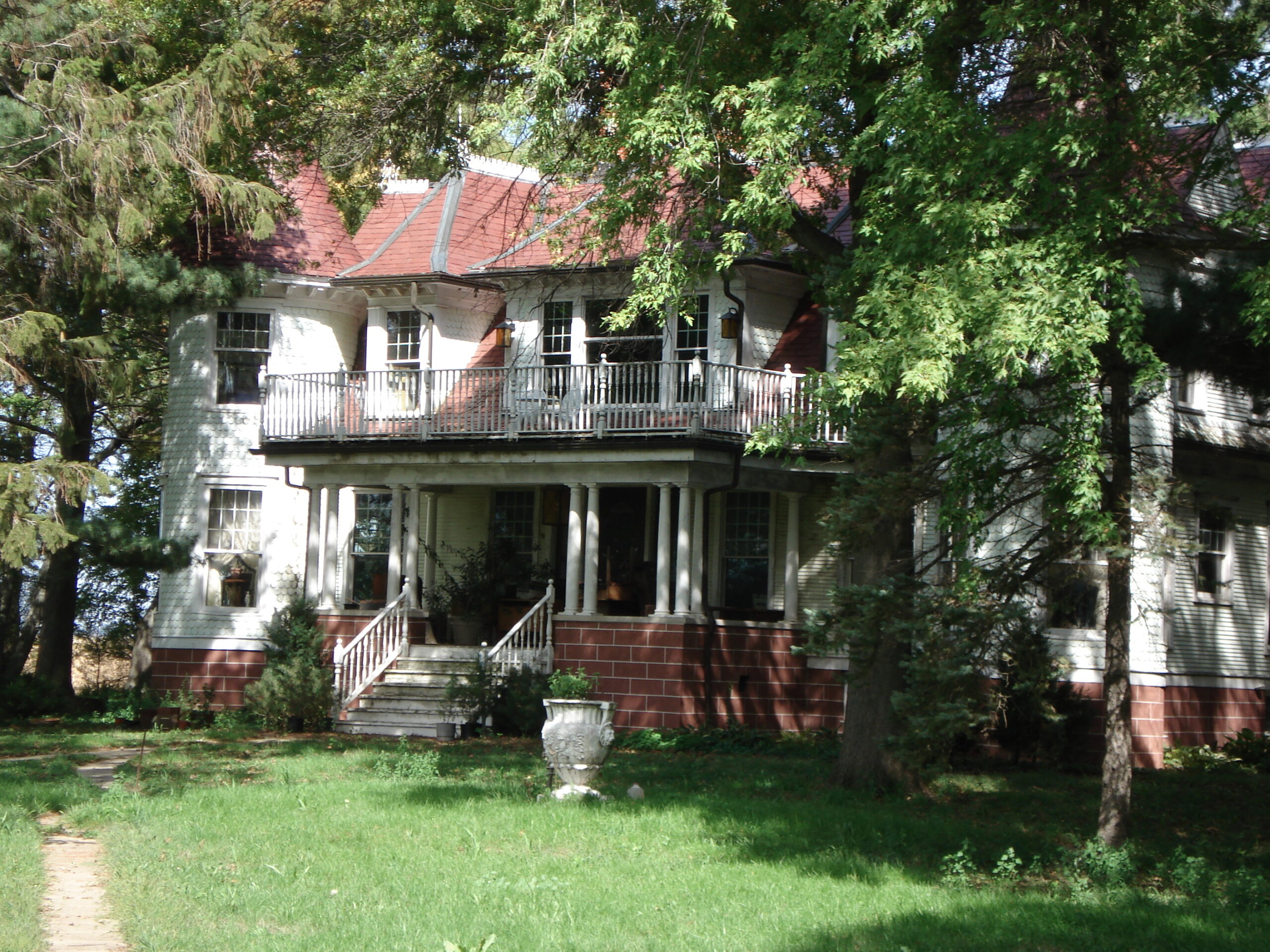
An hour later, we shut the engine and studied the midnight Sendak nightmare in front of us: an abandoned Queen-Anne mansion whistling in the cold prairie wind with shattered windows, corner turrets, and an imposing clock tower atop the barn.
The door was unlocked, so we invited ourselves in. Strangely, the rooms were fully furnished with period furniture, flock wallpaper, and even bed linens. A layer of decomposition on every surface suggested the owner had simply up and left decades earlier.
Rich, my roommate at the time, had just poked into one bedroom when a screeching blast of cold air sent tattered curtains flying and timbers creaking. With a blood-curdling scream, Rich flew down the stairs and into the frigid night. I followed.
Another hour, and we were sinking safely into our apartment couch, spinning Santana. “Black Magic Woman” felt suddenly real.
Voorhies Castle has lingered in my memory ever since, retaining an air of mystery until the internet arrived and a simple search provided surprising confirmation of our encounter.
In 1867, Nels Larson, a Swedish immigrant turned US landlord, funded the development of Voorhies, says hauntings historian Troy Taylor. The village featured a church, a grain elevator, several businesses, and tenant homes. Towering above it all was the grand Voorhies Castle, an engagement gift for Nels’ fiancée, Johannah Nilson.
Sparing no expense, Nels outfitted the mansion with two turrets, two parlors, massive fireplaces, indoor plumbing, a hot air furnace, and a lighting system that used dangerously explosive carbide gas. The most striking fixture, added in 1910, was the near-70-foot tower housing a nearly two-ton clock. (Nels was fascinated by clocks and spent five years building a structure that could support the mechanism.)

The couple lived lavishly in their castle until 1914, when workers found Johannah dead at the foot of the stairs, possibly from a heart attack. Distraught, Nels abandoned the house that same day to live with one of his children.
In his haste, he left everything behind: furniture; food sitting on the stove; Johannah’s apron, still slung over the back of a chair.
Even his beloved Johannah herself, whose spirit remains in the castle, if you’re to believe the lore.
“On certain nights, an eerie light could be seen coming from the east tower of the house,” Taylor writes. “Those who were brave enough to venture onto the property claimed to see Johannah framed in the window of the room.”
Adding to legend, the clock, for decades, was said to sound 13 times each year at the time of Nels’ death, “as though the man and the machine were somehow connected.” This happened until the summer of 1976, just a few years after Rich and I peeped inside, when the tower was destroyed by a tornado.
The house was eventually sold to a series of owners, but no renovations were made until 1999, when the current owner undertook the massive project of restoring the castle to its original splendor, seeking, too, to rebuild the tower.
I’ve been thinking a lot about ghosts again. When Karen, my wife of nearly four decades, died a couple of years ago, I didn’t know what to expect. She hasn’t been rattling chains like Johannah, but she has stuck with me. I would describe her visitation as a sweet, loving, continuous presence. I can’t prove this, but unlike Johannah and Nels, Karen and I were able to find peace and acceptance in the wake of her passing.
Rich is still seeing ghosts, too.
After college, he moved to Seattle, where he became a prominent photojournalist. Nearing retirement in the 2010s, he decided to embark on the culminating project of his career: documenting the Ghosts of Segregation, the architectural vestiges of America’s Jim Crow era.
The project’s origins were as happenstance as our brush with Johannah half a century prior. As Rich told me over a recent coffee:
“I was photographing peeling painted signs in Gonzales, Texas, when a guy in a pick-up pulled up. The guy asked, ‘What are you shooting?’ I replied, ‘Americana.’
“The guy suggested I go to Templin Saloon, where I encountered a young Hispanic bartender. He told me how, until 1965, his grandmother was forced to sit behind a ‘segregation wall’ at the establishment, pointing to a structure with a cheery corporate scrawl across it.

“I was shocked to realize that the colorful Dr. Pepper sign was covering America’s dark past. That saloon became the first of many leads I followed to uncover the racial ghosts that continue to haunt our landscape. I shot Japanese internment camps, Native American residential schools, and the murder site of Emmett Till.”
I thought about Karen and her continued presence.
Rich nodded, adding, “these ghosts haunt us because they are so very much alive.”

Observed
View all
Observed
Share on Social


By Bruce Miller
Related Posts
Business
Kim Devall|Essays
The most disruptive thing a brand can do is be human
AI Observer
Lee Moreau|Critique
The Wizards of AI are sad and lonely men
Business
Louisa Eunice|Essays
The afterlife of souvenirs: what survives between culture and commerce?
The Observatory Newsletter
Ellen McGirt|Fresh Ink
What happens when the social safety net disappears?
Related Posts
Business
Kim Devall|Essays
The most disruptive thing a brand can do is be human
AI Observer
Lee Moreau|Critique
The Wizards of AI are sad and lonely men
Business
Louisa Eunice|Essays
The afterlife of souvenirs: what survives between culture and commerce?
The Observatory Newsletter
Ellen McGirt|Fresh Ink