


January 4, 2011
Sweet Spot: Cake as Craft?
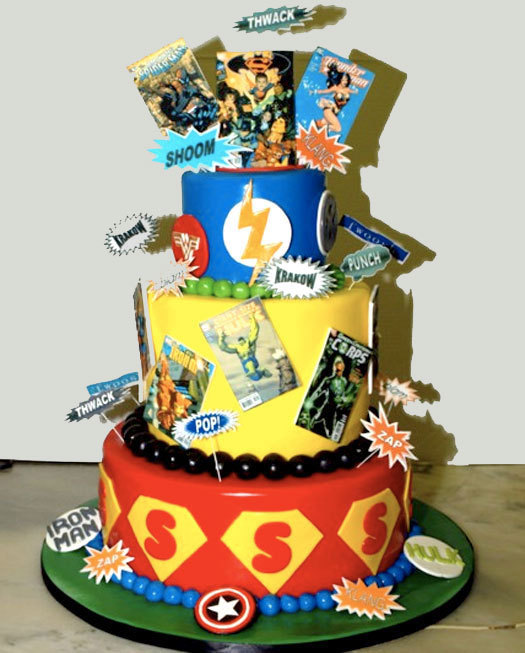
A typical cake made by Bartolo “Buddy” Valastro, of TLC’s Cake Boss
Within the broad genre known as reality television — in between the astonishing displays of amateur talent and the atrocious tales of teenage pregnancy — are nearly half a dozen programs devoted to extreme displays of, well, frosting.
(No, I am not making this up.)
Here in America, our love affair with sugar is hardly the stuff of news. But cake decorating has reached a new, arguably exalted position in the pantheon of nightly programming: from TLC’s Cake Boss, Ultimate Cake-Off and DC Cupcakes to the Food Network’s Ace of Cakes and Cupcake Wars, to WE-TV’s Amazing Wedding Cakes and Wedding Cake Wars, never has there been so much airtime devoted to the apparently endless details that go into making dessert.
Mind you, it’s fascinating to watch. In particular, the engineering and pyrotechnics go way beyond basic baking, and the creative process involves a fair amount of planning (obviously) and sketching (interestingly) as well as some rather ambitious 3-D modeling projections. Who among us knew, for example, that Rice Crispy Treats provide reliable structural foundations for life-size confections, or that chocolate comes in a flexible consistency akin to plasticine? Or that fondant — that smooth-as-glass icing that graces the surfaces of so many layered masterpieces — can be stretched and torqued and thinned to quarter-inch perfection through a giant metal machine? There are airbrushes and carving tools and colors not found in nature, sheer pastes and gilt powders and best of all, digital printers that, improbably, produce perfect little edible photographs. Suffice it to say, you’ll never look at an Oreo the same way again.
Or, for that matter, an art supply store.
For my money, this is where it gets really pathological. To walk down the cake supply aisle at any of the nation’s Michael’s Arts and Crafts stores is to be stunned into the realization that cake decorating is not a craft, but an art form where the medium is sugar. If you stop and realize the degree to which the civilian world has, in the last decade, become a population of artistic wannabes, you understand that the success of these shows lies in the simple fact that they supply two very fundamental human needs: they presuppose that everyone either is or aspires to be creative, and they assume all of us have a sweet tooth.
Fair enough. But do we really need ten of them?
Observed
View all
Observed
Share on Social


By Jessica Helfand
 Jessica Helfand is an artist and writer based in New England. A former critic at Yale School of Art and one of the founding editors of Design Observer, she is the author of several books on visual culture including Self Reliance, Design: The Invention of Desire, and Face: A Visual Odyssey. jessicahelfand.com
Related Posts
Innovation
Ashleigh Axios|Essays
Innovation needs a darker imagination

Business
Kim Devall|Essays
The most disruptive thing a brand can do is be human
AI Observer
Lee Moreau|Critique
The Wizards of AI are sad and lonely men
Business
Louisa Eunice|Essays
The afterlife of souvenirs: what survives between culture and commerce?
Recent Posts
Sam Furness got serious about investing in his curiosity. Now, he’s helping others do the same. Corporate crisis is design’s opportunity In a world that feels impossible to change, emerging designer Deborah Khodanovich is starting small Elixir Design founder Jennifer Jerde believes in the human touchRelated Posts
Innovation
Ashleigh Axios|Essays
Innovation needs a darker imagination
Business
Kim Devall|Essays
The most disruptive thing a brand can do is be human
AI Observer
Lee Moreau|Critique
The Wizards of AI are sad and lonely men
Business
Louisa Eunice|Essays