


Lee Moreau|Critique, Essays, Opinions
November 11, 2025
The Wizards of AI are sad and lonely men
Lee Moreau on AI, the loneliness of power, the danger of wizards, and the designer’s role in keeping hope alive.
While putting together the most recent season of the Design As podcast, I spent considerable time listening to many thoughtful perspectives on machine learning, recent technological developments, and trust. This focus got me reflecting on our role as designers, given the rise of AI and the state of the world at large. It’s heady stuff, and like many people, I find myself shifting my opinions from day to day as I think more deeply about these technologies and their potential implications.
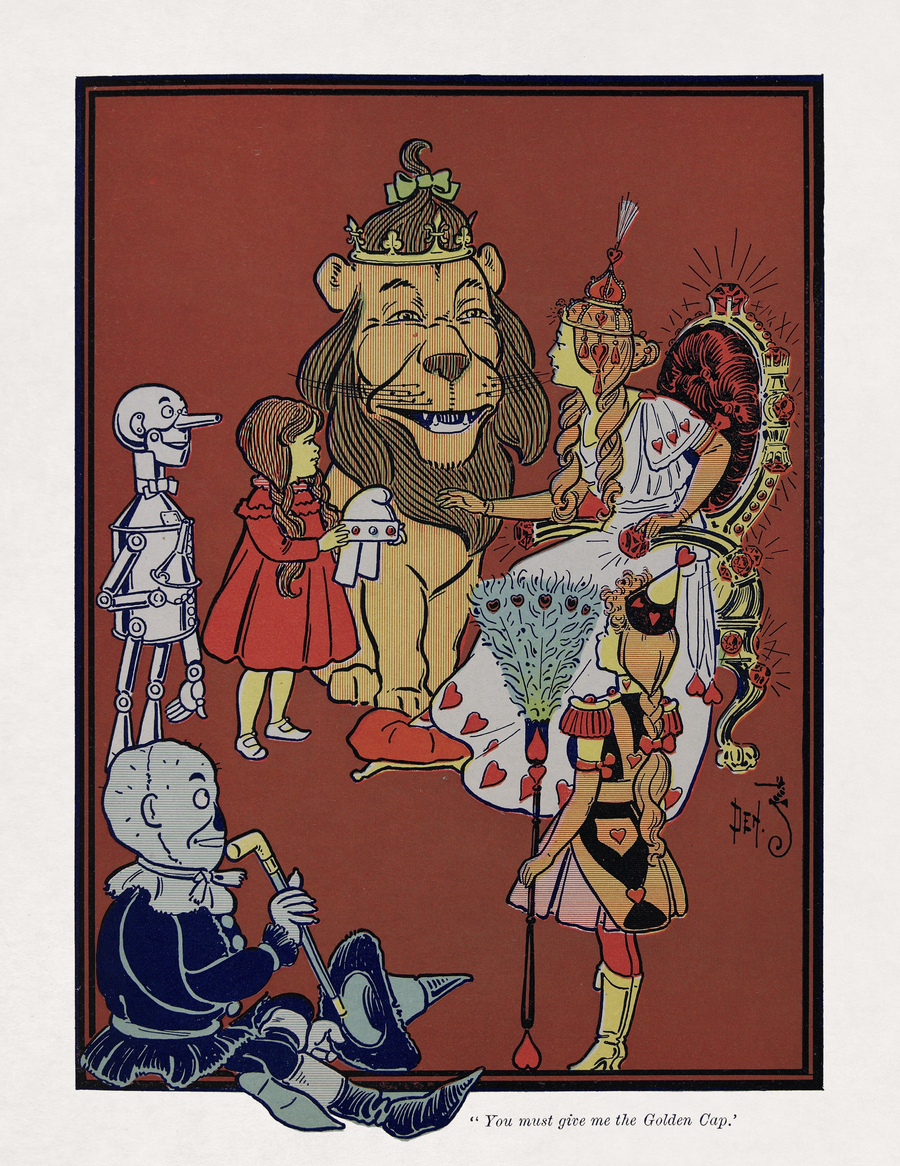
As I work to help my clients and students navigate this moment, I find myself drawn to The Wonderful Wizard of Oz by L. Frank Baum, the source material for so much subsequent creative interpretation, wisdom, and joy.
We know the story. After landing unexpectedly in Munchkin Country, Dorothy and her companions embark on a quest to meet a famous being whom the Good Witch of the North describes as “the Great Wizard… more powerful than all the rest of us together.” They’re each looking for something specific — a trip home for Dorothy, courage for the Lion, and so on — and they assume that a person with such great power will have the ability and mercy to help them. They have faith in his awesome potential.

In many ways, designers today are off to meet wizards of our own.
We, the “small and meek,” with, let’s face it, limited power and agency, are each in our own way confronting the story of AI’s “great and terrible” potential, while asking it to do something specific for us. It’s humbling to question power, yet I think it would be foolish or delusional to see our position relative to these technologies in any other way.
And still, I believe we are our own greatest threat.
The power of these technologies and the impact they will have is not solely based on their significant computational capabilities, but on the power they have over us in our interactions with one another.
These technologies can and will continue to do extraordinary things, but their influence and ability to hold our attention as the primary topic of conversation is far more powerful and dangerous. More troubling, as the topic of AI dominates our attention, these technologies continue to divide us. Daily. AI doesn’t collaborate with our colleagues in the studio. (Ask a design student.) AI doesn’t share its work with others for critique and feedback. (We all have our own assistants and agents for this and that.) Without much fanfare, AI has us all working and co-piloting independently, separately, and siloed with our own versions of Stable Diffusion, Midjourney, and ChatGPT.
This story of divide-and-conquer is all about power. Again, Baum reminds us how it works.
Recall: Dorothy becomes famous in her own right when her falling house accidentally crushes the cruel Wicked Witch of the East. But dispensing mercy or reward is not on the mind of the Great Oz. “Why should I do this for you?” he asks. “Because you are strong and I am weak; because you are a Great Wizard and I am only a little girl.”
And yet in response to Dorothy’s humble request, the Wizard takes hostage her dream and extracts a deadly quid pro quo. “You have no right to expect me to send you back to Kansas unless you do something for me in return,” he says. “Kill the Wicked Witch of the West.”

This response is a call to violence and a demand for submission. The Wizard of Oz is a sad and lonely man, made sadder and lonelier by the very power he conjures, controls, and profits from.
That doesn’t mean he isn’t dangerous.
To truly grasp what we are up against, it’s important to remember that not long ago, many of us believed, for example, that Tesla CEO Elon Musk would do extraordinarily positive things for our tech-fueled society and even for humanity. Some still do, and perhaps this may still happen. He is just one of many wizards holding the keys to things we don’t fully understand.
Here’s what I’ve been telling my students, first at MIT and now at Northeastern: stand up to all the wizards. More explicitly, tell the Mark Zuckerbergs of the world to “go fuck themselves” if and when they ask you to do something sinister or morally reprehensible. Those difficult conversations are coming, and the only thing we can do to meet that moment is to feel confident in our craft, our work, and what it stands for.

To do that, stay vigilant, stay engaged, and keep talking to each other. And if you are a designer, you need to keep working. Our greatest contributions to the world are the changes that we make daily in our studios — iterative, collaborative, and empathetic — whatever that looks like for you. This is the work that only we can do. It is literally our calling.
For those of you who don’t know how Baum’s version of Dorothy’s story ends, there’s a balloon, a Great Humbug, Aunt Em, and some magical silver shoes.
Most importantly, there is hope. Now, go design some, together.
Lee Moreau is the host of the Design As and The Futures Archive podcasts. He is professor of the practice of art + design at Northeastern University College of Arts, Media and Design, as well as the founder and director of Other Tomorrows, an independent design and strategy consultancy based in Boston.
This is the web version of The Observatory, our (now weekly) dispatch from the editors and contributors at Design Observer. Want it in your inbox? Sign up here. While you’re at it, come say hi on YouTube, Reddit, or Bluesky — and don’t miss the latest gigs on our Job Board.
Big Think

Every now and then, wandering around LinkedIn uncovers something truly unusual. (With all due respect to intrepid thought leaders, of course.)
The proof lies in this profile of two independent filmmakers who labored for years to complete a wholly original project. Design Observer editor-in-chief Ellen McGirt picked up their tale:
“I’m speaking via video call with Rob James and Bruce McClure, the filmmakers behind District Nurse, an independent horror feature first released in 2017 but only widely available online in 2025. I stumbled upon it by accident — McClure is currently a public relations specialist who had reached out to Design Observer with a client pitch, and it was on his LinkedIn profile. Intrigued, I clicked. Quickly transfixed, I watched it in one sitting. It felt like I’d discovered a rare and unfamiliar artifact, though try as I might, I struggled to summarize it to my colleagues. I asked McClure for a meeting right away.”
The story of the making of the film unfolds in a tumble, described by McClure as “homemade, it’s lo-fi, shows you what you can do with not much money, not much talent, some might say. It got laughs at the cinema because it is dark — it’s meant to be humorous as well.”
Although set in a pre-pandemic world, it now exists in one that is being entirely overrun by AI. As a result, its free-range, eclectic vibe feels more necessary than ever.
Some fine print
Here’s a sampling of our latest and greatest from the Design Observer editorial and contributor network.
‘6 Feet Deep:’ the hidden history of horror and occult imagery in rap music From the satanic imagery of Memphis mixtapes in the 90s to the devilish aesthetic of contemporary acts like Doja Cat and Lil Nas X, rap artists have long used horror iconography to expose society’s seedy underbelly. By John Morrison
How production designer Grace Yun turned domestic spaces into horror in ‘Hereditary’ and heartache in ‘Past Lives’ From cults to connections, production designer Grace Yun reveals how she crafts the visual language of films like Hereditary and Past Lives — turning ordinary rooms into sites of fear, longing, and memory. By Alexis Haut
The afterlife of souvenirs: what survives between culture and commerce? “Arts and crafts is the only creative industry where developing countries have a leading position in the global market.” What we often call kitsch may, in fact, be cultural endurance. By Louisa Eunice
A haunting on the prairie An adman recounts the ghostly encounter that’s haunted him for half a century. By Bruce Miller
‘The museum-going cannibal:’ On Francis Bacon On the heels of the Louvre heist, a poet reflects on his own hellish — and oddly heartening — encounter at a famed museum. By Yahia Lababidi
Happenings
Fortune Brainstorm Design Conference is December 2 in Macau. Fortune’s premiere event explores the intersection of business, technology, and design. Design Observer’s Ellen McGirt will take the stage as co-chair; other luminaries include designer and author Kevin Bethune, Microsoft’s Liz Danzico, and Nike’s futurist in residence Monika Bielskyte. This year’s theme is “Future Tense: Prototyping Tomorrow.”
Observed
What are you observing? Tell us.
Netflix House Philadelphia opens November 12 inside the King of Prussia Mall. The first-of-its-kind brick-and-mortar for streaming fans, it will offer free general entry with paid access to immersive experiences for shows like Squid Games and Stranger Things, plus attractions ranging from a full-service restaurant (Netflix Bites) to themed photo-ops.
Costume designer Kate Hawley unpacks the visual clues that bring Guillermo del Toro’s adaptation of Mary Shelley’s Frankenstein to life. “I’ve done three films now with Guillermo, but every time we are exploring the same language in a very different way,” she says.
“Not one single nation among you can afford this, as climate disasters rip double digits off GDP. To falter whilst mega-droughts wreck national harvests … to squabble while famines take hold, forcing millions to flee their homelands, this will never be forgotten, as conflicts spread.” Simon Stiell, the executive secretary of the UN Convention on Climate Change, to world leaders at COP30.
The moka pot has been redesigned, this time for energy efficiency.
The Studio Museum in Harlem is back and better than ever after an eight-year renovation. The new seven-story institution, dedicated to Black art, reopens to the public on November 15. Said Raymond J. McGuire, chairman of the Board of Trustees, “This building says to the world, Harlem matters. Black art matters. Black institutions matter… A space where creativity and community meet, where young people can see themselves reflected, and orders of African descent can continue to shape our history.”
The US Supreme Court declined the opportunity to overturn same-sex marriage provisions enshrined in the landmark Obergefell v. Hodges decision.
The dapper “fedora man” snapped by photogs at the scene of the Louvre heist coverage turns out to be 15-year-old Pedro Elias Garzon Delvaux, who is not affiliated with law enforcement, and has been dressing like that for a while. “For me, it’s important to dress classic. And I like to dress like that because I love history, especially the 20th century,” he told CNN.
The Washington National Opera may have to abandon its longtime home at the Kennedy Center after a collapse in both ticket sales and donor confidence in the aftermath of the Trump Administration’s takeover of the storied institution.
Getting to know Martha: the studio practice of designers Guillaume Lavallée and Ariane Leblanc, who are combining their diverse experiences (one is a self-taught graphic designer, the other did a stint in fashion) to focus on branding across industries. “What connects it all is a human sensibility, a desire to make creative work that feels alive,” says Leblanc.
The US won’t attend the G20 Summit in South Africa, citing the (false) claim of genocide. “Afrikaners (People who are descended from Dutch settlers and also French and German immigrants) are being killed and slaughtered, and their land and farms are being illegally confiscated,” Trump wrote on Truth Social.
What is biophilic design? Metropolis has published a guide by the creator of the field, renowned social ecologist Stephen Kellert. “Since today’s ‘natural habitat’ is largely the built environment, where we now spend 90% of our time, biophilic design seeks to satisfy our innate need to affiliate with nature in modern buildings and cities.”
Job Board
Associate or Full Professor and Chair of Product Design at The University of Kentucky, Lexington, KY.
Experience Designers (various types / levels) at Autodesk, Portland, OR (or remote).
Assistant Professor at American University of Sharjah, United Arab Emirates.
Multiple faculty positions at Virginia Tech, Blacksburg, VA.
Lecturer of Industrial Design at Auburn University, Auburn, AL.
Wickedly Truthful
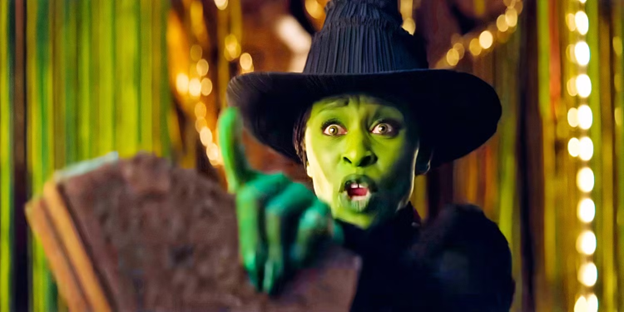
In anticipation of Jon M. Chu’s Wicked sequel, which debuts next week, Design Observer’s film critic Alexis Haut reminds us why Elphaba’s most important role is to speak truth to power — something she has in common with the everyday designers who read The Observatory.
“With Elphaba, Wicked mimics how those who appear different are treated in our real world. Her green skin can be read as a metaphor for race, disability, gender expression — the list goes on. What makes Elphaba’s story worthy of cinematic presentation is also what makes it ordinary: She is a force for good in a world that would prefer she weren’t part of it. She is an unflinching advocate for her disabled younger sister Nessa Rose (Marissa Bode). She has an almost spiritual connection to nature. She stands in fierce solidarity with Shiz University’s beleaguered animal professors.”
This is the web version of The Observatory, our (now weekly) dispatch from the editors and contributors at Design Observer. Want it in your inbox? Sign up here. While you’re at it, come say hi on YouTube, Reddit, or Bluesky — and don’t miss the latest gigs on our Job Board.
Observed
View all
Observed
Share on Social


By Lee Moreau
 Lee Moreau is the host of Design As and The Futures Archive. He is Professor of the Practice of Art + Design at Northeastern University College of Arts, Media and Design as well as the Founder and Director of Other Tomorrows, a design and strategy consultancy based in Boston.
Related Posts
AI Observer
Raphael Tsavkko Garcia|Analysis
AI actress Tilly Norwood ignites Hollywood debate on automation vs. authenticity
AI Observer
Jameson Proctor|Opinions
Open systems, open futures
AI Observer
Ellen McGirt|Opinions
AI can generate content, but it can’t generate feeling
Business
Kim Devall|Essays
The most disruptive thing a brand can do is be human
Related Posts
AI Observer
Raphael Tsavkko Garcia|Analysis
AI actress Tilly Norwood ignites Hollywood debate on automation vs. authenticity
AI Observer
Jameson Proctor|Opinions
Open systems, open futures
AI Observer
Ellen McGirt|Opinions
AI can generate content, but it can’t generate feeling
Business
Kim Devall|Essays