


June 10, 2026
Mamdani’s city-owned grocery stores need a brand identity
"People can’t benefit from resources they don’t know about."
Is there nothing Zohran Mamdani can’t do?
The charismatic mayor of New York City is barely six months in office, and kids are getting day care, potholes are being filled, and the Knicks are in the finals. NYC is in a very good mood these days.
So, it should come as no surprise that his first big outreach to the design community is for city-owned grocery stores.
“Grocery prices are rising faster than wages, so we’re launching 5 city-owned grocery stores with lower prices,” he wrote on an Instagram post. “But people can’t benefit from resources they don’t know about. We need expert branding for New York’s city-owned grocery stores to properly serve New Yorkers.”
More than messaging, the brief promises a seat at the customer experience table.
“A fresh, vibrant brand identity is essential to successfully bring these stores to market, communicate the unique value proposition, and achieve widespread adoption amongst New Yorkers. These brand parameters will also serve as critical inputs for the physical makeup of the stores themselves, guiding everything from materials to signage, lighting, merchandise, and customer flow.”
Experts suggest Mamdani’s early wins are part of his long-term engagement strategy.
“He’s picking some of the stuff that he thinks he can most easily build support with, trying to find issues that have a broad base of support behind them instead of picking potentially divisive issues to start with,” Justin de Benedictis-Kessner, public policy professor at Harvard University’s Kennedy School of Government, told the BBC.
Sure. But I’d add an important twist — addressing residents’ needs feels like a strategy (rather than excellent customer service that builds relationships and trust) because it’s so unfamiliar to voters.
Sticking with the design theme for a hot second, consider recent big swings launched in similar time frames by two of Mamdani’s big-city peers.
New York Mayor Eric Adams took office in January 2022 and, by November, announced a $780 million, City-funded soccer stadium in Queens as part of a broader revitalization plan for the borough of my mother’s birth. (She wasn’t mentioned in the plan.) A big fight ensued. Critics labeled it a handout of public land, and, although it is now privately funded, they decry the loss of tax revenue.
Less than a year into his term, Chicago’s Mayor Brandon Johnson unveiled a massive new lakefront stadium for the Chicago Bears that required $1.5 to $2 billion in public funding and infrastructure bonds. The legislature passed on the “deal.” Losing the Bears would be a tough blow, said Governor JB Pritzker, “But the reality is: I wasn’t willing to give up billions of dollars of taxpayer money in order to give it to a billionaire-owned family or team.” (As of this month, Brandon is looking at new options. In, uh, Indiana.)
It’s traditional and politically tempting for new mayors to go for splashy, big-ticket, business-friendly public design projects out of the gate, which is part of what makes Mamdani’s move so appealing.
And while city-owned grocery stores are not a new idea, Mamdani is proposing a hybrid model, run privately but built by the city. “The city will subsidize a core set of staples,” Mamdani said in a press conference. “A private operator will run the store, but they answer to the standards that the city will set,” like lower prices on basics like bread and eggs.
We leave the details in your capable hands.
The Mamdani administration is accepting design proposals at grocery.nyc/brand until June 30, 2026 at 4:30 p.m. ET.
If any of you branding geniuses out there are submitting ideas, would you mind keeping Design Observer in the loop? We’d love to cover your ideas on what would make a true community grocery store, especially in the diverse NYC neighborhoods slated to become home to one. (Points if it includes a cookbook, we love those around here.)
And sorry that happened to you, Bears fans. (Knicks in four.)
Ellen McGirt
Editor-in-Chief
LinkedIn
Instagram
Threads
Ellen@designobserver.com
P.S. Did someone who loves you send you this newsletter? Welcome! Subscribe here.
This edition of The Observatory was edited by Rachel Paese.
This is the web version of The Observatory, our (now weekly) dispatch from the editors and contributors at Design Observer. Want it in your inbox? Sign up here. While you’re at it, come say hi on YouTube, Reddit, or Bluesky — and don’t miss the latest gigs on our Job Board.
Join the Substack conversation
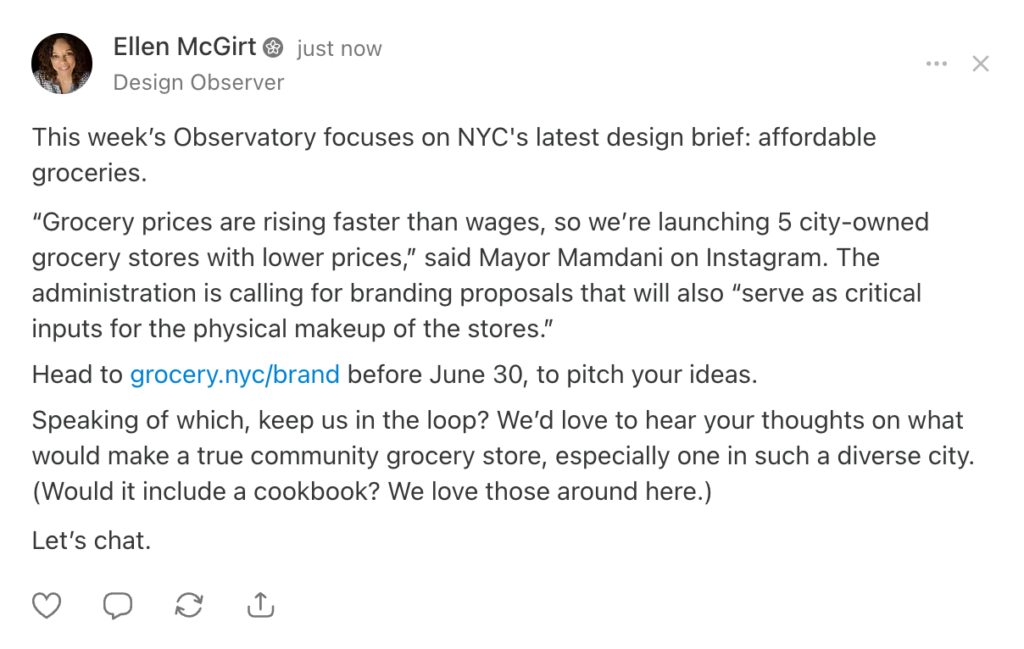
Are you submitting branding ideas? What makes a true community grocery store? Tell us on Substack.
Observed: designers on Mamdani
What are you observing? Tell us.
Turning supporters into ambassadors. “At a time when political communication feels increasingly uniform, his campaign showed that design is far more than an aesthetic layer. It’s conviction. It’s language. And, at its best, it’s a tool for social change.” Studio tülü founders Wiebke Meyer-Lüters and Anne Thürnau.
Designers should study the campaign itself, UX Collective says in a Medium post. “His campaign didn’t just change politics; it offered a masterclass in user-centered design. It’s a commitment to stakeholderism that yields better outcomes. “[I]t is known that the campaign operated with a community-driven approach characterized by deep community roots, and a decentralized yet well-coordinated volunteer network, with digital and field teams working closely to listen, test, and refine the outreach based on real-time input from voters.
Tyler Evans is the designer behind Mamdani’s iconic campaign poster, but it was just one stop on his progressive branding pedigree. (He’s worked with Alexandria Ocasio-Cortez, the Teamsters, and Bernie Sanders.) He got candid with Fast Company. “Like I’m really really, really, really, sick of like the corporatization of visuals within politics and especially within the Democratic brand of politics,” he says. There was a period there where some logos and like some honestly just some stuff on social media …like I couldn’t tell if it was yoga studio or you know the guy running for governor or congress.”
A Mamdani master class on r/graphic_design. “It works insanely well out in the wild,” notes verminqueeen. “The website is just okay, but all the branding/signage/type work in his campaign has been 10/10 imo,” notes Canadian designer backwardzhatz. “So fresh and really reflects what he’s bringing to the table politically.” More here.
Draw the Line
The Supreme Court has gutted the Voting Rights Act. Redistricting determines whose voice counts, whose neighborhood thrives, and whose representation vanishes. That is exactly the kind of design we exist to examine.
Podcast coming soon. Follow along in The Observatory Newsletter, on our socials, or on the website for updates.
Job board
Hiring a designer? Post your role on the Design Observer Job Board to reach a highly engaged audience of designers, creative leaders, and studios across the Design Employment Network.
Lead Product Designer – Breed-Specific Hardgoods & Apparel at Gooby, Los Angeles, CA.
Industrial Designer, Packaging – Lead at WHOOP, Boston, MA.
Creative Director at Threespot Media, Remote.
End marks
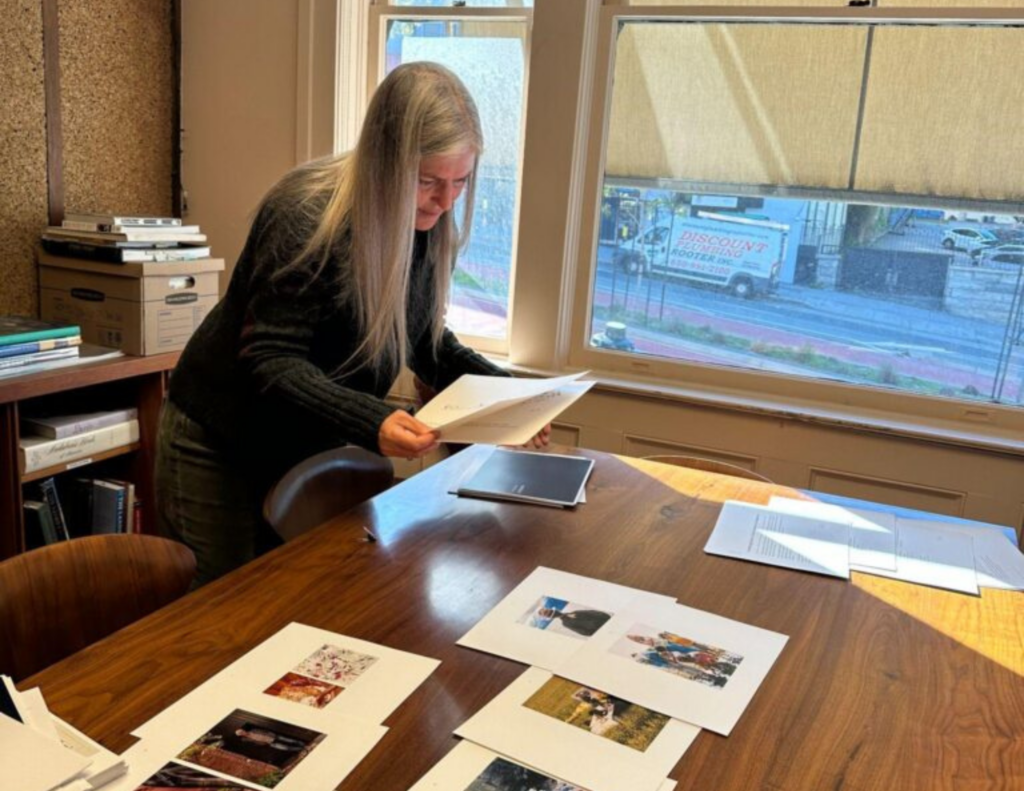
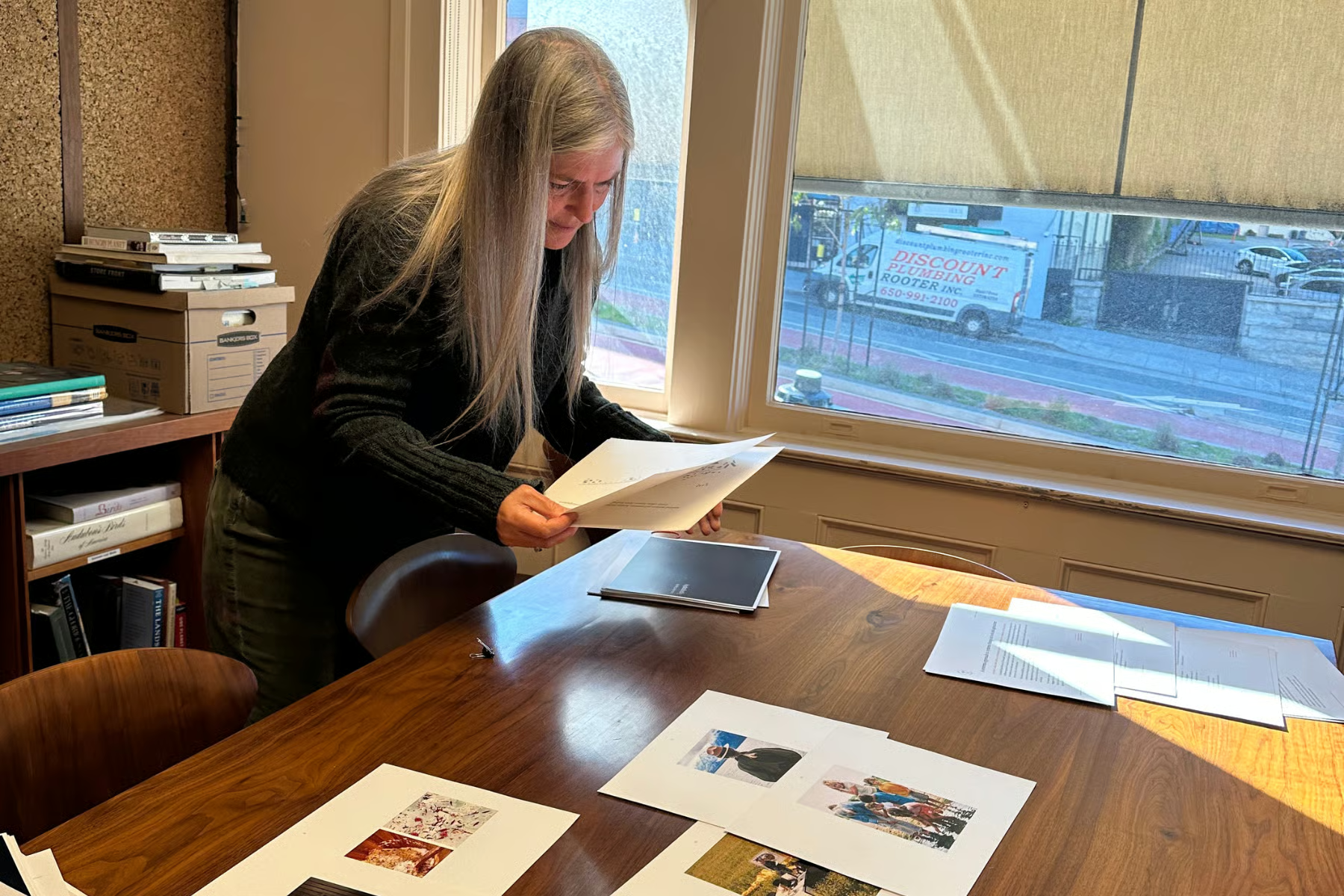
According to Jennifer Jerde, founder of the 34-year-old Elixir Design, brands still need real people to lead with observation and connection in their effort to tell the visual story.
“For brands that really want to be understood in a deep way, it takes other humans to make a thoughtful effort,” she says.
Discover Jerde’s insights about what makes good branding design and what else 34 years running her own firm has taught her.
This is the web version of The Observatory, our (now weekly) dispatch from the editors and contributors at Design Observer. Want it in your inbox? Sign up here. While you’re at it, come say hi on YouTube, Reddit, or Bluesky — and don’t miss the latest gigs on our Job Board.
Observed
View all
Observed
Share on Social


By Ellen McGirt
 Ellen McGirt is an author, podcaster, speaker, community builder, and award-winning business journalist. She is the editor-in-chief of Design Observer, a media company that has maintained the same clear vision for more than two decades: to expand the definition of design in service of a better world. Ellen established the inclusive leadership beat at Fortune in 2016 with raceAhead, an award-winning newsletter on race, culture, and business. The Fortune, Time, Money, and Fast Company alumna has published over twenty magazine cover stories throughout her twenty-year career, exploring the people and ideas changing business for good. Ask her about fly fishing if you get the chance.
Related Posts
The Observatory Newsletter
Ellen McGirt
Who gets to decide where power begins and ends?
The Observatory Newsletter
Rachel Paese
You need an observation practice
Draw the Line
Audio
BONUS: Live from Essence Fest – The Work Gets Personal
Draw the Line
Audio
BONUS: Live from Essence Fest – The Accounting
Subscribe to The Observatory
Related Posts
The Observatory Newsletter
Ellen McGirt
Who gets to decide where power begins and ends?
The Observatory Newsletter
Rachel Paese
You need an observation practice
Draw the Line
Audio
BONUS: Live from Essence Fest – The Work Gets Personal
Draw the Line
Audio