


November 17, 2025
No mandates, only opportunities: IBM’s Phil Gilbert on rethinking change
In his new book, Gilbert shows how "change as a product" unlocked a decade of innovation and why designers need to lead now.
There are only a few instances in business life when a single person is truly responsible for a seismic event, a massive realignment, or other significant breakthrough of any kind. (Years of business reporting have taught me to dispel the “great man” myth whenever necessary. It is always necessary.)
Yet, even with all caveats in place — including the partners, teams, systems, and key alliances required for success — it’s hard to argue that Phil Gilbert was not the clear architect of IBM’s remarkable decade-long transformation to a design-forward, innovation-focused global force.
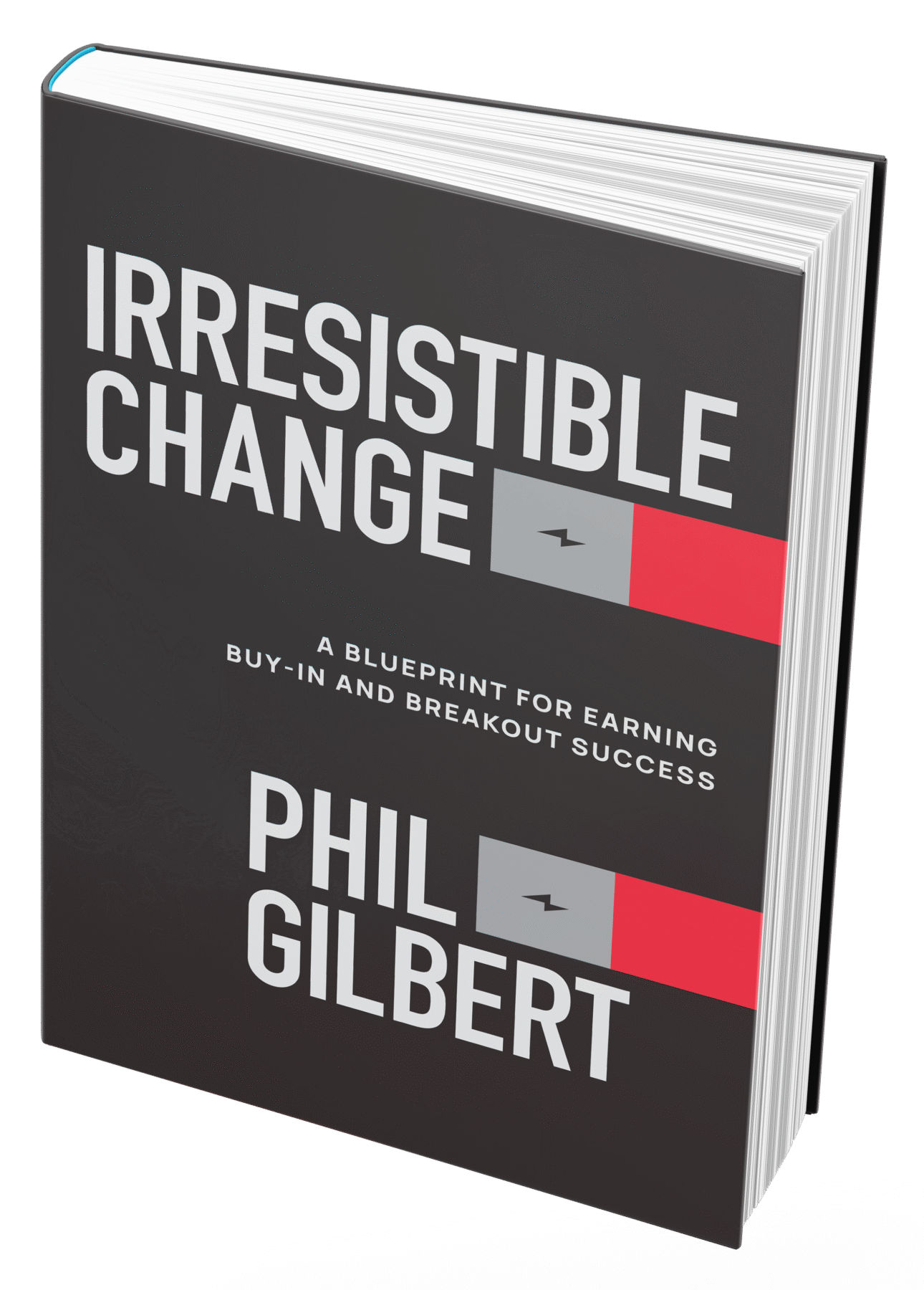
I caught up with Gilbert late last Friday to discuss his new book, Irresistible Change: A Blueprint for Earning Buy-In and Breakout Success, for our latest installment of the Design Juice conversation series.
The book does the heavy lifting.
In it, he recounts the business need behind IBM’s massive cultural shift under longtime IBM’er but new CEO, Ginni Rometty. The book offers a blueprint for how IBM, a company with 400,000 employees, transformed its culture from a stodgy, engineering-centered and hierarchical approach to one that is nimble, human-centered, team-driven, and user-responsive.
His secret: treat “change” as a product to be designed, not a skill to be taught.
Gilbert joined IBM in 2011 after his small but popular software company, Lombardi, was acquired.
“We were doing ‘gorpy” middleware software, and yet business people and our clients loved us,” he said. IBM wanted that juice. “They didn’t know about design, or user-centric thinking. They just wanted what we had: speed, great results, and customers who advocated for us.”
When tasked by Rometty to scale his approach, Gilbert’s team created Hallmark, an internal change-as-product program with a neutral name (so people didn’t bring preconceived opinions about “design thinking” or “agile”) and its own internal brand that signaled prestige, exclusivity, and opportunity. Hallmark offered a big promise. Join us and bring your project to us for an intensive (and bespoke) boot camp. If you don’t achieve a 10x advancement at the end, then walk away. “No one ever did,” he says.
Gilbert knows what we all do: most radical change efforts like these crash and burn.
“I’ve been around companies going through transformations for decades, and they almost all fail,” he told me. “In my opinion, they’ve all executed transformation wrong. I felt there needed to be an operator’s manual—not strategy, but how to execute strategy regardless of the provocation.”
We will post my complete interview with him later this week, so please stay tuned.
But here’s a sneak peek that may help you navigate your week.
First, Gilbert says that the Hallmark method would have been (and still might be?) a terrific model for scaling stakeholder and inclusion strategies within big organizations.
“This whole approach says there are no mandates, there are only opportunities,” he says. “I feel like we can still get to that world where the diversity, equity and inclusion programs work—if they are rethought and reframed in a way that is more in this ‘we’re going to create this opportunity… we’re going to have this set of tools, this set of policies or ways of working.”
The second is his perspective on the current state of AI. Stop panicking and start preparing. Your time is coming.
“We’re at a time where there is technical disruption… and there is a cyclical investment in technology that has to be made,” he says. “But I believe the future value of outcomes is going to come primarily from people who are very conversant with imagining multiple futures and doing divergent thinking and really understanding their users.”
Put another way, the best creative minds need to be at the table, now.
“We’re going to be living in a world where the execution of code and artifacts is going to approach zero cost,” he says. “Today, the best teams—when you do divergent thinking—maybe generate artifacts and test prototypes along two or three or four axes. Imagine a world where all of that is free?
“How many of those futures, how much of the divergent solutions, can now be prototyped and tested? A dozen, a hundred, a thousand in a period of days or weeks? That’s the opportunity.”
And that’s what we few, we happy divergent thinking few, need to prepare for.
In the meantime, I encourage you in the strongest possible terms to buy and read the book. Who knows? If we can get a critical mass of Design Observer readers on board, say 50, perhaps I can persuade Gilbert to return for a special Design Juice live session. (Note: I have not run this plan by him, but let us know if you’re interested either way.)
Have a spectacularly divergent week.
Ellen McGirt
Editor-in-Chief
Ellen@designobserver.com
LinkedIn
Instagram
Threads
P.S. Did someone who loves you send you this newsletter? Welcome! Subscribe here.
This edition of The Observatory was edited by Sheena Medina.
This is the web version of The Observatory, our (now weekly) dispatch from the editors and contributors at Design Observer. Want it in your inbox? Sign up here. While you’re at it, come say hi on YouTube, Reddit, or Bluesky — and don’t miss the latest gigs on our Job Board.
Big Think

Season 12 of The Design of Business | The Business of Design closes with a deeply personal conversation between Design Observer editor-in-chief Ellen McGirt and designer, educator, and Design As host Lee Moreau. The big takeaway: design helps us understand where we’ve been and imagine where we’re going, and that’s about to become an essential survival skill.
In this unexpectedly emotional conversation, Moreau gets real about the state of design and explains why design is a practice of reckoning with the past as much as it is of designing for the future. He reflects on his conversations with other designers about balancing the threats and opportunities presented by AI — the basis for his optimism that not only will there always be a place in the world for design, but the need for designers is about to become urgent.
“Everything that’s being dismantled right now will have to be rebuilt, or versions of it will have to be rebuilt. And that’s going to be a space for us,” Moreau says. “And some of that will be done by corporations, some of that will be done by us working in concert with governments…You know, I think all that is a huge opportunity for [designers] to make things right again.”
Later, in a follow-up opinion piece, Moreau shared the pointed advice he gives his students to prepare them for the great remantling.
Please listen and share widely.
Some fine print (and good news)
Here’s a sampling of our latest and greatest from the Design Observer editorial and contributor network.

What does AI understand about fine art? Xintian Tina Wang’s unique experiment with ChatGPT and the unsettling way it is learning to interpret fine artists has won the Bronze prize from the United Nations Correspondents Association (UNCA) and Itaglas Global Prize for Digital Innovation and Artificial Intelligence. The prize highlights journalism that explores how technology is shaping a more sustainable and equitable future. Yay Tina!
The most disruptive thing a brand can do is be human In her first opinion piece for Design Observer, Kim Devall, the creative director at Bindery, cites the rise of automation and new technology as a fundamental threat to doing good work.
‘6 Feet Deep:’ the hidden history of horror and occult imagery in rap music From the satanic imagery of Memphis mixtapes in the 90s to the devilish aesthetic of contemporary acts like Doja Cat and Lil Nas X, rap artists have long used horror iconography to expose society’s seedy underbelly. By John Morrison
The afterlife of souvenirs: what survives between culture and commerce? “Arts and crafts is the only creative industry where developing countries have a leading position in the global market.” What we often call kitsch may, in fact, be cultural endurance. By Louisa Eunice
How to make a horror film with no money, no script, and lots of friends How two determined creative partners struggled to finish a film that turned a labor of love into actual labor. “We had bits — lines, images from our minds, the deepest recesses—and then based on what we’d shot, we started to weave some serious sort of weirdness together,” says Bruce McClure. By Ellen McGirt
A new chapter of human ingenuity in the age of AI LLMs may mark a turning point in how we create. Still, as AKQA’s TK Tennakoon writes, the hand that guides the brush, human ingenuity, remains irreplaceable.
Happenings
Fortune Brainstorm Design Conference is December 2 in Macau. Fortune’s premiere event explores the intersection of business, technology, and design. Design Observer’s Ellen McGirt will take the stage as co-chair; other luminaries include designer and author Kevin Bethune, Microsoft’s Liz Danzico, and Nike’s futurist in residence Monika Bielskyte. This year’s theme is “Future Tense: Prototyping Tomorrow.”
Observed
What are you observing? Tell us
Adobe ramps up its design-tool ecosystem via agentic AI. The company behind Photoshop/Illustrator is repositioning itself—not just as a tool maker—but as a creator of “agentic AI” that helps brands (like Kate Spade, Newell Brands, Coca-Cola, and even Barbie), design teams, and agencies more efficiently manage their creative supply chains.
The Met Gala gets a party room. The Costume Institute’s annual show gets a permanent home off the Met’s Grand Hall, thanks to Anna Wintour’s efforts to get “out of the basement.”
Goodbye “Glass House.” Ford Motor Company opens its new global headquarters in Dearborn, Michigan, designed by Snøhetta. The 2.1 million sq ft building consolidates engineering/design/fab under one roof, designed to enable collaboration. Come for the natural light, stay for the rotisserie chickens.
Microsoft and Anthropic announce new data center projects in the U.S. focused on AI infrastructure and large-scale computing. The projects, slated for Texas, New York, and Georgia, are pressing ahead despite persistent concerns about a looming AI business bubble and the energy demands of data centers.
A former Japanese toy designer has created a transformer-inspired scooter. The all-electric Icoma Tatamel Bike folds down to the size of a rolling carry-on, and based on the photos, also works as a fashion accessory.
BIG – Bjarke Ingels Group wins competition to design a new state opera in Hamburg.
The practice was selected to design the new Hamburg State Opera on HafenCity’s waterfront. “The opera is envisioned as a topographic structure shaped by a series of stepped terraces,” linking the riverfront with the surrounding city.
We are all in the gutter, but some of us are looking at Solæ, the latest typeface from Paris-based graphic designer and art director Gwennina Moigne. Solæ draws inspiration from Louis XIV, the Sun King, with letterforms inspired by cosmic themes: “stars, constellations, and celestial forms.”
World Architecture Festival (WAF) reveals its top awards for 2025 — including “World Building of the Year” and “Interior of the Year.” The Holy Redeemer Church & Community Centre of Las Chumberas (Spain) grabbed the top building award.
Aesthetically specific film director Wes Anderson is presenting an exhibition at the Design Museum in London that encompasses his 30-year career. His productions require a lot of stuff. “It’s an unusual quantity of paintings, puppets, and original objects you haven’t quite seen elsewhere because of the nature of these movies.”
Everything old is new, again. How adding mass timber floors to existing, but crumbling, buildings is gaining traction as a familiar yet innovative tool for more sustainable renovation and design. (Also: the tallest mass timber residential building in the world is being built in Milwaukee.) (Also, also: Optoppen.)
Job Board
Professor of Practice in Design Company at Tulane University. New Orleans, LA
Technical Soft-goods Designer (TPU / Waterproof Construction), Vancouver, BC
Mid-Level Landscape Designer/Architect, Harrison Green, Brooklyn, NY
Chair Professor / Professor / Associate Professor / Assistant Professor in Architecture, Hong Kong Polytechnic University
Back to the future

Imagining the future is never easy. Décor, fashion, graphics, nothing dates faster than our predictions. But in 2001: A Space Odyssey, Stanley Kubrick got it right. His quiet precision, his obsession with typography, and his almost prophetic sense of the everyday banality of technology still ring true 35 years later. Michael Bierut reflects on his legacy.
– Sheena Medina, Managing Editor
This is the web version of The Observatory, our (now weekly) dispatch from the editors and contributors at Design Observer. Want it in your inbox? Sign up here. While you’re at it, come say hi on YouTube, Reddit, or Bluesky — and don’t miss the latest gigs on our Job Board.
Observed
View all
Observed
Share on Social


By Ellen McGirt
 Ellen McGirt is an author, podcaster, speaker, community builder, and award-winning business journalist. She is the editor-in-chief of Design Observer, a media company that has maintained the same clear vision for more than two decades: to expand the definition of design in service of a better world. Ellen established the inclusive leadership beat at Fortune in 2016 with raceAhead, an award-winning newsletter on race, culture, and business. The Fortune, Time, Money, and Fast Company alumna has published over twenty magazine cover stories throughout her twenty-year career, exploring the people and ideas changing business for good. Ask her about fly fishing if you get the chance.
Related Posts
Education
The Editors|Books
Your October reading list: The Design of Horror | The Horror of Design
Innovation
Vicki Tan|Books
How can I design at a time like this?

AI Observer
John Maeda|Books
Should we teach AI to reflect human values, emotions, and intentions?
Design Juice
Delaney Rebernik|Books
Head in the boughs: ‘Designed Forests’ author Dan Handel on the interspecies influences that shape our thickety relationship with nature
Related Posts
Education
The Editors|Books
Your October reading list: The Design of Horror | The Horror of Design
Innovation
Vicki Tan|Books
How can I design at a time like this?
AI Observer
John Maeda|Books
Should we teach AI to reflect human values, emotions, and intentions?
Design Juice
Delaney Rebernik|Books