


April 13, 2026
“The future does not need more speed; it needs more meaning”
Ashley Lukasik on the impact of meaningful convening ͏ ͏
I first met Ashley Lukasik over Zoom in the spring of 2025, in advance of the Shapeshift Summit hosted by the Institute of Design in Chicago. (Our Design As podcast team captured the event.)
I was immediately dazzled.
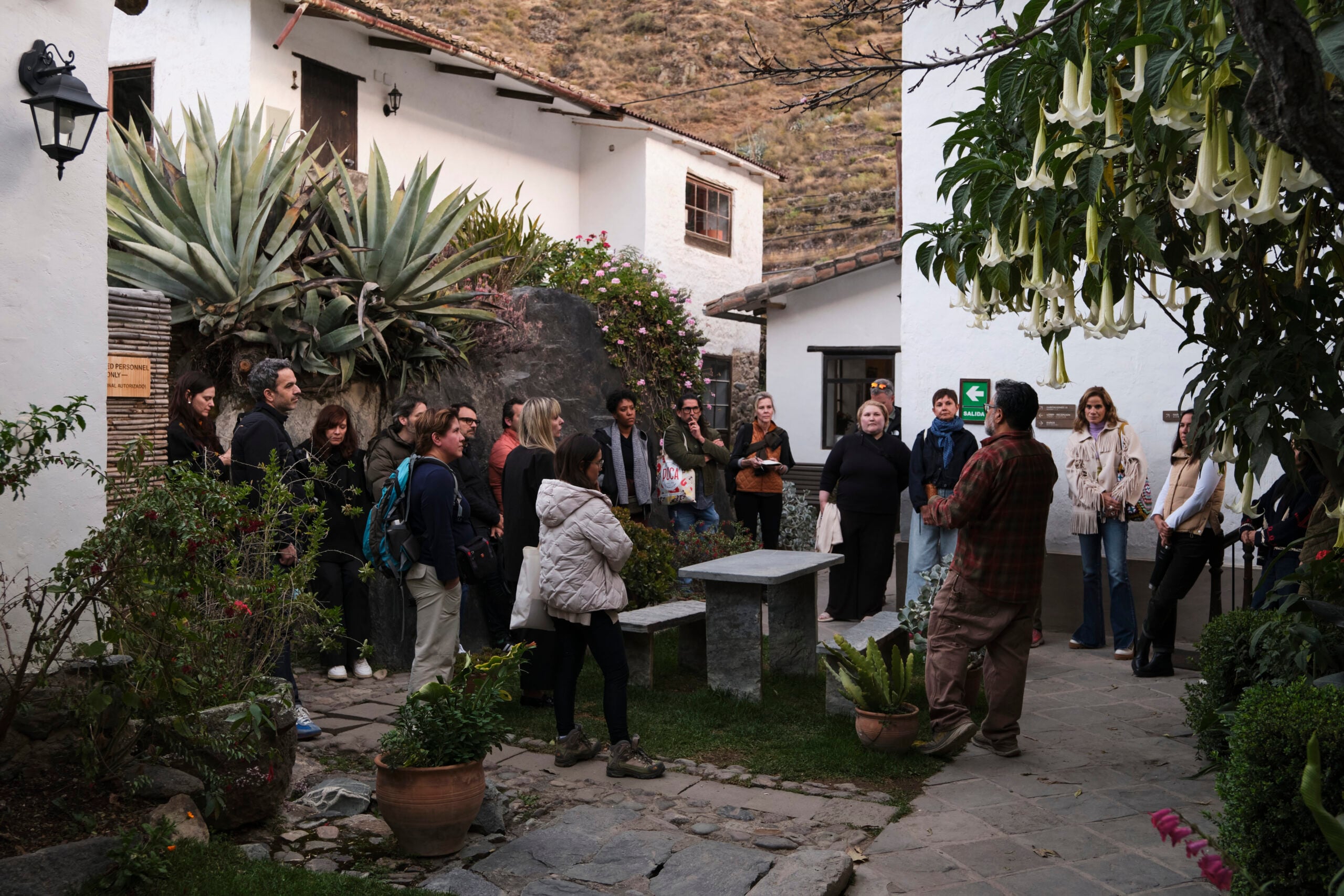
Lukasik was sharing the details of the latest “immersion” she was planning for the conference — it was about how AI is already reshaping Chicago — and she described the way she’d learned to convene diverse practitioners for deep learning and co-creation in places as wide-ranging as Detroit, Mumbai, Hong Kong, Mexico City, New Orleans, and, as we explore in this series, Peru’s Sacred Valley. “What can we discover in and about the world?” she asks. “How can we restore wonder, reflection, and creativity in the search for solutions to the big problems we’re facing?”
In just over 10 years, Lukasik and her team, along with their partners, have curated some 20 immersions around the world with clients and participants representing organizations like Salesforce, Gensler, Google, the People’s Action Institute, and more. The goal is executive focus with a higher calling to address complex issues, such as the housing crisis in Los Angeles, global food system security, and the strategic integration of AI.
Lukasik began her design career at the Institute of Design in 2008, an eight-year period that coincided with a particularly affirming era for the field. “It was a time when big companies and organizations were diving into ‘design thinking,’ believing they could grow revenue by understanding new markets and customer needs.” But the former anthropology graduate student was also skeptical that the momentum would last. “It’s a powerful way of thinking, absolutely, but as the design consulting model became more corporatized, there was pressure to scale,” she says, which was effectively removing the humanity from human-centered design.
“The future does not need more speed; it needs more meaning.”
Her firm, Murmur Ring, launched in 2020, another auspicious time to begin asking more of design and ourselves. I asked Lukasik if she, her team, partners, and immersion participants would be willing to share what they’ve learned over the years — the juice, if you will — from bringing people together in search of meaning.
It’s a topic that’s top of mind for the Design Observer audience, for whom connection, courage, and creativity are the tools of choice to address thorny problems — particularly now.
And we have questions:
- Pre-conditions: What’s necessary for an immersion experience to be truly transformational?
- Openness: How do you encourage busy individuals with looming responsibilities to resist the temptation to rush to find answers?
- Discovery: How do you respectfully lead people through experiences in impoverished communities, sacred places, or with Indigenous experts, and avoid being exploitative?
- Breakthrough: How do you handle reticence or resistance from participants?
- Muscle memory: How do you use what you’ve learned designing immersions in your day-to-day interactions with colleagues and community members?
- Humanity: What have you learned about designing for joy?
Check out the ongoing series for reflections from Lukasik and her circle, and keep your eye out for more coming soon.
In the meantime: if you could ask an expert, what would you want to know about building meaningful convenings? Did we miss anything? Let us know. Or, if you know someone who might have questions, forward this to them
Ellen McGirt
Editor-in-Chief
LinkedIn
Instagram
Threads
Ellen@designobserver.com
P.S. Did someone who loves you send you this newsletter? Welcome! Subscribe here.
This edition of The Observatory was edited by Rachel Paese.
This is the web version of The Observatory, our (now weekly) dispatch from the editors and contributors at Design Observer. Want it in your inbox? Sign up here. While you’re at it, come say hi on YouTube, Reddit, or Bluesky — and don’t miss the latest gigs on our Job Board.
Some fine print
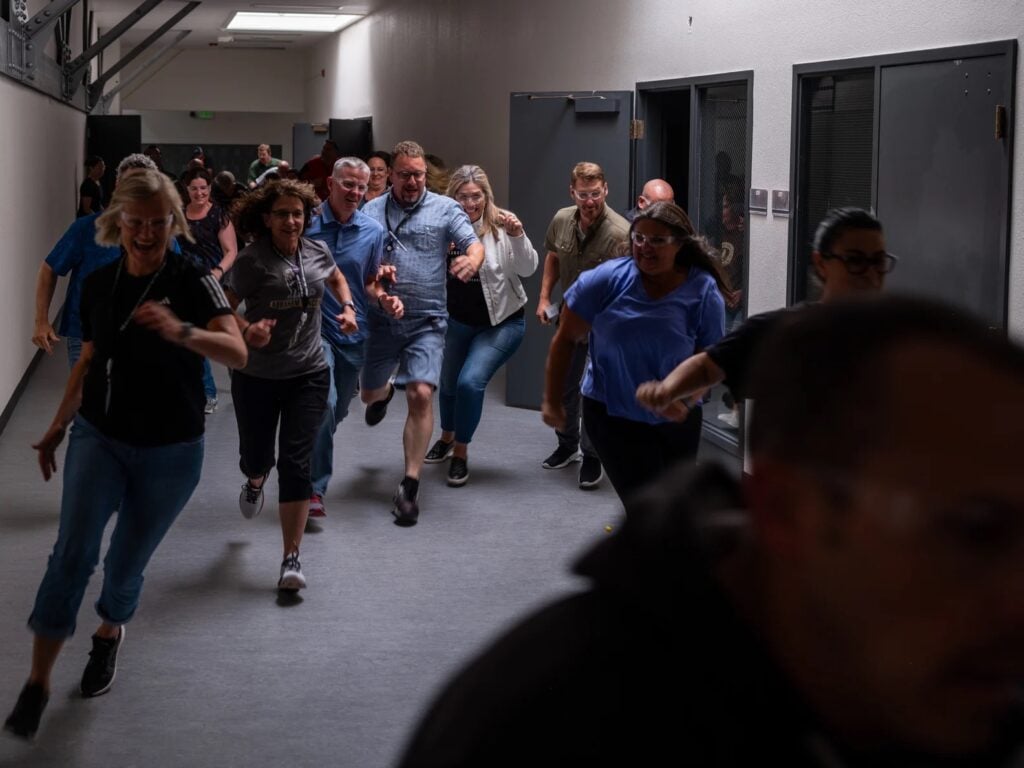
Documentary filmmakers Jessica Dimmock and Zackary Canepari were nominated for an Emmy and a Peabody for “Thoughts and Prayers,” an in-depth look at school shootings and the booming shooter defense industry. “Is surviving a school shooting a design problem? The $3 billion active shooter preparedness industry believes that the answer to that question is, unfortunately, yes.”
Find our exclusive interview with them.
Observed
What are you observing? Tell us.
On April 9, a group of working film directors launched the Filmmaker Leadership Council in partnership with the movie-theater trade association Cinema United. The filmmaker-led organization aims to protect and expand the shrinking window for theatrical releases; circumventing studios’ push toward streaming. “Our industry is strongest when it works together to promote the singular experience of seeing a movie on the big screen,” says Cinema United chief Michael O’Leary. “That is what drives us—and it is what will forge the Next Great Era in Cinema.” Follow @OccupyDirectors on Instagram.
Designs for a new gold-tinged “victory arch” have been released by the Trump administration. The plan is to call it, and I’m not kidding here, “Arc de Trump.” Please tag us in all memes and commentary.
Can I get it in red? Will it fold? Do you want it in red? Do you want it to fold? All rumored signs point to yes, a deep red color is being tested for the iPhone 18 Pro and iPhone 18 Pro Max. And it looks like Huawei has outpaced both Apple and Samsung by launching a “passport” aspect ratio for a new, foldable phone. No word on whether it will blend.
Paddington the bear won big at the Olivier Awards last weekend. Other winners include the revival of Evita, and Punch, about an accidental death and a mother’s grief, for best new play.
Meta is reportedly building an AI clone of Mark Zuckerberg. So, that’s happening.
All who wander, win. David Epstein, best-selling author of RANGE, is out with a new book called Inside the Box: How Constraints Make Us Better. In it, he expands on science that explains how breakthroughs actually happen. Turns out, it’s not the grind, it’s the journey that yields insights. “Nearly everyone’s most impactful work, their hot streak, came after a period of exploration.”
We’re in AI’s “scary phase” according to, well everyone. “Anthropic has begun a tightly controlled release of Mythos, the first AI model that officials believe is capable of bringing down a Fortune 100 company,” says Axios. “In perhaps what’s one of the most eyebrow-raising findings, Mythos Preview” has a ‘potentially dangerous capability’ to bypass its own safeguards,” says Hacker News. “Yeah, but these stocks are a buy!” Says JP Morgan.
“The NYC department of records, to their eternal glory, has digitized hundreds of historic videos and audio recordings from @WNYC ’s history since 1937. Anyone who is an NYC-phile needs to get into this STAT.” via history prof @dlondonwortel on X.
The Obama Presidential Center is slated to open to the public on Juneteenth weekend. The 19-acre campus hosts a playground, museum, public art installations, landscaped park space, and a new Chicago Public Library branch. “Here on the South Side of Chicago, hope is getting a permanent home,” President Obama said in a statement. The Obama Presidential Center Museum was designed by Tod Williams Billie Tsien Architects (TWBTA).
Architecture students at Virginia Tech are participating in a new training initiative to help them design for people who are blind or visually impaired. “Architecture is often treated as a visual discipline,” assistant professor Andrew Gipe-Lazarou says. “But space is experienced with the whole body. When students are pushed to design beyond sight, it fundamentally changes how they understand architecture and their responsibility as designers.”
The runway as performance art. This is a fashion, not an airport story, for a change.
Wanted: the Hog Butcher for the (New)World. Poetry Magazine is putting together a special issue dedicated to all things Chicago. If you were born, raised, or have lived there for at least 7 years (random number, must be a Chicago thing), submit your work by May 15.
Job board
Hiring a designer? Post your role on the Design Observer Job Board to reach a highly engaged audience of designers, creative leaders, and studios across the Design Employment Network.
Retoucher at APPARATUS, New York, NY.
Industrial Design Intern – Summer 2026 at Choi Design Group, Chicago, IL.
Creative Design Specialist at University of Georgia, Athens, GA.
End marks
If beautiful April weather has been getting you out in nature lately, it might be time to revisit our interview with Dan Handel, the author of “Designed Forests.” He reminds us that design plays more of a role in our experiences with nature than we might expect.
“Once you look back, you find all these points in which design responded in quite nuanced and interesting ways,” he says, “to establish connections between humans and their environments that are not the extractive, the colonial, the profit-making kind of mainstream that we’re seeing in many places around the world.”

This is the web version of The Observatory, our (now weekly) dispatch from the editors and contributors at Design Observer. Want it in your inbox? Sign up here. While you’re at it, come say hi on YouTube, Reddit, or Bluesky — and don’t miss the latest gigs on our Job Board.
Observed
View all
Observed
Share on Social


By Ellen McGirt
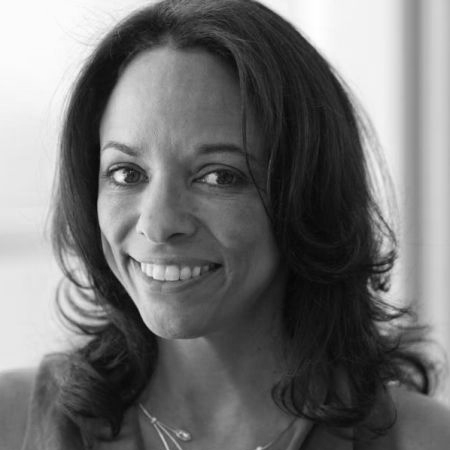 Ellen McGirt is an author, podcaster, speaker, community builder, and award-winning business journalist. She is the editor-in-chief of Design Observer, a media company that has maintained the same clear vision for more than two decades: to expand the definition of design in service of a better world. Ellen established the inclusive leadership beat at Fortune in 2016 with raceAhead, an award-winning newsletter on race, culture, and business. The Fortune, Time, Money, and Fast Company alumna has published over twenty magazine cover stories throughout her twenty-year career, exploring the people and ideas changing business for good. Ask her about fly fishing if you get the chance.
Related Posts
The Observatory Newsletter
Ellen McGirt
Who gets to decide where power begins and ends?
The Observatory Newsletter
Rachel Paese
You need an observation practice
Draw the Line
Audio
BONUS: Live from Essence Fest – The Work Gets Personal
Draw the Line
Audio
BONUS: Live from Essence Fest – The Accounting
Subscribe to The Observatory
Related Posts
The Observatory Newsletter
Ellen McGirt
Who gets to decide where power begins and ends?
The Observatory Newsletter
Rachel Paese
You need an observation practice
Draw the Line
Audio
BONUS: Live from Essence Fest – The Work Gets Personal
Draw the Line
Audio