


October 7, 2009
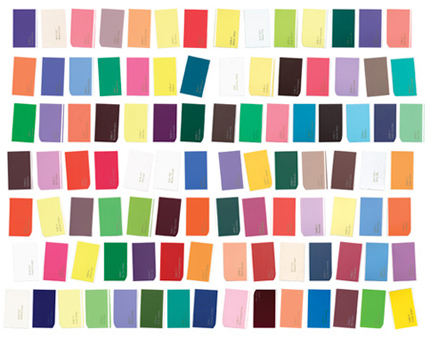
100 Colors, 100 Writings, 100 Days

When my father came East to visit me, he wanted to take a day trip to a state he’d never seen. “How about Delaware?” he said. We settled on Rhode Island. “I’m looking forward to being on Rhode Island,” he said. “It isn’t an island, Dad.” “No?”

Election Day two days away, and I’m too nervous not to be superstitious. Is this paint chip telling me we’ll be inaugurating a black man in January? I stare at it, stroke its matte surface, absently stick it halfway into my sleeve. My sweatshirt is nearly the same color, a warmer grey than I realized.

At some point in childhood, we start having memories, born of experience and not of photographs or family lore. Before I had memories, our attic had a wasp nest. It was discovered and fumigated but not removed. My first memories are of buzzing, of lying awake at night in terror, of the wasps that had surely returned.

What’s the difference between Sarah Palin and the next vice president of the United States? Lipstick.

I bought my first yam this week. I wanted sweet potatoes, which sound a bit friendlier, but the store didn’t have any. The yam is quite rooty, forever looking freshly pulled from the earth — something that is born, grows, and dies in darkness. It’s bumping around my cupboard now, rolling into view when I take out the sugar canister, tin of anchovies. It’s clumsy and bulky. I rudely shove it back, out of my way, further into the darkness.

At some point during college, a curious sidebar article appeared in the Daily News. I clipped it, filed it, and never found it again. A sad fate for the clipping, but well-suited to the content: Campus police found a six-foot-tall marijuana plant growing in the dry ornamental moat surrounding one of the dorms. It was destroyed.

My stepfather doesn’t like green food. Categorically, I’m pretty sure. Green: leaves of any kind, beans or peas, sprouts, stalks, things that come in stalks. He is liable to say “ew” to things that come in stalks, like he did when my friend Liz was over and sneezed at the dinner table. Vegetables. Fruit too. He’ll eat a banana if my mom slips one into his lunch pail, but his preferred fruit delivery system is a personal fruit pie, the kind that comes in white waxed paper and seems itself to be dipped in wax.

Connecticut does fall pretty well, and this one has been no exception. Red-orange-brown-gold trees burning up the hills. Brisk days, mellow light. Crashing walks, I drag my feet to pulverize the fallen leaves. Today was the first that added a punishing wind, whirling up New Haven’s open alleys and across the Green, to the season. It is the first night where mention of spring seems cruel.

Ian taught me that pine is a soft wood. “Use the nail test,” he said. “Test its hardness by pressing your fingernail into it.” He taught me the phrase “cobbed up,” which he explained as using your desk to build a car. He taught me how to use a table saw.

She was the best reader in third grade. She knew it. We all knew it.

I’m flying today. PDX to JFK, via ATL. The unasked-for jag south means that the midday sun shines brightly through the window of seat 26F. The man in 26D tells me to close the window shade, first halfway, then all the way. The sun is in his eyes. My favorite thing about flying, an unfavored activity, is the window, landing at night in a city spread out like dying embers, popping up above big cartoon clouds into the blue. Surely it is fate, to be staring at a color called billowy clouds even as my rumpled shade is pulled tight, blocking all sight of them.

Margarine. Or, more accurately, marge. My brother and I were furious when our mother tried to reintroduce butter to the dinner table. Was it like the chocolate milk in the fridge and the donuts on the counter, treats we gulped down sulkily — sweet reminders of our father’s fresh absence from the house? No, I think we just liked margarine. Fleischmann’s. It came in a white plastic tub with a translucent lid, perfect for storing leftover cranberry sauce or beads. Like its tub, marge was shiny and molded. A cheery, synthetic daffodil yellow. Compared to marge, butter was just a dumpy, boxy old thing. Always too hard or too soft, didn’t taste like much.

Take some of the warmth out of this, the dusty blushing rose of an old lady’s eye shadow, and this is a color I wear every day. I am wearing it now, and I wore it yesterday. Without the het-up pinkish hue, it’s grey. A shift from one overcooked meat to another, mutton to triangle roast. Tongue to chop.

People love their Granny Smiths, eat them like meals. They chomp and slosh around in there with such gusto, like it’s meat, like they’re horses, like someone might take it. I don’t. Granny Smiths have too much fight in them. I love a challenging fruit, but Granny Smiths are sour and hard, and the sound of someone biting into one gives me the chills.

Friday, I drank big cold gulps of red wine from a pint glass I’d covered loosely with plastic wrap and put in the fridge, not thinking so logically after Thanksgiving dinner last week. I drank a glass of water. I drank another glass of water. I drank a cocktail Julie made with Pimm’s, ginger ale, and a long lovely strip of lemon peel. When it was done, I sucked the peel and then left it at the bottom of my glass. I drank a whiskey and coke. I drank another whiskey and coke. I drank whiskey.

We went to Palm Springs every year of my life until Maurice died. He died there, that paradisiacal oasis in the living desert, where the streets are called Dinah Shore and Bob Hope and where the many branches of Bank of America are all irresistible shades of California modern, far away from his cold flat home on the Canadian prairie. When they could swing it, he and Cynthia rented a condo right on a golf course. Sometimes golf balls flew through the kitchen window, which I found terrifying and everyone else seemed to think hilarious and exhilarating. I hated those immaculate, hazardous lawns but loved the beds of snapdragons that lined them. When I heard Maurice was dead, my first thought was, At last! My grandfather has been fatally struck by a golf ball.
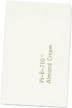
My boss at the museum was a grannyish 30-year-old whose ill-fitting slacks gave her what she called “diaperbutt.” Her Subaru wagon had heated seats. “Do you want me to turn your butt on?” she’d say when she gave me rides home in the winter. Her husband was a chef, so she and I often ended up talking about food. She told me how hollandaise sauce was made. She told me that cooks love junk food. She liked her meat extremely rare, “Just introduce it to the flame,” she’d say to waiters, feeling sophisticated and hungry. She kept pounds of raw almonds in her desk. She had the most unbelievable skin.

My mother wore a periwinkle dress to her second wedding. And her second husband wore a periwinkle tie. It was a casual, celebratory affair, heavy on beer and light on ceremony. As was only natural, my brother was thirsty. But he was not yet twenty-one, and the bartenders were strict. He became something of a cause célèbre for the more sympathetic friends and relatives. They shuttled pints to him as he complained about the situation. They didn’t know he’d come armed with a fifth of Jack Daniels, just in case. There is a picture of him from the day, huge smile, arms draped around the newlyweds, as near as he’s ever stood to his stepfather.

Ken Kesey’s Sometimes a Great Notion opens with a description of the frightening, dripping, verdancy of Oregon. It continues for many pages, and it’s all true. In Portland, moss grows on the roofs of the houses, ferns sprout from cracks in the sidewalk, even the best maintained streets and buildings are prone to sliding around during the dark wet winter. One time in college, I came home for a holiday, and there were huge gray mushrooms growing out of my bedroom carpet.

In seventh grade science class, we studied drugs. Hard drugs. We were each assigned a drug (mine was LSD). We zealously researched its scientific name (Lysergic acid diethylamide), type (semisynthetic psychedelic), solubility (fat), cultural reference (Huxley, Leary, Beatles), and most useful of all, street names (Acid, Window Pane, Electric Koolaid, Blotter, Doses, Tabs, Trips, Purple Haze, Sugar Cubes, Paper Mushrooms, Rainbows, Smilies, White Lightening, Mellow Yellow).

I’m stranded at my father’s house, what Joanna calls “the Greenway Inn,” on Greenway Avenue, way up in the West Hills. It snowed all night and is snowing now. Seven, ten, thirteen inches. Never in my life has it snowed this much in Portland. When I describe the white carnage to people in Connecticut and New York, they are not nearly impressed enough. They think Portland is like I think Denver is, snowy, cold, mountainous. I was shocked when I finally visited Denver and it was flat and sunny.

A color like the banged up Pyrex bowl we got from Second-Hand Rose, the roadside junk store in northern Minnesota on the way back from the cabin we rented a couple summers ago with Marc and Esther. The ladies at the checkout blessed us and wrapped the little bowl in five layers of newsprint.

Freshman year, Dan and I tutored at a local junior high school. A sophomore named Sascha coordinated the tutoring program. Each of us had a secret: Dan was fulfilling the community service requirement of the MIP he’d picked up in Denver over the summer. I was in love with Dan. Sascha, who walked us over to the school each week, was covered in terrible bruises. She had shiners, a swollen lip, purple welts on her arms. Some days, she had a slight limp. She never mentioned it. This continued through the fall. Dan and I grew worried but didn’t know how to ask, didn’t ask. After winter break, Sascha quit the program, Dan had done his hours, my ardor was cooling. I never saw Sascha again. Julie knew her a bit. They were on the rugby team together.

Only three times in its hundred-year history has the Crayola company changed the name of a crayon. Prussian Blue became Midnight Blue in 1958 and Indian Red was renamed Chestnut in 1999, both in response to requests from educators. In 1962, the company voluntarily changed Flesh to Peach, partially in response to the U.S. Civil Rights Movement.

In certain Brooklyn bars, many liquors come infused: Thai chili-infused vodka, vanilla bean-infused rum, candied ginger-infused bourbon. This is a pricy inversion of a trick from high school, where we infused many things with cheap liquor: whiskey-infused Diet Pepsi, grain alcohol-infused Jell-O, and the classic vodka watermelon.

Sonia had dry, mousy hair and big bright eyes. She wore boots with pointy toes, tight stonewashed jeans, and pale ribbed turtlenecks. She was one of the tall girls of junior high, so we shared a moderate sense of sisterhood and played on the same basketball team. But she was boy crazy and rode horses and always looked startled. She wore makeup. She took dance instead of gym. Sonia was girly. I thought my tallness put dancing and horses and boys out-of-reach. I was too mortified to experiment with applying pastels and open, innocent expressions to my face, choosing instead to be ironic and good at math.

I wore a silk teal suit at my Bat Mitzvah. From Ann Taylor. The shoulder pads were between the lining and the shell, so if I’d wanted to take them out — I didn’t — I couldn’t. If Hillary Clinton had had a Bat Mitzvah, I like to think it’s what she would have worn. That powdery greeny-blue, if there had been a giant Tiffany’s box on the bima, it would have looked like it sired me.

The other great suit of my young adulthood was the debate suit. It was chocolate brown. Under it, I wore a pale blue polyester button-down with a wonderfully wide collar. I left the shirt’s top three buttons open between rounds and only two open during a debate. I walked from classroom to classroom in brown Birkenstock clogs, taking bigger, bolder strides than the skirt was built to accommodate. The slit ripped again and again, no matter how much my mom reinforced it.

This paint chip smells a bit like money. I wonder if they all smell that way.

This color reminds me of my mother. It’s not anything like the color of her eyes, which are brown. She had a blue car once, a 1986 Toyota Celica, but it was a pale-steely blue. She doesn’t wear lots of blue, prefers warm colors. She doesn’t swim much, in pools or at the ocean. We didn’t have plates or mugs or a tablecloth this color. I look at — look into — this flat deep aqua color and think of her and don’t know why.

I’m on a bus to Washington DC to see Sarah. It has poured cold rain the whole way and feels as if we’re driving through clouds, some kind of nightmare natural no-touch carwash. She keeps calling to ask me where we are, but I can’t see the road signs.

In sixth grade, I grew six inches and my complexion went all to hell. In the basketball team photo, I tower over the others, my eyes and chin glowing fiery red. Trying to be helpful, my mother took me to the Clinique counter. There, a woman in a sexy lab coat asked me a series of questions and diagnosed me with combination skin. My mother bought everything the woman prescribed: a bar of anti-blemish soap, spot-treatment gel with salicylic acid, liquid foundation, powder, blush, eye shadow, lip gloss, lipstick, all of it packed in elegant pale green boxes, each sized precisely to house the tube inside.

ENDOWMENT FALLS 25 PERCENT
Headline, Yale Daily News

In the fall of 2006, spinach was implicated in a deadly E. coli outbreak. According to the FDA’s final report on the outbreak, more than 200 people got sick and three people died. Bagged spinach was pulled from grocery store shelves. People who hated the nutrient-rich green felt justified, even smug. People who fed it to their children to make them grow up healthy and strong felt betrayed. In the end, the bacteria was traced to cattle manure found on pastures surrounding a spinach field in Salinas Valley, California.

My parents didn’t hire a photographer for my Bat Mitzvah. Our neighbor, Chuck Saxe, offered to do it. Chuck was a software engineer at Tektronix and an amateur shutterbug. He arrived at the party toting two cameras, four lenses, a tripod and flash. We encouraged him to grab a bite before he got to work. Minutes later, Chuck was quite sure he’d been poisoned by the edible flower in the dinner salad and went immediately home to bed. His wife Harriet left with him, the poor woman had to haul all that gear.

I think I lived in a room, or maybe a whole apartment, painted this color. Is this the color of Julie’s apartment? My sense of recognition is as strong as my sense of disorientation. I don’t like this color, but I know this color, have awakened to this color, watched the sun crawl over it, nailed a picture hanger into it.

Grandma Cynthia made a thousand paintings of the Palm Springs desert, the blooming, living scrub edging the mountains beyond the golf course. Early in the morning, before Grandpa Maurice lumbered out onto the green for the first game of the day, she drove into the desert, away from the chilly dew coming off the swimming pools, from the orderly roadbeds of bougainvillea clumped around a single palm, from Gerald Ford Drive, to take the pictures that would become paintings. She wasn’t one of the heroic, romantic landscape painters, in wind and sun, her canvas lashed to the hard earth. Painting was done in the studio, surrounded by treasured views of a hot, alien land.

Last night, the liquid was gray and white and brown and black and cold. It was below and it was above. It tore the sole off one of my boots and soaked through two thick jackets. It tricked me. It pushed me around. This morning, the liquid is solid. And more treacherous still.

In my second grade class picture, I am the only girl in pants. But it’s not like I dressed down. My pants are pale orange and white checked, a daring compliment to my shirt, which is a rayon button-down with pictures of the planets on it. I stand out from the crowd: tall and skinny, a sandy bowl cut, orange pants.

Coming back to New Haven on the first off-peak train of the morning. The doors open at Westport. It’s snowing lightly. The computer is warm on my lap, but the blue cast of the screen makes me realize I’m cold. Someone has written OBESE VAGINA in permanent marker on the wall next to my seat.
Observed
View all
Observed
Share on Social


By Rachel Berger
Related Posts

Innovation
Ashleigh Axios|Essays
Innovation needs a darker imagination
Business
Kim Devall|Commentary
The most disruptive thing a brand can do is be human
AI Observer
Lee Moreau|Commentary
The Wizards of AI are sad and lonely men
Business
Louisa Eunice|Essays
The afterlife of souvenirs: what survives between culture and commerce?
Subscribe to The Observatory
Related Posts
Innovation
Ashleigh Axios|Essays
Innovation needs a darker imagination
Business
Kim Devall|Commentary
The most disruptive thing a brand can do is be human
AI Observer
Lee Moreau|Commentary
The Wizards of AI are sad and lonely men
Business
Louisa Eunice|Essays