



March 24, 2026
Systems are failing. Just ask airport staff.
(No, really. Ask them.)
When a major tech platform goes down for any reason, a meme typically circulates as the online masses gleefully imagine the panic of the incompetents as they rush to find the problem.
“SysAdmin looking at server rack” is one of the most popular of the genre; it shows a young Black man in a t-shirt and jeans, hands on his hips, staring into a janky server cabinet and its befuddling tangle of wires. According to the AI Memes archival site, the image “is commonly used online to humorously depict someone attempting a task for which they are unprepared, particularly in contexts involving tech support or IT failures.”
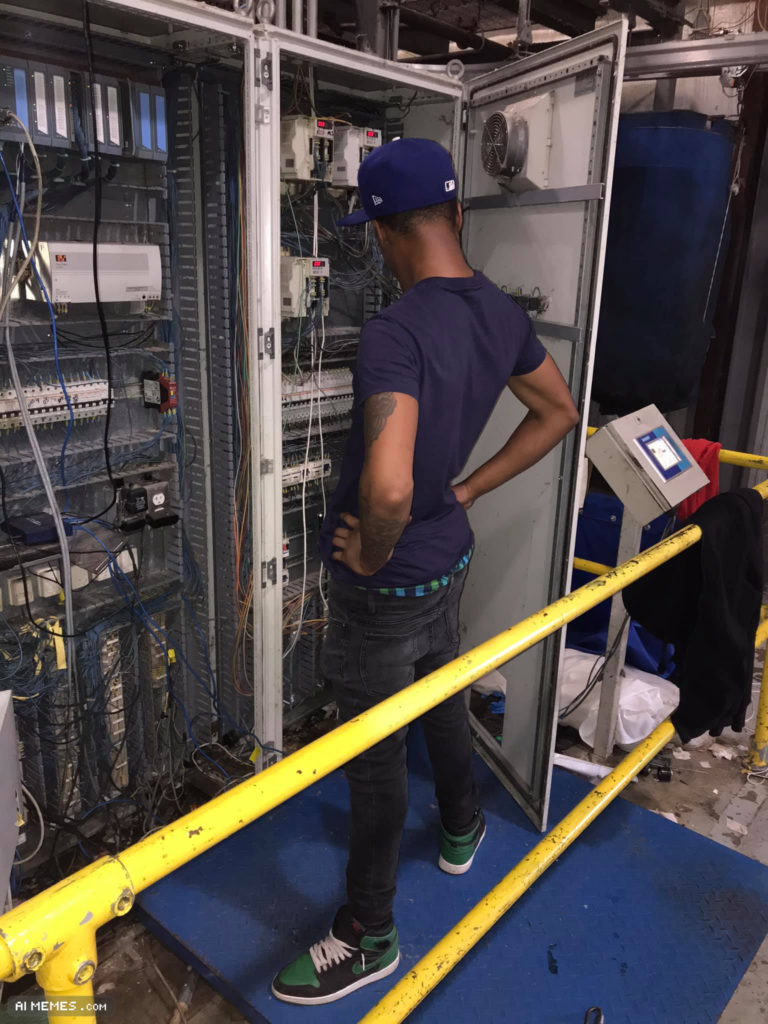
I thought about the poor SysAdmin guy a lot last week.
I was stranded, sitting on the floor among hundreds of increasingly desperate travelers at the Nashville airport and experiencing the four stages of travel grief: trying to find a new flight, trying to find the bag I was forced to check, then, a rental car, and finally, in defeat, a cheap hotel. (All while failing to meet the deadline for last week’s column. Sorry.) I had been stuck in airport drama for days, in part due to the crazy weather. But only in part.
Watching the airport version of SysAdmins scramble to help us, they were also in a unique position to explain why we actually couldn’t be helped. Understaffed and overworked air traffic controllers and unpaid TSA agents quitting en masse were chief among them.
With the news of the deadly tarmac collision at LaGuardia Airport this morning, it is clear things are only getting worse.
At times like these, I take solace in the insights of Dr. Richard Cook, who once ran the Cognitive Technologies Laboratory at the University of Chicago. He was an anesthesiologist and researcher whose work focused on understanding how complex systems like health care, transportation, and beyond become more resilient. His 2012 lecture, How Complex Systems Fail, starts with one eye-opening insight: it’s a miracle that complex systems work at all. “The real surprise for us is not that there are so many accidents,” he says. “The surprise is that there are so few.”
Systems safety is buoyed by a seemingly random set of baked-in safeguards that trigger at points of potential failure. Some are designed, like circuit breakers. Others are regulatory in nature, or institutional mandates for training, work rules, expertise certification, and pressure testing. It helps a system get lucky. “The array of defenses works,” writes Cook. “System operations are generally successful.”
But critical to the effort are the people who do the day-to-day work. They’re the ones, metaphorically speaking, who know which side of the refrigerator to hit to get it to work again. Or, not so metaphorically, they understand what to do to get your lost luggage rerouted. Cook reminds us that systems operators, unlike the befuddled guy in the meme, often have the deepest practical understanding of complex systems, even if they are not the designers. They shouldn’t be summarily DOGE’d out of their jobs. They should be trained. They should be paid, of course. And they should be listened to.
With the realities of an escalating war, geopolitical conflict, and oil shocks , I worry that we are all about to experience a series of hard lessons in the failure of critical global systems, from food to pharmaceuticals. Everything is connected. It would be good to have people who understand how things work on the job.
If you’re a leader, design or otherwise, chances are, you are surrounded by people who touch the complex systems that keep your organization running. You may not know their names or even think much about them, but they are there. (If you are one of these people, please forward this to your boss.)
Cook challenges us to think of them as resilience agents, vital human nodes in an array of safeguards who are responsible for the miracle of system success. This makes the job of leadership clear: focus on finding these people, developing their skills, and growing their capacity to problem-solve and lead. This may feel like a vague swipe at AI agents, and it’s not really. (Maybe, just a little.) This may also feel like a swipe at the current state of Beltway dysfunction. (It definitely is.) It’s also a reminder that systems get luckier when the people who use them are valued.
“Nobody ever calls you at 3:00 in the morning to tell you that the system is running well and they’re happy with things,” Cook says. Understanding system resilience means understanding that the power to stay operational doesn’t come from the top. “The way our systems are developed, designed, run, used, and maintained, we should be having ‘crashes’ all the time. What should that mean?”
Ellen McGirt
Editor-in-Chief
LinkedIn
Instagram
Threads
Ellen@designobserver.com
P.S. I finally got home, but it was a long, strange trip. How are you faring? What do you need from us? Let us know.
Did someone who loves you send you this newsletter? Welcome! Subscribe here.
This edition of The Observatory was edited by Rachel Paese.
This is the web version of The Observatory, our (now weekly) dispatch from the editors and contributors at Design Observer. Want it in your inbox? Sign up here. While you’re at it, come say hi on YouTube, Reddit, or Bluesky — and don’t miss the latest gigs on our Job Board.
Some fine print

Every Tuesday, artist, writer, and co-founder of Design Observer, Jessica Helfand, invites us into her studio and her mind as she develops a series of paintings based on the myth of Icarus. Along with a close examination of her thinking,The Icarus Diaries reveal her strikingly unique process — involving AI as her research partner, seeking its strange results to adapt, absorb, and iterate.
Last week, in the ninth installment, she says, “AI gets confused when I go from natural references to aeronautical references to literary references : the visual results are always more compelling to me when they’re discordant, even wrong. I like trying to confuse it even more, like asking for Renaissance lighting but setting the date to 1975.”
Observed
What are you observing? Tell us.
ICE agents are being deployed to busy airports to help fill staffing gaps amid the ongoing partial government shutdown. So, untrained people with a clear history of violence and an unclear mandate now have unfettered access to legions of trapped people and their data? What could go wrong? Not a hypothetical, we’re making a list.
Now in its ninth year, the Dezeen Awards honor architects and designers around the world. In 2026, they will introduce public voting and publish three Top 50 lists identifying the best projects across four regions: Europe, the Middle East and Africa, Asia Pacific, and the Americas. Apply before March 25 for discounted rates.
Those fancy journals you keep buying are good for your brain. “Writing by hand engages a deeper level of cognitive processing. It slows the pace of thinking and forces you to organize your thoughts as you go,” says Elizabeth Mateer, citing research. “It requires summarization and selection and encourages active engagement rather than passive transcription.” And probably uses less energy.
What if a philosopher saved democracy? The New Yorker has a thoughtful profile of Elizabeth Anderson, the chair of the University of Michigan’s department of philosophy. She’s been building a case that equality is the true basis for a free society, and finding success in bringing the politically divided together. “Anderson’s democratic model shifted the remit of egalitarianism from the idea of equalizing wealth to the idea that people should be equally free, regardless of their differences.” Worth your time.
OpenAI has a new North Star. It’s the quest for a fully automated research agent, trained to work on big, hairy, societal problems all on its own. The company plans to debut the “autonomous AI research intern” in September. “We are much more focused now on research that’s relevant in the real world,” Jakub Pachocki, OpenAI’s chief scientist, tells MIT.
If you were a font, what kind of font would you be? Brand designer Briana Summers believes she has found the Carolyn Bessette Kennedy of font families. “In honor of my obsession with the show and now her, here are some fonts that feel like miss Carolyn,” she posted on Instagram.
All Oscars matter? Damien Davis, a Newark-based artist and educator, argues that cultural awards like the Oscars are not really about celebrating excellence. “What is being offered as recognition often operates as a way of organizing power, determining not only what is seen, but who is positioned to benefit from that visibility.”
Thomas Eakins, the once-renowned 19th-century painter, was also a known sexual predator. And yet, evidence of his behavior, specifically disturbing photographic images of an unnamed Black girl, remains in the permanent collection of the Pennsylvania Academy of Fine Arts. Philly artist Mary Enoch Elizabeth Baxter is reclaiming the images by creating a photographic series in which she inserts herself as the girl’s protector. Her show, 𝘌𝘱𝘪𝘭𝘰𝘨𝘶𝘦𝘴 𝘰𝘧 𝘵𝘩𝘦 𝘉𝘭𝘢𝘤𝘬 𝘔𝘢𝘥𝘰𝘯𝘯𝘢 is now on view at The Print Center in Philadelphia through April 4, 2026. Folk art historian Isa Segalovic reports.
It’s possible to design a data center responsibly. “Current design techniques have given rise to effective strategies developers can use to minimize operational cost, environmental impact and neighborhood disturbance.”
Job board
Hiring a designer? Post your role on the Design Observer Job Board to reach a highly engaged audience of designers, creative leaders, and studios across the Design Employment Network.
Designer at SDCO Partners, Charleston, SC.
Industrial Product Designer at Össur, Reykjavík, Iceland.
Design Director at New York Magazine, New York, NY.
End marks
Spring is officially here, which means busy public parks are not far behind. In her essay “Meet Me Under the Bents,” Victoria Sloan asks an enduring question: how can artists collaborate with citizens to create inclusive, meaningful urban space? And who really owns the park?

This is the web version of The Observatory, our (now weekly) dispatch from the editors and contributors at Design Observer. Want it in your inbox? Sign up here. While you’re at it, come say hi on YouTube, Reddit, or Bluesky — and don’t miss the latest gigs on our Job Board.
Observed
View all
Observed
Share on Social


By Ellen McGirt
 Ellen McGirt is an author, podcaster, speaker, community builder, and award-winning business journalist. She is the editor-in-chief of Design Observer, a media company that has maintained the same clear vision for more than two decades: to expand the definition of design in service of a better world. Ellen established the inclusive leadership beat at Fortune in 2016 with raceAhead, an award-winning newsletter on race, culture, and business. The Fortune, Time, Money, and Fast Company alumna has published over twenty magazine cover stories throughout her twenty-year career, exploring the people and ideas changing business for good. Ask her about fly fishing if you get the chance.
Related Posts

The Observatory Newsletter
Ellen McGirt
A design lesson from Major League Baseball
Design Juice
Rachel Paese|Design Juice
Typography is an accessibility, usability, and customer care issue, says Charles Nix
The Observatory Newsletter
Ellen McGirt
Who gets to decide where power begins and ends?
The Observatory Newsletter
Rachel Paese
You need an observation practice
Subscribe to The Observatory
Related Posts
The Observatory Newsletter
Ellen McGirt
A design lesson from Major League Baseball
Design Juice
Rachel Paese|Design Juice
Typography is an accessibility, usability, and customer care issue, says Charles Nix
The Observatory Newsletter
Ellen McGirt
Who gets to decide where power begins and ends?
The Observatory Newsletter
Rachel Paese