So often we hear, with regard to cities, terms like “livable,” “sustainable,” “green,” “resilient,” and more recently, “smart,” spreading promise of a city as the ideal model for humanity’s urban dwellers. We are fed dreams of a self-aware, self-sustaining, self-mending, ecological, and egalitarian urban paradise. But livable, green, sustainable, and smart for whom, exactly? And, at what cost? And whose? If the city of the future can’t better the lives of those most in need—those without homes—then how do we measure its success? Despite many well-intended “quality of life” advancements made through urban design, separate infrastructures are put into place to explicitly degrade the lives of the city’s already poorest. And the architectural surface often has to deliver the message.
Architecture is a prism for pondering more than design. It is the dominant means by which humanity’s landscapes are formatted for social life. We are a social species, but perhaps more than that, we are a spatial species; and ultimately, because of these relations, a political one, too. While architecture is our interface with the earth, it is also the dimension through which we interact with each other and organize (and are organized by) larger systems of political, legal, and economic class structuring. Since so very few have a hand in actually shaping the city, most people are captives of the spaces they inhabit and subjects of their categorical powers and biases. Many more are even fiercely excluded from participating at all in the city’s making.
Architecture alone has never produced a truly egalitarian society, and perhaps there can never be true equality without an absolute recalibration of the spatial. In fact, from the urban poor’s perspective, you could say architecture is a kind of warfare through other means; at times a bureaucratic leviathan of segregation and incarceration, and at others blunt force trauma to the head. It only makes sense that many scholars and activists today are working together to further social movements already afoot within the evolving framework of “spatial justice.”
++
At the very least, the issue of anti-homeless design does occasionally turn up in the news. In London last year, locals found spikes placed in the ground near an upscale real estate development to ward off rough sleepers. Days later, activists dumped concrete over them and they were never replaced. More recently, in Manchester, barbs were installed alongside the sidewalks of a high-end shopping mall to discourage loitering. Photos taken by activists went viral and led to their removal. Last year in France, right wing officials in Angouleme installed cages over city-center benches on Christmas Eve to expel the homeless. From Wales to Vienna, cages are erected near heat exhausts where the homeless seek warmth. Tokyo has long been known to deploy similar tactics. But now cities all over the world are practicing their own brand of “defensive,” or “disciplinary” design. These sorts of cruel strategies are hardly anything new to cities in the US. They date back to at least the 1980s, when these architectural irritants started to crop up in places like New York, San Francisco, and Los Angeles, when the deflation in federal affordable housing budgets led to an increase in homelessness, but they probably originate with the entrenchment of urban poverty after the Vietnam War.
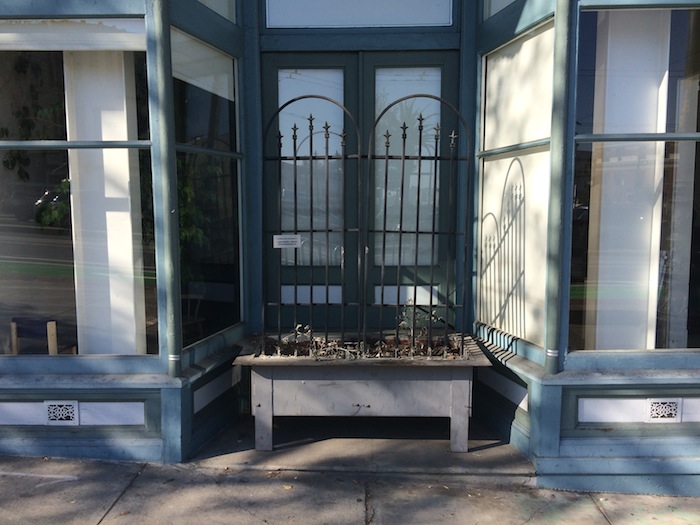 The San Francisco LGBT Community Center in the Castro
I’ve lived in San Francisco—a city that loves to portray itself as exceptionally homeless-friendly—for close to twenty years and can attest to not only the existence of these crude measures dating to the mid-1990s, but have seen them become more insidiously interwoven into the legal fabric through other city practices and criminalization policies. Just weeks ago, city officials forced St. Mary’s Cathedral to remove a sprinkler system it had set up to deter overnight campers. Homeless activists speculated that the city pressured the church only to spare itself the negative image of wasting water (California is experiencing its worst recorded drought), not because it has an issue with using sprinklers to deter homeless encampments (in fact, the city has used strategically timed park sprinklers and street cleaners with hoses to deter homeless persons). Nevertheless, the increase in limiting the use of public space by the homeless is what continues to drive them to places like the church. But these policies are not merely acts of enforcement through the treatment of landscape, they are a malicious inscribing of institutional violence onto the very sanctuary of the notion of “public” itself at the immediate cost to society’s most vulnerable.
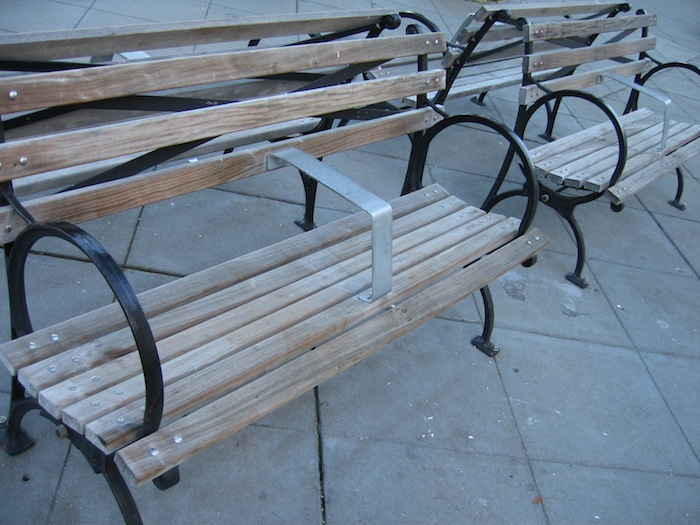
Embarcadero waterfront benches, San Francisco
The trajectory of these urban campaigns to ban the homeless from the city is part of the larger transformation into not only “smart” or “resilient” cities (cities that could potentially, through technology, automate the policing of the homeless and limit their movements), but toward what geographer David Harvey calls the “revanchist city,” and what other scholars like Stephen Graham refer to as the “new military urbanism”—the city that aggressively takes back public space and its commons in order to incorporate it into the globalized, commerce-driven terrain, and the practice of which is both extremely lucrative and part of a long legacy of racism and urban paranoia. For those impoverished communities deemed an offense to globalization’s image of urban life (members of the Occupy movement, poor black communities, immigrants, and the homeless), they are quietly (or not) targeted and removed, or suspended in a cycle of jail and release. So, while city police agencies gorge on inflated budgets, the poor’s credibility is ruined by frivolous citations and criminal records.
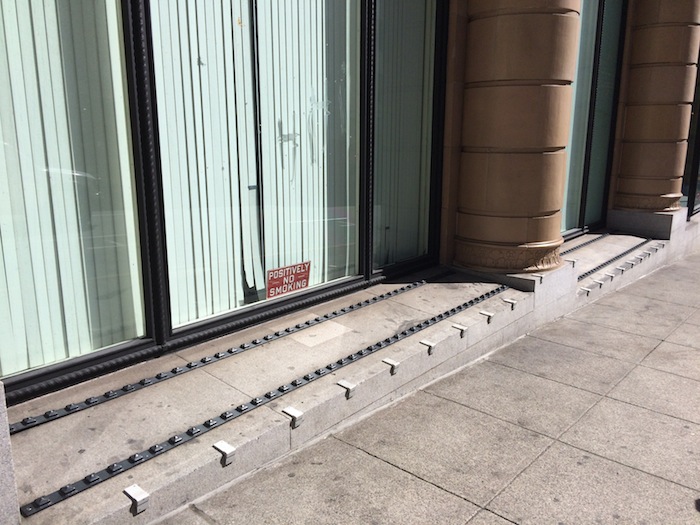
AT&T Building on Bush Street in San Francisco’s financial district
Because of the homeless’ permanent existence in the outer public domain, they are particularly prone to architecture as something that has been designed to be specifically hostile to them, yet camouflaged into the normal fabric as permanent barriers. The post-9/11 makeover of the urban environment only served to justify the intensification of this process under a new name. For the homeless populations struggling to survive in the neoliberal city, urban design translates into an infinitely inhospitable surface; a brutal run-away edge that they can neither penetrate nor separate themselves from.

A/X Armani Exchange, near San Francisco’s Union Square shopping district
While the conditions of homelessness are the result of many complex and largely misunderstood—and misrepresented—sociocultural underpinnings, they partially thrive within the inhumane trappings of the built environment’s architectural surfaces themselves. For those who are pushed towards the outside, the city is a colossal mega-structure that sustains only their permanent exteriorization. It is a city designed to ensure the near impossibility of their inhabitation. Between the vitriol of those who wish to see the homeless simply disappear and the militancy of advocates devoted to homeless rights and resistance, the policing of homelessness pushes them ever toward the city’s edge. The homeless are essentially being made into anti-monumental ghosts—ghosts of an architectural surface that makes them disappear.