


April 24, 2026
Art Basel Hong Kong featured an AI and digital art exhibit
The artists and their work tell a story about the ways technology is changing — or not changing — how art is made and sold
The AI and digital art market is booming. Last year, an autonomous AI artist, Botto, sold its work “Err Hold” at auction for over $333,000 USD. Generative AI in the art market is projected to grow from $0.88 billion to $3.56 billion in 2030, or 42% each year, according to a report from The Business Research Company.
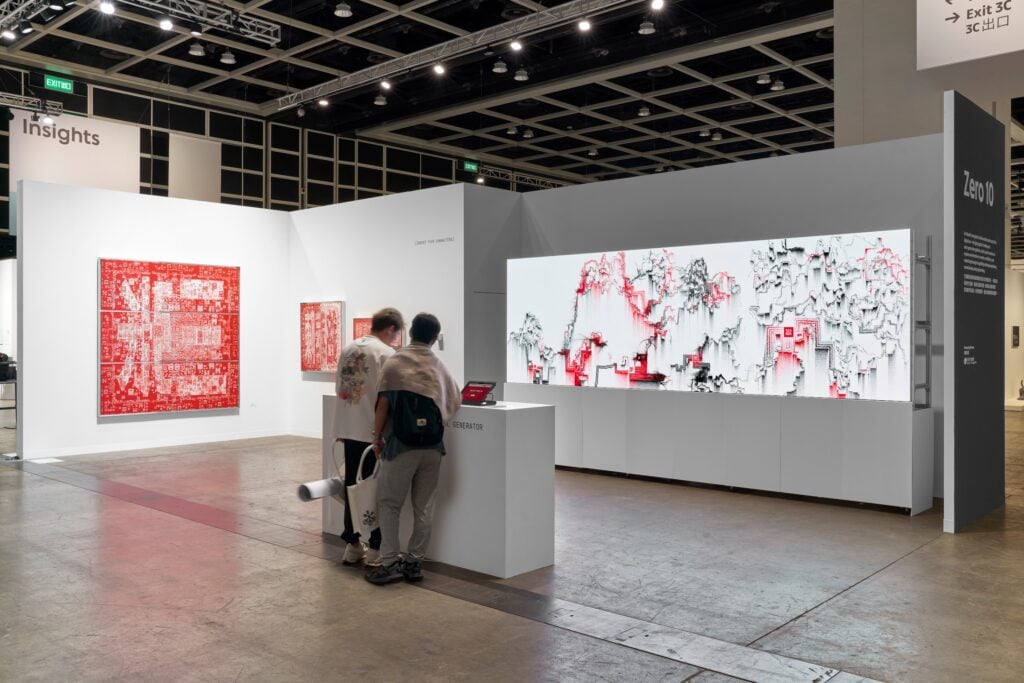
At Art Basel Hong Kong, artists from 14 exhibitors showcased their work at Zero 10, a new AI and digital art exhibit that was a hit at the Miami fair last year. The Hong Kong event drew over 90,000 international attendees and showcased art from 240 galleries representing over 40 countries.
After the fair, Japanese artist Emi Kusano said in a LinkedIn post following the event, “This was…the first time I felt digital art was so genuinely welcomed at an art fair.”
Despite the focus on digital and AI art, the artists and their work tell a nuanced story about the ways technology is changing — or not changing — how art is made and sold. While some see AI as a collaborator that expands artistic potential, others feel that it would interfere with the soul of the work, or liken it to an annoying intern.
A tech focus
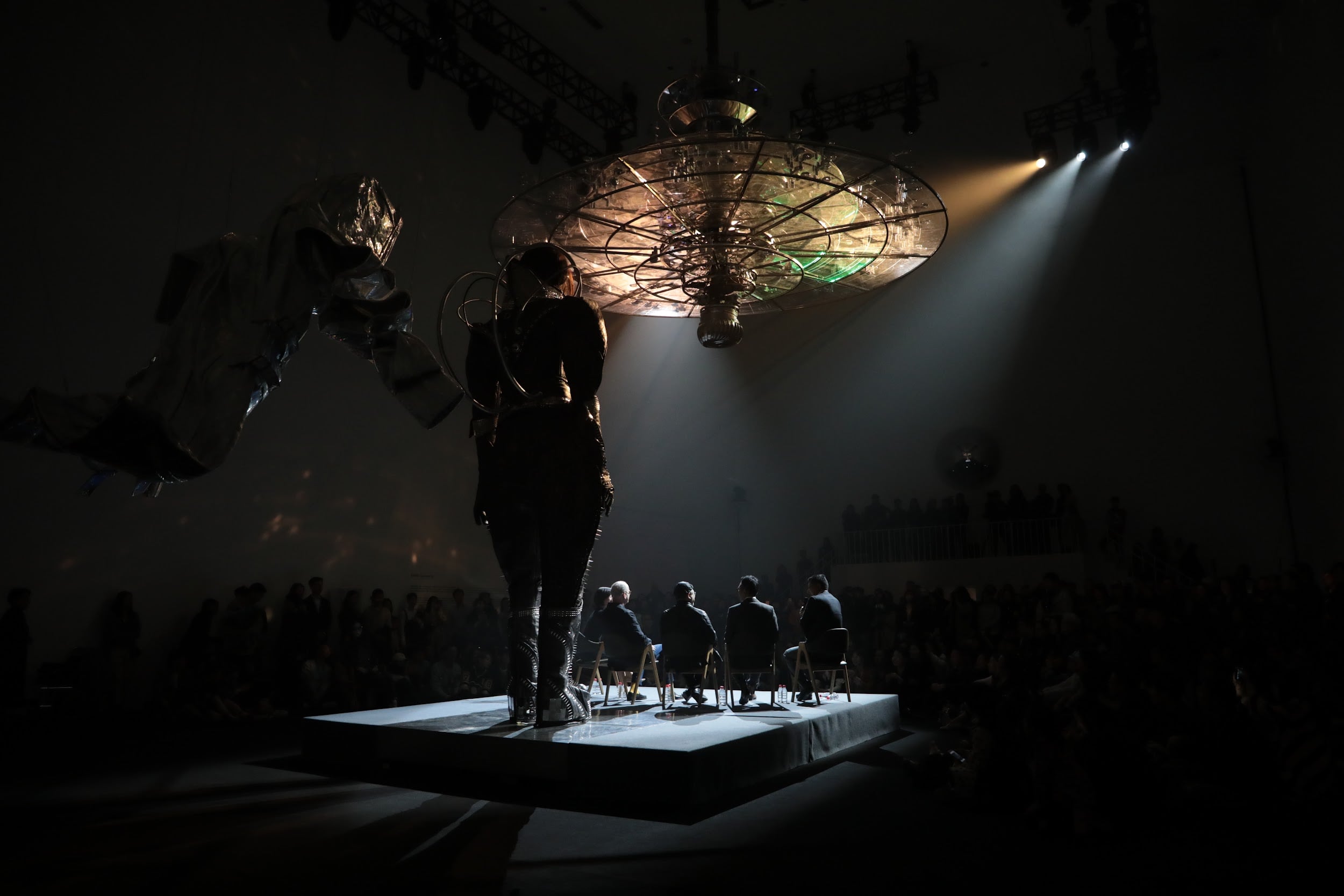
Miami’s Zero 10 piked the heads of artists and billionaire tech moguls such as Elon Musk and Mark Zuckerberg onto robot dogs (which sold out the first day for $100,000 per canine pair), but Hong Kong’s standout was 15-foot “Lili,” a giraffe-sized dystopian female mannequin donning futuristic glasses, a green gemstone and armor.
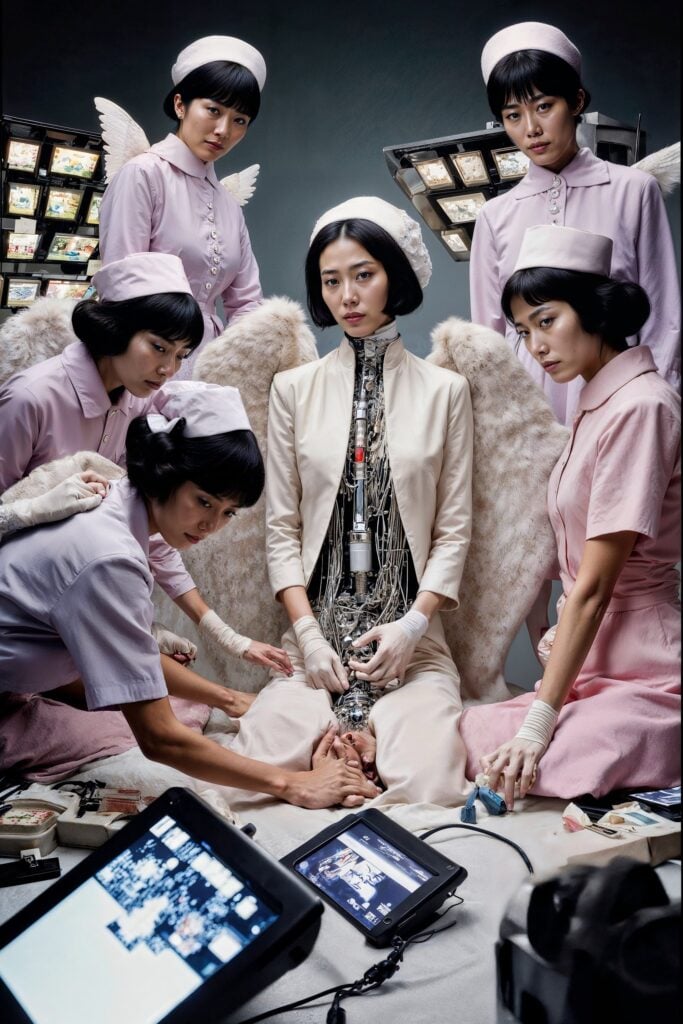
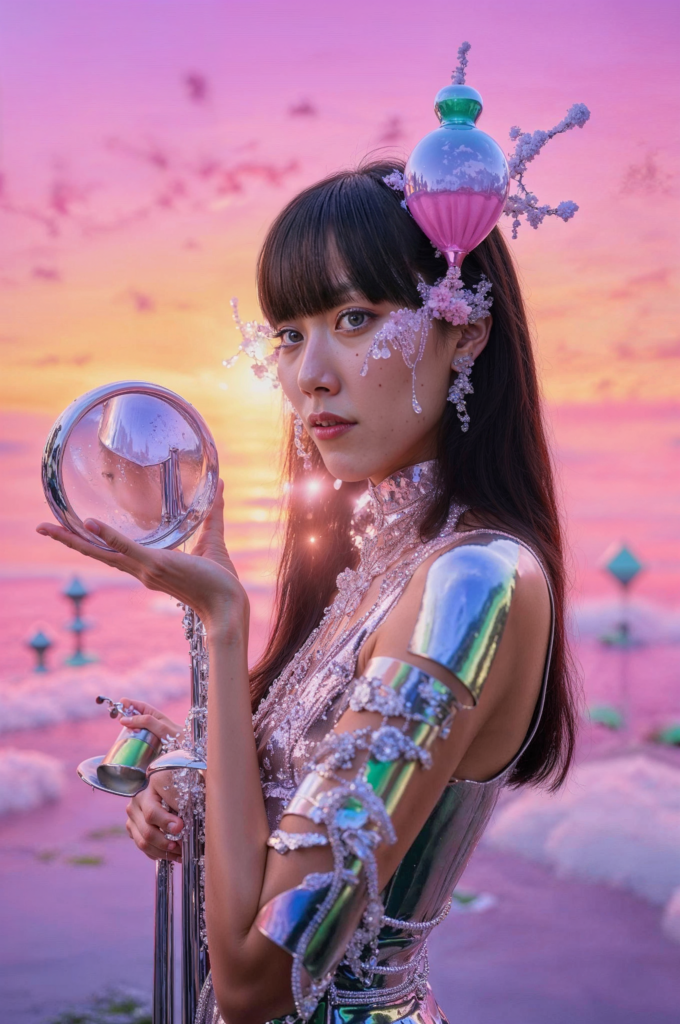
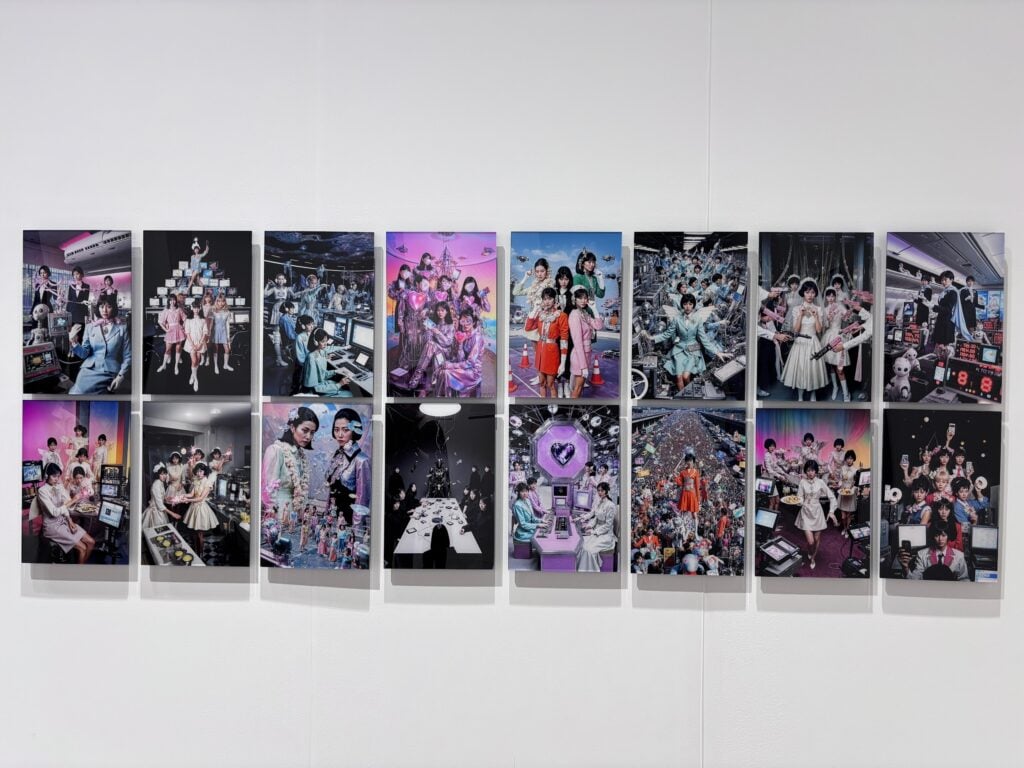
Kusano showcased her sculpture, video and photo collection “Ornament Survival” in which she used AI to create multiples of herself as a variety of characters. In the video, six of Kusano in colorful blazers and headsets multiply into an army of fashioned blondes, and then morph again into dozens of waitresses in orange dresses hustling trays of food.
Artist Sougwen Chung, named one of the 100 most influential people in AI by TIME in 2023, performed a live demonstration, completing their painting on a 10-meter calligraphic scroll. Chung is assisted by a flanking motion-driven robotic system trained on decades of Chung’s gesture data and a responsive biosensor input worn on Chung’s temple during painting.
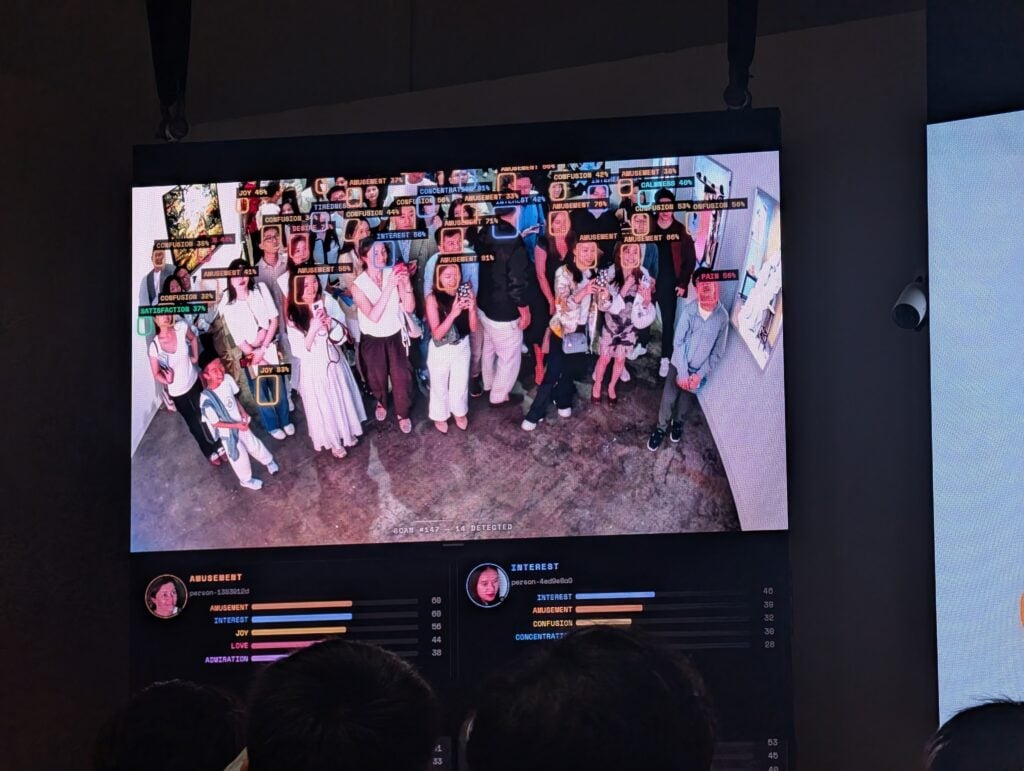
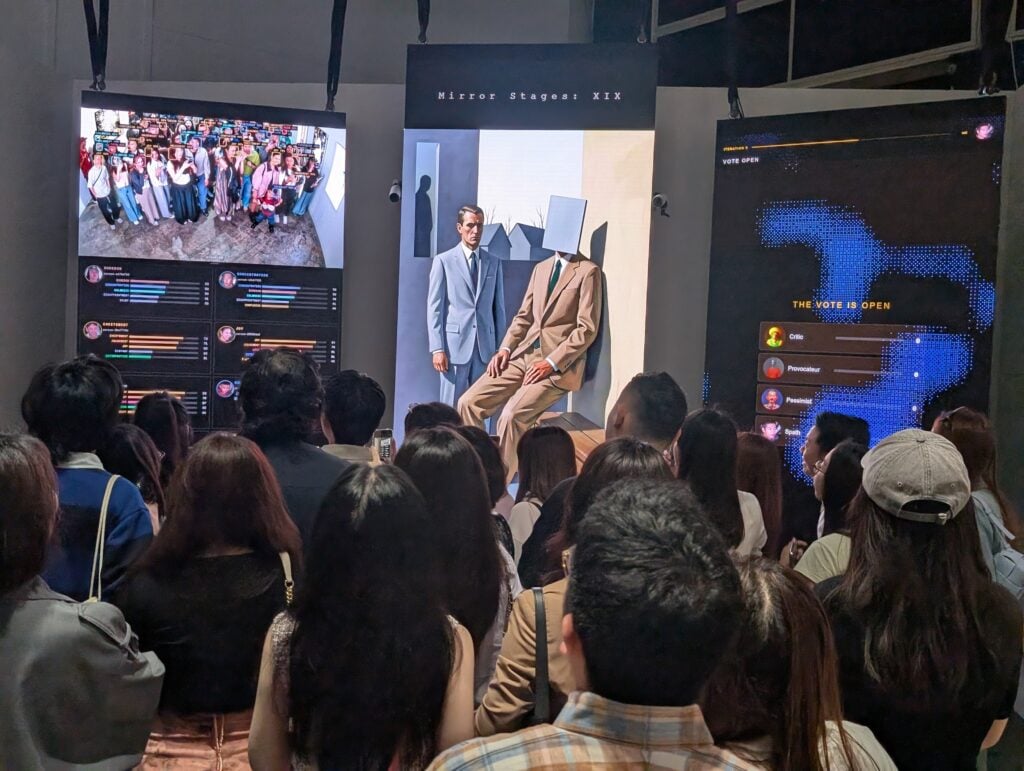
Botto was also on display in a special installation, performing in real time scanning the audience through a camera and using attendees’ emotional responses and gestures to create fictional characters to inform the art it was creating, co-lead of Botto Simon Hudson said. This was the first time Botto used data from a live audience in its creative pipeline, where Botto’s art is typically guided by votes and comments from an online community.
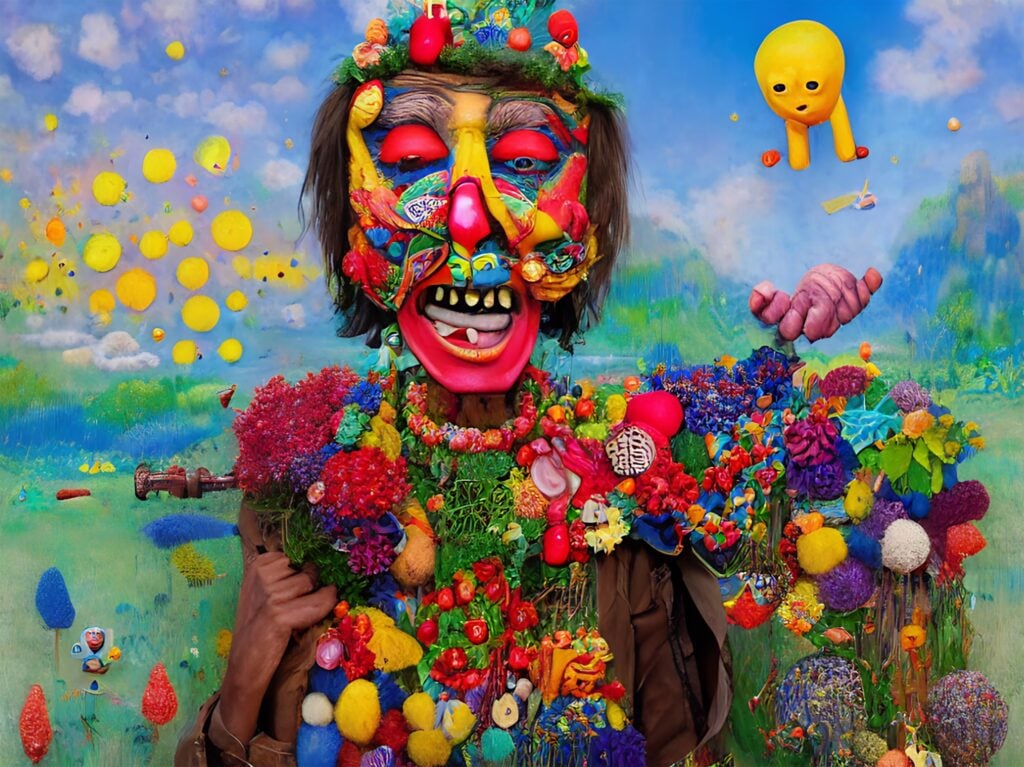
Botto, dreamed up in 2021 by longtime AI artist Mario Klingemann and developed by a software collective called Eleven Yellow, is guided by a Decentralized Autonomous Organization (DAO) called BottoDAO, a plutocratic community of members who vote to decide which pieces will be minted as NFTs. Botto operates its own economy. Fifty percent of auction proceeds fund its servers and development. The other 50% return to the voters, who can buy voting power.
AI controversy
Some artists embraced incorporating AI in their digital work while others explicitly excluded it.
Emi Kusano, who spent three months producing her “Ornament Survival” collection, compares AI to a “co-worker” that sometimes provides “surprising” results. She asserts that “the human has to have an intention” to make the tool meaningful.
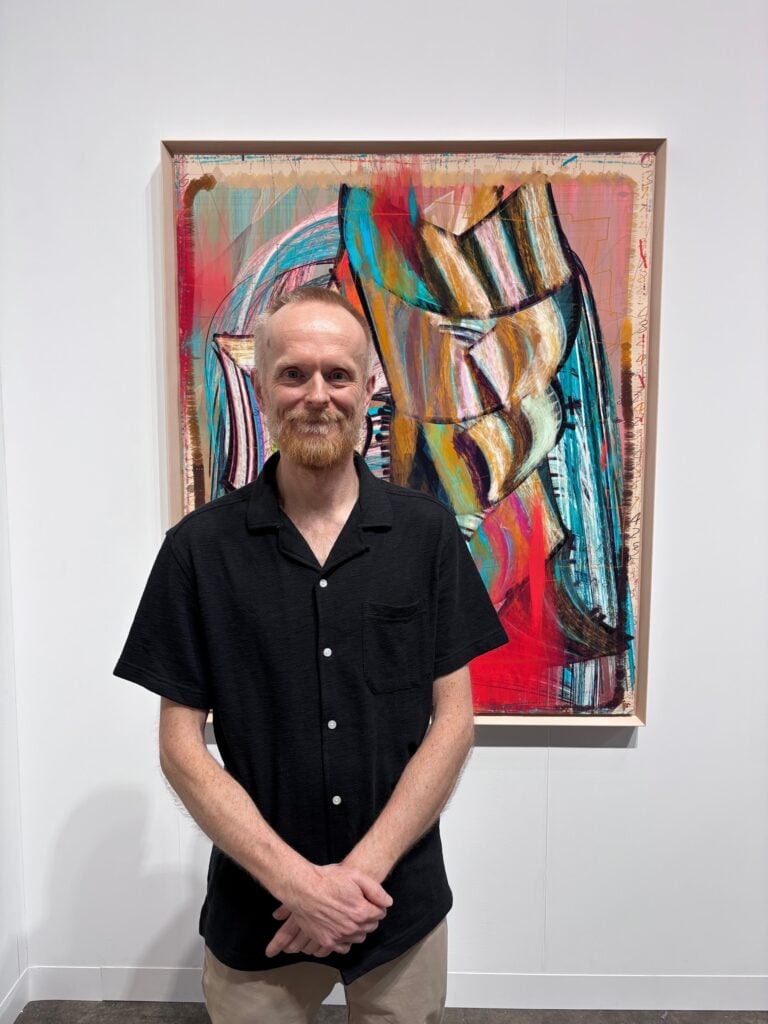
Fair attendee Serena Chan contends that critics often wrongly assume AI requires no effort when, in reality, success depends on the artist’s “intuition, thought process and ability to ask the right questions.”
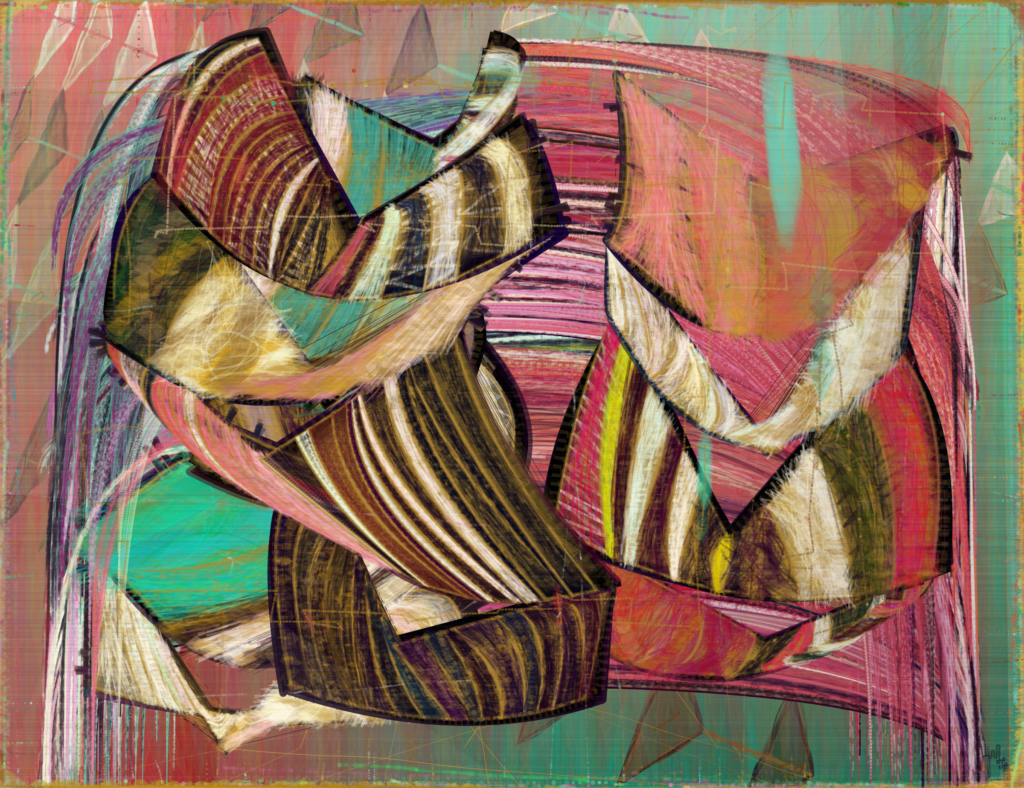
Conversely, digital artist Harvey Rayner explicitly avoids AI, describing it similarly as “having an annoying, sort of average intern in my studio.” Rayner instead utilizes JavaScript to maintain “precise control” over his art, hand-tweaking over 1,000 distinct parameters, such as line thickness and curvature. Rayner, from Art Blocks gallery, says his work is a “direct craft” rather than a machine-led output from a “black box.”
Kevin Abosch is a pioneer of the synthetic photography genre. In a statement, Abosch said he interrogates through his work “why we value the biological over the synthetic, and where the threshold of ‘truth’ lies when the machine can mirror the complexities of the natural world so faithfully.”
Some images in “Testing Ground” are based on terrains altered by human activity, such as coal mining sites, power plants, water reservoirs and agricultural lands.
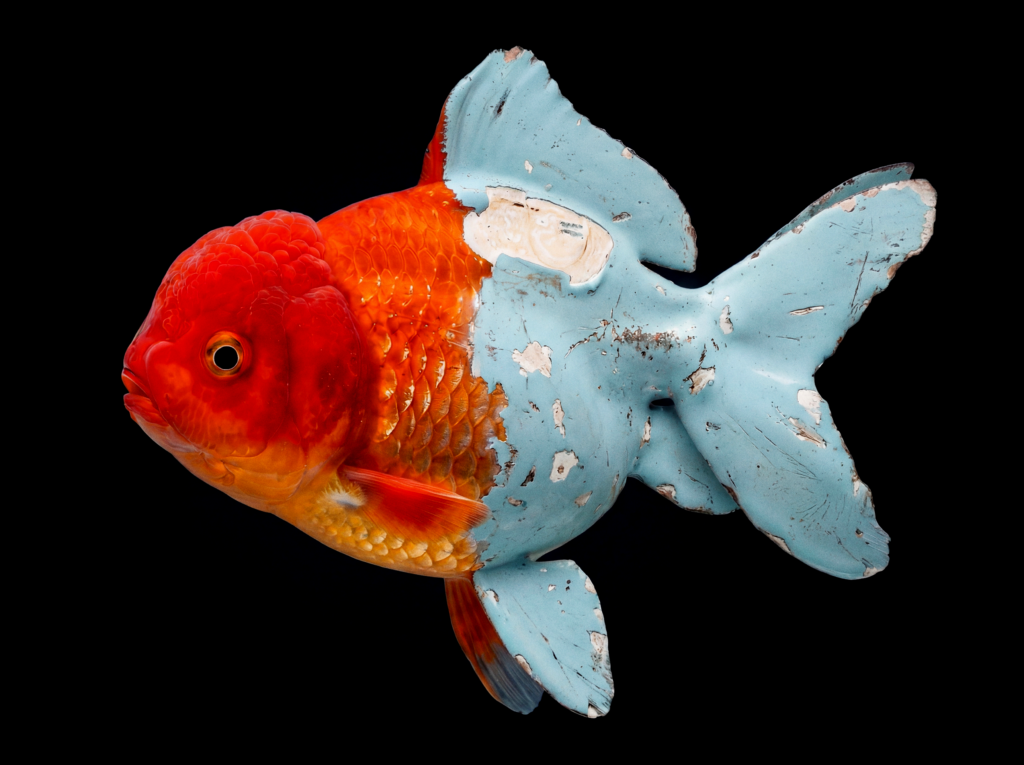
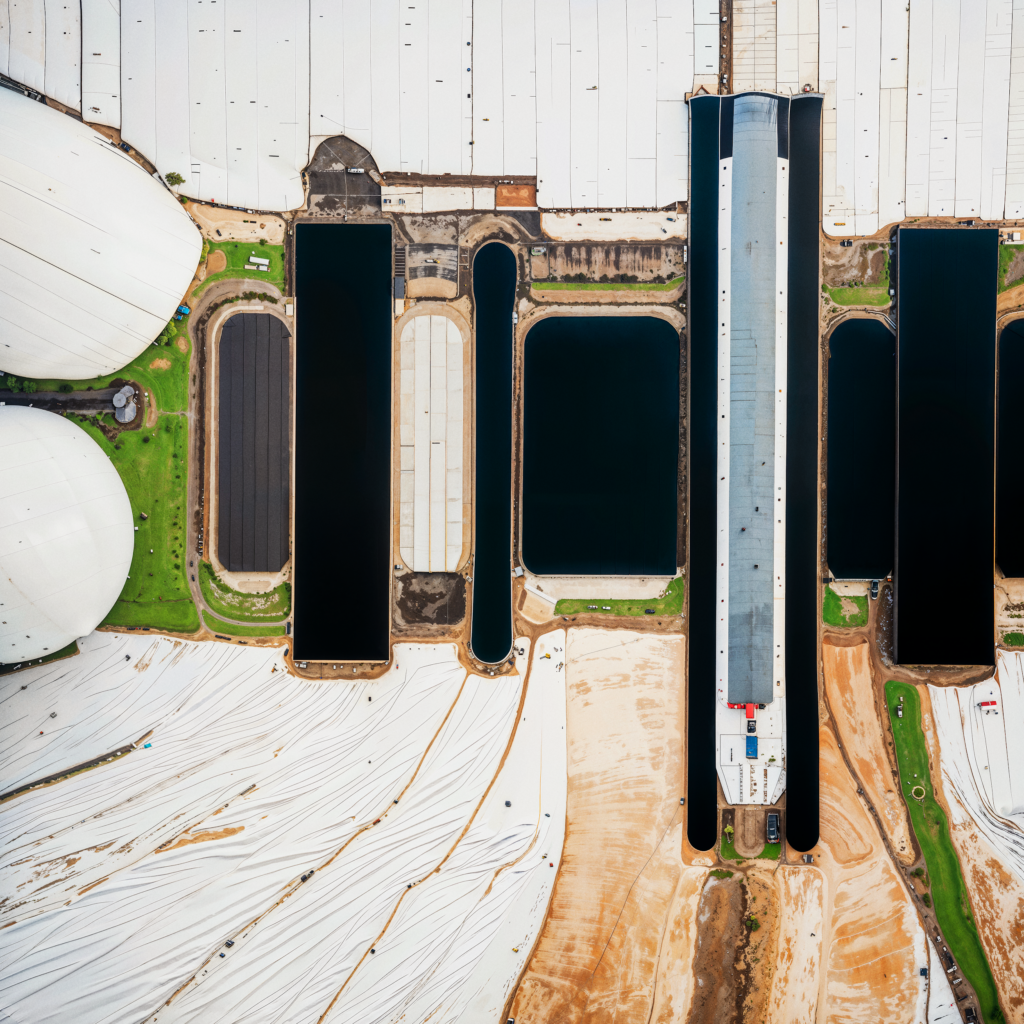
Abosch feeds his own photographs into AI deep-learning algorithms he developed. The system extracts morphological and visual data. With this data, Abosch said, “I work back and forth with the machine until I feel the work is finished. My process is more akin to sculpting.”
Kusano and artist Robert Alice both suggested that controversy about digital and AI art is a natural part of art history. Alice noted that photography was “basically hated by the art world for like 80 years” before its acceptance. So if there is resistance to a new medium such as blockchains, “and lots of people say that’s weird, that’s actually a good sign” to be part of that movement.
Defining value
Some artists argue that the value of digital art lies in the artistic intent, effort and time invested.
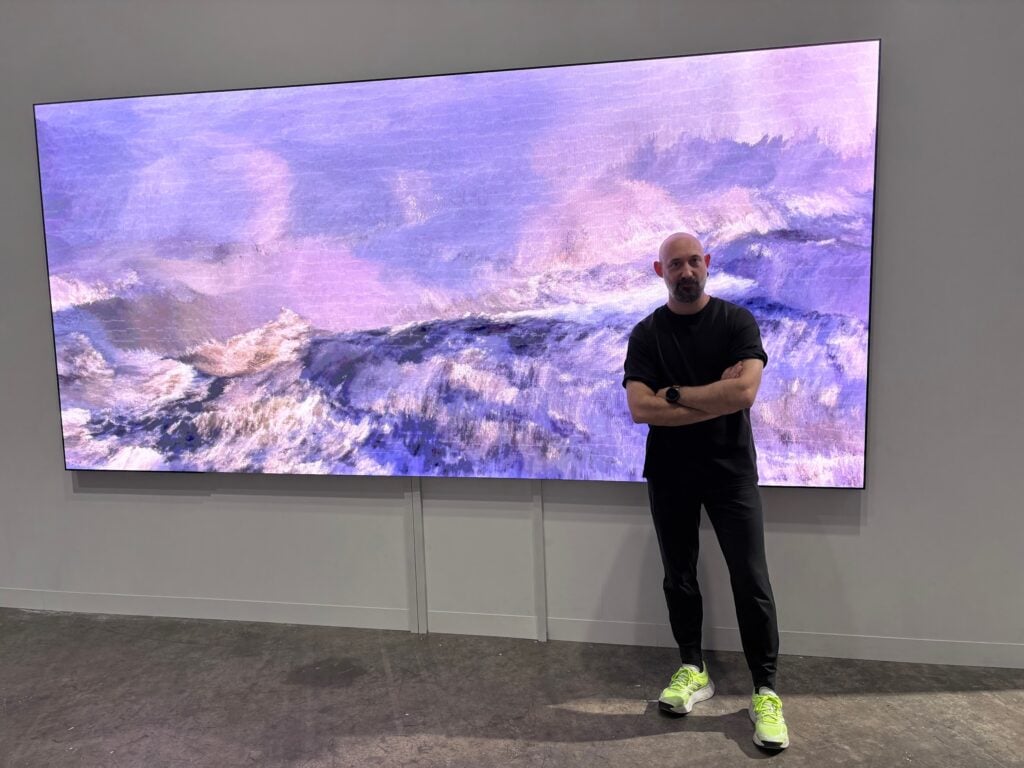
Italian artist Quayola, who won the second annual Digital Art Award for Innovation, exhibited his “Storms” series, an homage to the violent seascapes of the late-19th-century British painter J.M.W. Turner which required months of chasing actual tempests off the coast of Cornwall. Using high-frame-rate cameras, he captured slow-motion video data of real waves crashing. He fed the data into custom software to “control, calibrate and guide” pictorial simulations. The result is a hybrid of observation and algorithm which Quayola sees as a “continuation of the tradition of landscape painting through a new language.”
Why go to such lengths when an AI model could generate a convincing storm in five minutes? Quayola said, “I’m not so fascinated about just searching for an image from a model that someone has developed on the other side of the world.” Meaning, for him, depends on “how personal you make something.”
Like playing guitar, you could program a perfect solo, but the joy and the humanity for both the artist and the viewer is in the gesture, Quayola said. Although he uses technology, Quayola says, there’s a “human gesture” in his process, which is what’s important.
Multiple artists emphasized that the physical manifestation of the work, whether through high-resolution screens or bespoke frames, is essential to the viewer’s experience similar to contemplating a large painting in a gallery rather than viewing a file on a phone. “The way it is presented physically, the kind of orchestration of this experience brings you to a different place,” Quayola said. “It’s a physical experience.”
Tech has revolutionized more than just process for many artists. It’s also rapidly changing the way art is bought and sold.
Blockchain technology allowed artists to mint and sell their work. “It changed my life,” Harvey Rayner said. “I wasn’t selling anything prior to NFTs. Now I have a big collector base.”
For South Korean artist DeeKay Kwon, the ability to sell digital animations as fine art was “legitimately life-changing,” allowing him to transition from commercial animation for companies like Google to being a full-time artist, Director of AOTM gallery Aniko Berman said.
Robert Alice made history in 2020 when he sold the first NFT at a major auction house at Christie’s New York. Alice spent months hand-painting 12.3 million digits of Bitcoin’s original code across 40 paintings, each canvas a hybrid object: physical art connected to an NFT. His collection “SEAL” at the fair is physical canvases hand-painted with traditional Chinese seals — an ancient method of ownership and authentication. There was also a participatory component where fair attendees could add their own seals to a digital scroll.
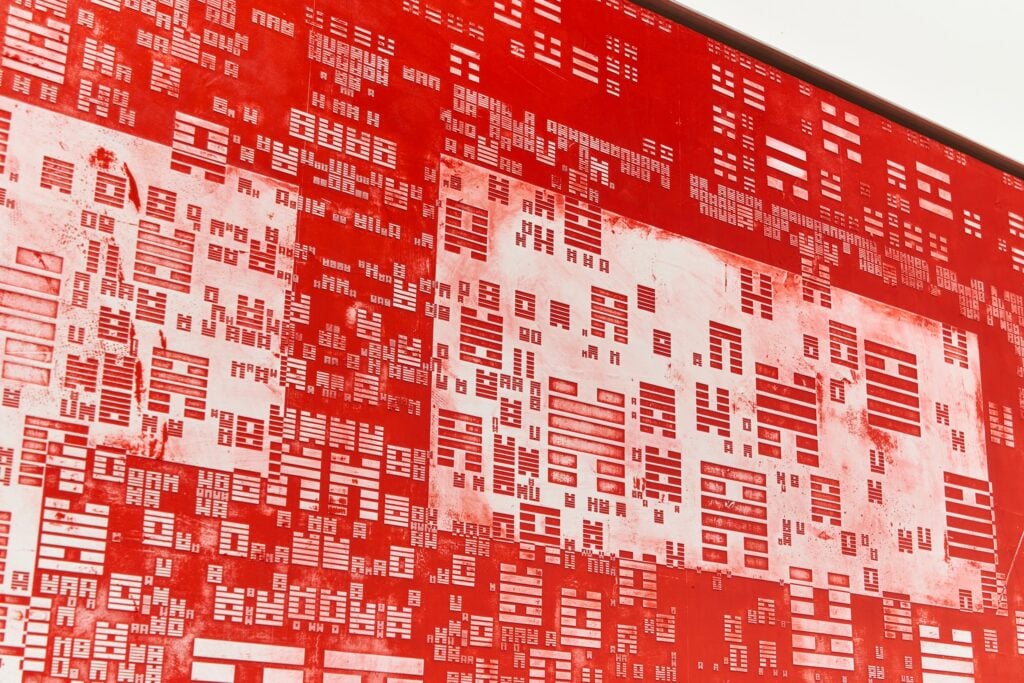
In a world of “unlimited synthetic imagery,” Alice argues that the “tactile quality” and “sense of human time” found in physical craft will become ever more precious. Despite the growth of digital imagery, painting isn’t dead, Alice says. Drawing from a deeper historical line, Alice notes that for 2,000 years in the East, collectors added their own seals to the front of artworks, turning paintings into “living artworks.” In the West, by contrast, “only the artist is permitted to sign…no one else is allowed to touch the front.” Alice sees Chinese seals as “a precursor to blockchains,” or distributed ledgers of provenance long before the digital age.
“The Renaissance was basically created because people figured out how to create three-dimensional perspective on a flat plane in the 15th century,” Alice said. “You saw an explosion of culture because of that technological disruption.” Today, blockchain and AI are our own perspectival shift. Quayola sums it up: “This is a celebration of us humans, this gesture.”
Observed
View all
Observed
Share on Social


By Kajsa Kedefors
 Kajsa Kedefors is a digital, print and audio freelance journalist reporting on international news, culture, power and AI. Her work has appeared in The Boston Globe, The Dallas Morning News, GBH, 48 Hills and The Design Observer. She is a graduate of Boston University.
Related Posts
The Observatory Newsletter
Ellen McGirt
Who gets to decide where power begins and ends?
The Observatory Newsletter
Rachel Paese
You need an observation practice
Draw the Line
Audio
BONUS: Live from Essence Fest – The Work Gets Personal
Draw the Line
Audio
BONUS: Live from Essence Fest – The Accounting
Subscribe to The Observatory
Related Posts
The Observatory Newsletter
Ellen McGirt
Who gets to decide where power begins and ends?
The Observatory Newsletter
Rachel Paese
You need an observation practice
Draw the Line
Audio
BONUS: Live from Essence Fest – The Work Gets Personal
Draw the Line
Audio