


February 9, 2026
Branding the global water crisis
Water.org and Wolff Olins team up on a new campaign announced at Davos
Some important branding news was lost in the political cacophony of this year’s World Economic Forum Annual Meeting in Davos. It’s not surprising it was overlooked: the news aims to help the 2.1 billion people who lack access to safe water and the 3.4 billion who lack access to a safe toilet.
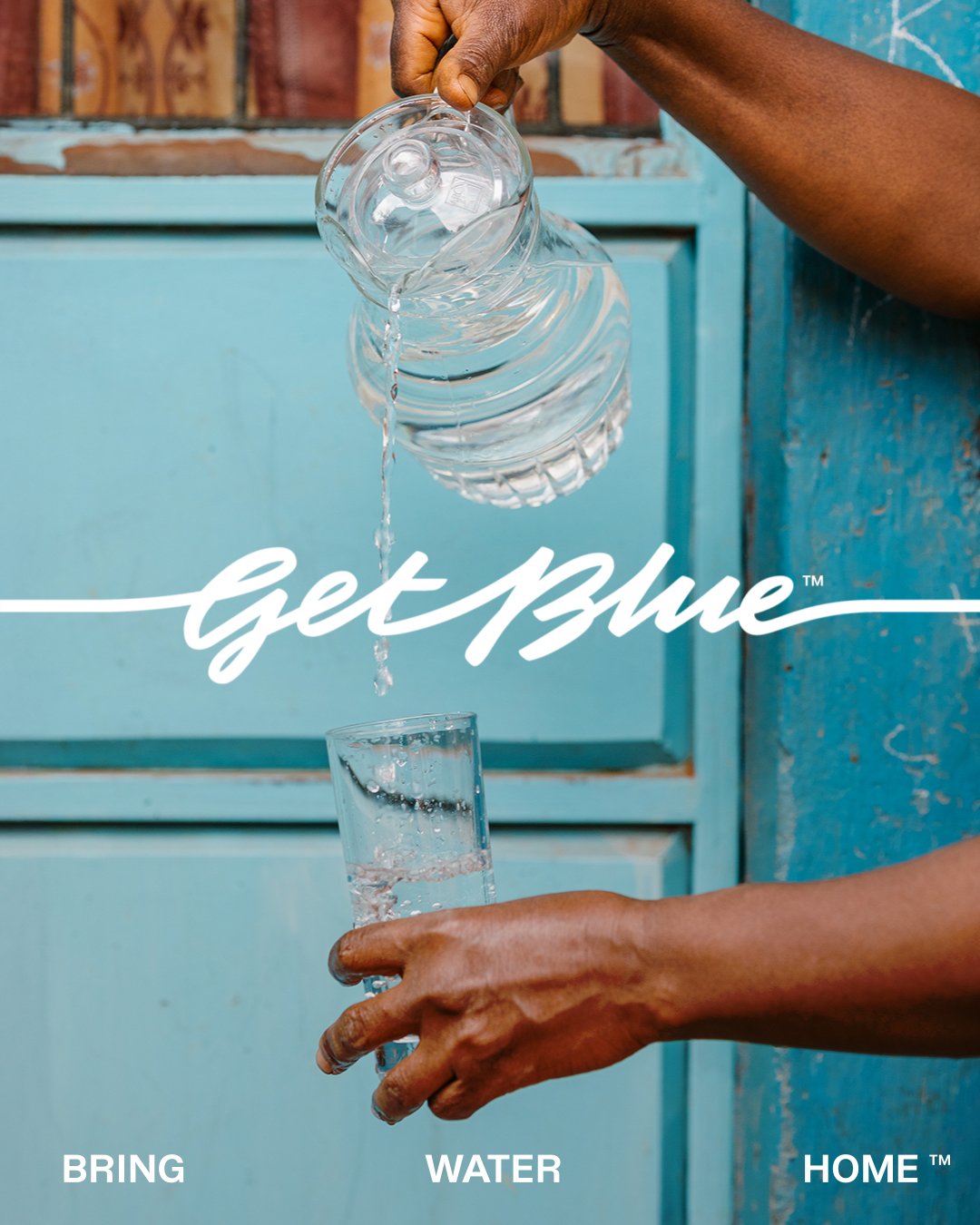
Get Blue is the latest campaign from Water.org, the international nonprofit co-founded by water engineer Gary White and actor Matt Damon. (I’ve profiled them many times; see this piece from 2011.) It’s blue, of course, and beautifully fluid, with a continuous script logo and compelling tag: bring water home.
The campaign launched with partnerships with Amazon, Gap, Ecolab, and Starbucks, who will sell Get Blue branded products to raise funds for Water.org’s market-based solutions. They’re also committing to address their water usage in a number of ways, including within their operations or by mitigating water insecurity in the communities in which they operate. (For more on that, click here.)
“Get Blue gives companies a way to lead on an issue their industries depend on and to help scale solutions that are already reaching millions of people who need them,” White says. “It gives businesses and consumers a direct way to participate in expanding access to safe water for people in need around the world.”
On the subject of awareness, I’ve always found Water.org’s theory of change particularly compelling, but hard for them to explain in a short-attention-span world. It’s harder still to get brands, investors, donors, and voters to understand that the global water and sanitation crisis, while challenging, is solvable.
I’m hoping this campaign, co-created with global consultancy Wolff Olins, will advance the conversation.
But first, some background.
In the mid 2010s, I traveled frequently with the Water.org team, primarily in Haiti. On one trip to India, however, White was able to walk me through specifically how poor people around the world use their meager resources to pay too much for water—often exorbitant rates for pumps and water trucks, or interest of over 125% on badly structured loans from shifty middlemen. “We knew people were getting water somewhere, because they were alive,” White says. “But the cost was often horrific.”
What would it mean if poor people could pay a reasonable rate for clean water and safe sanitation facilities and become customers with rights instead of victims? And who could make that happen?
Water.org’s contribution to the water crisis was to eschew quick-fix solutions — like wells or one-off projects that often failed at alarming rates — and instead offer affordable micro-credit-style loans, underwritten by philanthropic investment. These loans enable people to install the pipes and pumps they need to join infrastructure already in progress by connecting to existing water systems. (I was surprised to learn how frequently impoverished communities are simply excluded from these systems.) The Water Credit Initiative became the standard for a suite of solutions tailored to the complex needs of people living in poverty worldwide, and it also gave philanthropically minded investors and brands a way to leverage their capital for transformational work.
To date, they’ve connected some 85 million people to clean water and safe sanitation around the world.
It’s a good story—but again, a hard one to tell. To that end, Get Blue has a big job: bringing the water and sanitation conversation into the mainstream, and making the Water.org mission familiar, accessible, and attractive.
It’s what branding does.
I asked Scott Cress, Creative Director at Wolff OIins, to talk a bit about the process of developing the Get Blue bran. In many ways, they were the perfect choice. Their recent work includes premium brands like TikTok, Instacart, Uber, The Economist Group, and the iconic RED campaign; in an edgier category, there’s Bite Back, a youth activist movement against unhealthy junk food.
“First, it was important we got the name right. It needed to be active, rallying, feel connected to Water.org and work together with various partner brands, while being simple and represent the immediacy of the solution,” he said, via email. “We were able to leverage Wolff Olin’s experience on (RED) to help inform an approach that is optimistic, direct, and immediate –— buy blue products, bring water home.”
Q: What did you need to really understand about Water.org and its work before you started designing Get Blue?
Cress: While we knew it to be a major issue, fully appreciating the scale of the global water crisis was the first step. It’s hard to fathom that 2.1 billion people – 1 in 4 – are without access to safe water. Next was understanding Water.org’s innovative approach to primarily utilizing micro loans. Finally, understanding the deep relationships between Water.org and the Get Blue founding partner brands was instrumental to us being able to best tap into their pool of resources, insights and connections as we began developing the brand.
Q: How did you approach turning a complex, global issue like water access into something people could quickly grasp and care about?
Cress: In 2026 we continue to be confronted with a barrage of seemingly insurmountable issues and so the biggest challenge to get people involved is really overcoming that feeling of powerlessness. The unlock for our team then was solvability – Water.org’s approach has the potential to actually tackle this crisis in a way that few can. The other part of the equation was showing up in way that felt modern and culturally relevant. . We were able to leverage Wolff Olin’s experience on (RED) to help inform an approach that is optimistic, direct, and immediate – buy blue products, bring water home.
Q: What were the hardest decisions you had to make during the design process, and how did you work through them?
Cress: First, it was important we got the name right. It needed to be active, rallying, feel connected to Water.org and work together with various partner brands, while being simple and represent the immediacy of the solution. The answer was “Get Blue”. The next challenge then became balancing the need to clearly telegraph the cause with our ambition to create a brand that did not fall into the familiar trappings of the category. Getting alignment around the human gesture of the continuous script logo was what brought everything together, supported by the creation of a motion-driven typographic system that suggests flowing water and helps the brand communicate the mission in a fresh way.
Ellen McGirt
Editor-in-Chief
Ellen@designobserver.com
P.S. Did someone who loves you send you this newsletter? Welcome! Subscribe here.
This edition of The Observatory was edited by Rachel Paese.
This is the web version of The Observatory, our (now weekly) dispatch from the editors and contributors at Design Observer. Want it in your inbox? Sign up here. While you’re at it, come say hi on YouTube, Reddit, or Bluesky — and don’t miss the latest gigs on our Job Board.
The big think
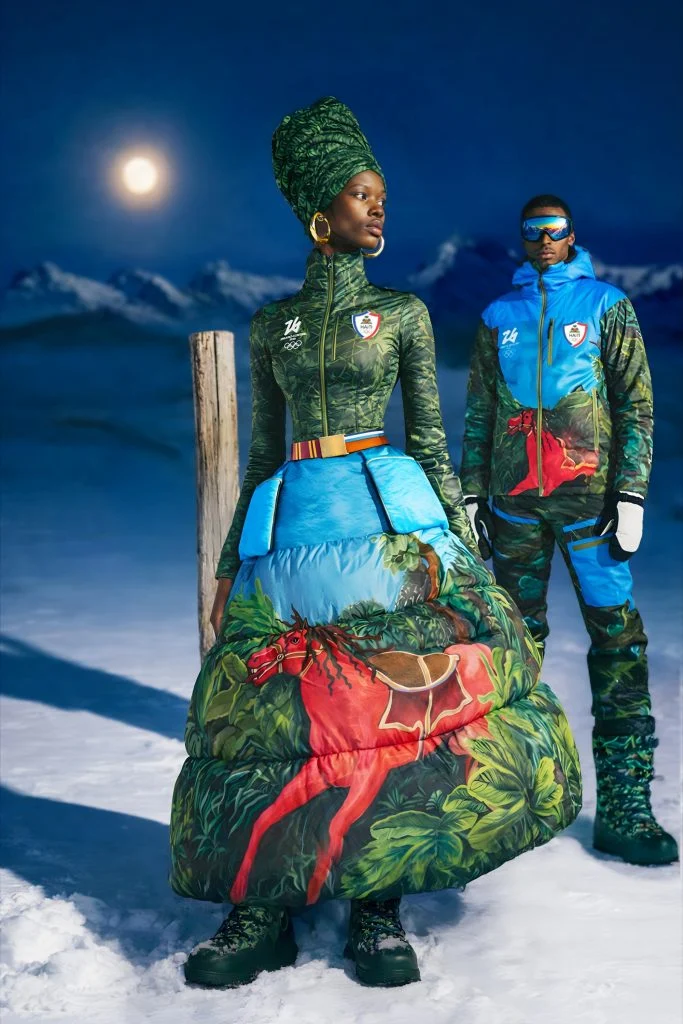
Haiti is fielding two athletes at the Milan Cortina Winter Games, which kicked off last Friday, February 6: Richardson Viano in alpine skiing and Stevenson Savart in cross-country skiing.
But their athletic performance risks being overshadowed by their spectacular uniforms, adorned with symbols of Haitian history and power and designed by the Italian-Haitian designer Stella Jean. “This uniform is the very symbol of the Haitian spirit,” Jean told the Miami Herald.
Jean drew inspiration from a painting by Miami-based Haitian artist Edouard Duval-Carrié, initially depicting Haiti’s revolutionary hero Toussaint Louverture on horseback, charging into battle. There is also a reference to Vodou, in the form of a snake that symbolizes Damballa, the great spirit of wisdom, peace, and purity.
Jean spent a year on the costumes, but was told at the last minute that the image of Louverture on the costumes violated Olympic Committee rules against political imagery at the games. “Two hundred years later?” Duval-Carrié told the Miami Herald. “It’s amazing that Toussaint would represent a political statement.”
Jean herself is known for her political activism — she launched a ten-day hunger strike in 2023 to protest the lack of Black designers in the Italian fashion industry. Her upcoming collection, which will be shown during Milan Fashion Week, will feature the uncensored versions of what she had planned for Team Haiti. (Dazed has a terrific interview with her here.)
For Haiti, competing is political. “Haiti’s presence at the Winter Olympics is a symbol, it is a statement not a coincidence,” Haiti’s ambassador to Italy Gandy Thomas told the Haitian Times. “We may not be a winter country but we are a nation that refuses to be confined by expectation. Absence is the most dangerous form of erasing.”
Podcasts
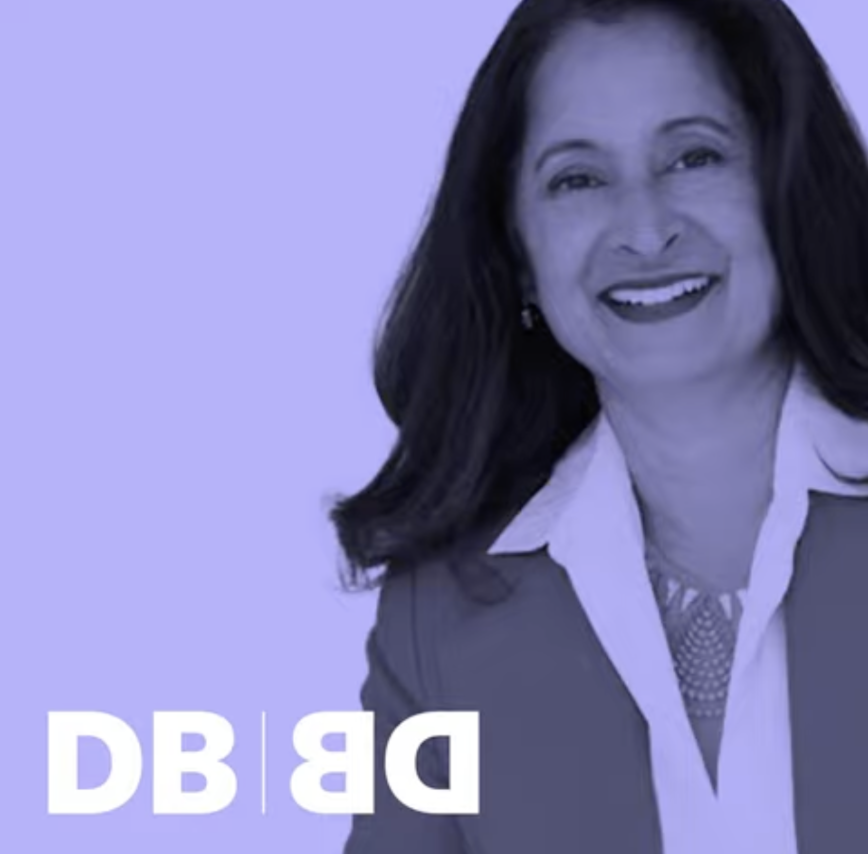
A Mastercard for Pigs? How Digital Infrastructure is Transforming Farming and Fighting Poverty
Mastercard’s Tara Nathan is building a digital bridge for smallholder farmers — connecting them to markets, resources, and opportunity through Community Pass.
Some fine print
Here’s a sampling from the Design Observer editorial and contributor network.

John Thackara|Essays
The Hidden Costs of Tiger Water
We need new ways of thinking about water.

Design Impact
Sanaphay Rattanavong|Design and Climate Change
The prepper’s palette: designing for collapse in a culture of control
From bunkers to backpacks, the visual language of doomsday prepping is designed for social dissolution. But when disaster strikes, it’s not the trappings of rugged individualism that will save us; it’s radical interdependence.

Sarah Fonder|Essays
An Expert Reveals the Secrets of Sustainable Design
Editor’s Note: This post is brought to you by iF Design Award. For more information about the projects and to learn about the awards program, click here. As the effects of climate change become more pronounced, interest in sustainable products has skyrocketed. A growing concern for waste and emissions has inspired consumers to look for … Continued

Architecture
Victoria Solan|Essays
Meet Me Under the Bents
There are now more than 25 so-called “infrastructure parks” in North America, including Canada’s Bentway.

Health + Safety
Observed|Miscellaneous
Celebrate World Toilet Day
2.6 billion people don’t have access to a toilet. For them poop can be poison.
Observed
What are you observing? Tell us.
Vogue loves them some Bad Bunny. “Remember the time he wore a backless Jacquemus suit with a 26-foot floral cape? Or in 2024, when he wore a Margiela design that included a dramatic sculptural chapeau?” A slide show with all his fashion triumphs.
A memorial to Renee Macklin Good in the Minnesota snow. A group of snow sculptors and poets collaborated on a sculpture honoring Good, who was killed by ICE agents on January 7. The sculpture features the face of Macklin Good wearing a blindfold that says “ICE OUT.” Two snow sculptures were disqualified from routine competitions this month because of their anti-ICE themes. “This seemed both a justice to these artists whose work was taken down, and it seems like a justice to honor a poet who didn’t get the chance to have this community include and honor her,” says Ojibwe poet Heid E. Erdrich.
Jeffrey Epstein’s emails, as he saw them in Gmail. This interface was created by artist Riley Walz and developer Luke Igel.
Trump shares a video depicting the Obamas as apes. “The most racist thing I’ve seen out of this White House,” says one guy who is not paying attention.
Canva and ChatGPT together at last. A new integration allows ChatGPT to make logos and other visuals that are consistent with your brand’s identity and editable in Canva. This follows a similar development in Claude’s capabilities.
People with disabilities make up 16% of the world’s population, says Google. (And anyone can become disabled at any time.) What does universal design look like in the age of AI? “With the adaptive capabilities of generative AI, we have an opportunity to better serve 1.3 billion people globally by adopting a “Nothing About Us Without Us” approach to our tech development.”
Michelangelo’s multimillion-dollar foot. A tiny sketch of a human foot, red chalked by the Renaissance master as a study for part of the Sistine Chapel, just sold for $27.2 million, including fees, at a Christie’s sale in New York.
iPhone users brace for a design update. After years of few useful design changes, many found the iPhone 17… wanting. It appears the iPhone 18 offers little in the way of improvement. (Unless the fold is finally here?)
A polymath, an eccentric, a savant, a mid-century prodigy, gets his flowers. “Every once in a while America needs an exhibition about the architect Bruce Goff to remind us of our better, kinder self,” says reviewer Michael Kimmerman.
Job board
Hiring a designer? Post your role on the Design Observer Job Board to reach a highly engaged audience of designers, creative leaders, and studios across the Design Employment Network.
Graphic Designer at Central Park Conservancy, New York, NY
Open Rank, Professional Track Faculty In Markets, Innovation, And Design at Bucknell University, Lewisburg, PA
Senior Exhibit Designer at PG Exhibits, Aurora, CO
Graphic Designer & Illustrator at Luki Lab, Irvine, CA
End marks
Wally Olins, the veteran strategist who cofounded Wolff Olins in 1965, told Debbie Millman in Brand Thinking And Other Noble Pursuits, that “fundamentally, branding is a profound manifestation of the human condition. It’s about belonging: belonging to a tribe, to a religion, to a family.” The symbols, the logos, and the image-making should lead to recognition. “The commercial, anthropological, and sociological branding process that professionals engage in now creates visceral distinctions to evoke immediate responses in people.”
This is the web version of The Observatory, our (now weekly) dispatch from the editors and contributors at Design Observer. Want it in your inbox? Sign up here. While you’re at it, come say hi on YouTube, Reddit, or Bluesky — and don’t miss the latest gigs on our Job Board.
Observed
View all
Observed
Share on Social


By Ellen McGirt
 Ellen McGirt is an author, podcaster, speaker, community builder, and award-winning business journalist. She is the editor-in-chief of Design Observer, a media company that has maintained the same clear vision for more than two decades: to expand the definition of design in service of a better world. Ellen established the inclusive leadership beat at Fortune in 2016 with raceAhead, an award-winning newsletter on race, culture, and business. The Fortune, Time, Money, and Fast Company alumna has published over twenty magazine cover stories throughout her twenty-year career, exploring the people and ideas changing business for good. Ask her about fly fishing if you get the chance.
Related Posts

Business
Audio
S13 E8 DB|BD at Aspen: Eric Ries Would Like to Apologize

Business
Audio
S13 E7 DB|BD at Aspen: Proactivity is the Key to Survival With Edelman’s Dave Fleet AI, aspen business and society program, aspen institute, corporate culture, Delta, economic equity, government, harvard business school, hbs, innovation, leadership, Mastercard, Pfizer

Business
Audio
S13E5 DB|BD at Aspen: Innovation Requires Collaboration with Professor Linda Hill
Business
Audio
S13 E4 DB|BD at Aspen: Dean Erika James Says a Prepared Leader is a Disciplined One
Recent Posts
S13 E8 DB|BD at Aspen: Eric Ries Would Like to Apologize S13 E7 DB|BD at Aspen: Proactivity is the Key to Survival With Edelman’s Dave Fleet AI, aspen business and society program, aspen institute, corporate culture, Delta, economic equity, government, harvard business school, hbs, innovation, leadership, Mastercard, Pfizer S13E5 DB|BD at Aspen: Innovation Requires Collaboration with Professor Linda Hill S13 E4 DB|BD at Aspen: Dean Erika James Says a Prepared Leader is a Disciplined OneSubscribe to The Observatory
Related Posts
Business
Audio
S13 E8 DB|BD at Aspen: Eric Ries Would Like to Apologize
Business
Audio
S13 E7 DB|BD at Aspen: Proactivity is the Key to Survival With Edelman’s Dave Fleet AI, aspen business and society program, aspen institute, corporate culture, Delta, economic equity, government, harvard business school, hbs, innovation, leadership, Mastercard, Pfizer
Business
Audio
S13E5 DB|BD at Aspen: Innovation Requires Collaboration with Professor Linda Hill
Business
Audio