


Baxstar Jonmarie Ferguson|Analysis
September 25, 2025
Dancing with AI: how next-gen game designers are taking the lead
A new generation of visual artists and creators is using artificial intelligence to create art with machines, without sacrificing their humanity in the process.
Step into Jonah King’s queer sci-fi virtual reality game Honey Fungus, and you’re immediately transported to a world that could only exist through the marriage of human imagination and machine learning. Floating through a viscous digital landscape, you encounter creatures that defy biological classification: lush beings that are part human torso, part exotic mushroom, with forms that pulse and contort like alien dancers caught mid-performance.
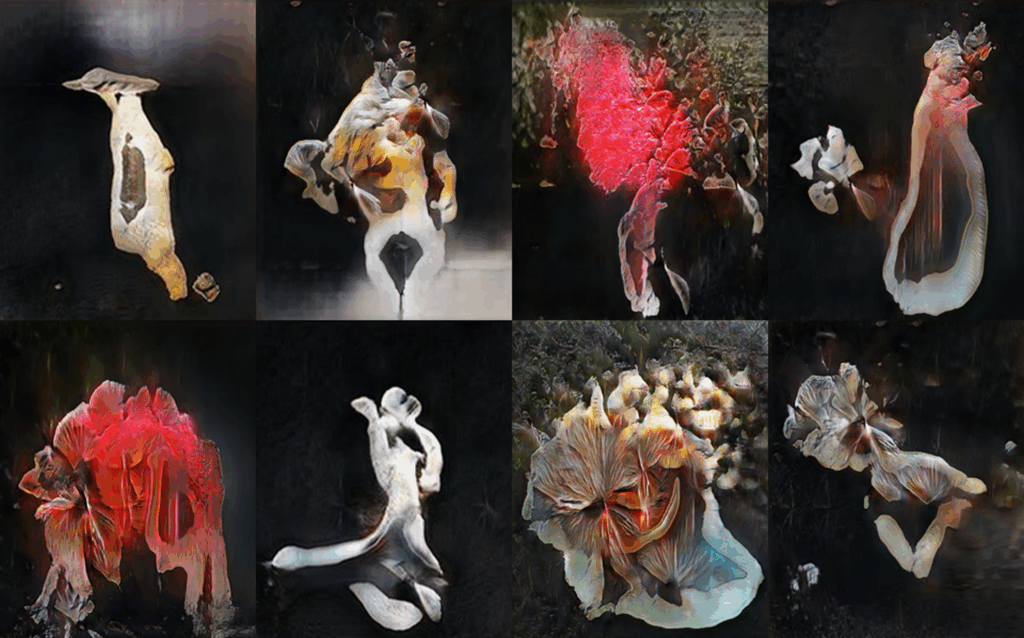
As you move deeper into this mycelial network, luminescent spores whisper to you in verses of poetry generated by AI that’s been trained on an unlikely pairing: Smithsonian botanical research archives and public-domain amateur erotica.
The resulting lines are scientifically precise yet surprisingly sensual. Every creature you meet, every poem you hear, emerges fresh from algorithmically enhanced imagination, meaning the journey you take is yours alone.
As tech companies rush to automate human expression and policymakers scramble to catch up, creators like King are quietly taking a different tack: using AI not to replace human creativity but to enhance their artistic processes and creations. They represent a new wave of creators who prioritize ethical AI use, building consent and transparency into their creative processes from the ground up.
“We can think about the relationship to technology, particularly the relationship to AI, as a kind of a dance,” says King. They drew images for their graphical training data from old picture books and field guides, combining color photos and drawings of fungus in the wild with black and white images of contemporary and traditional dancers, using a simple, local Generative Adversarial Network (GAN) to train for a more realistic appearance in the output.
Without the tech, King and their collaborator Sue Huang’s vision would be limited to static sculptures and predetermined text; with it, their virtual world becomes a living laboratory of endlessly generating, evolving biological fantasies.
Minimizing the potential damage of new tech
Kelsey Falter, CEO and cofounder of Mother Games, is keenly aware of the potential of their chosen technology tool to do harm in the world. Their role-playing game Le Zoo uses personalized data and machine learning to create unique graphics and enable playful self-inquiry in the natural world.
The game uses AI-driven personalization to create a journey of self-discovery unique to each user. Players enter the surreal, low-poly landscape populated by five distinct “houses,” each offering a different lens for reflecting on oneself and the world. An algorithm helps sort each player into one or more houses — Yellow House of Jewels, Red House of Infinity, White House of Mirrors, Green House of Powers, and Blue House of Wisdom — which change as you play based on your decisions, transforming the traditional role-playing game format into something more akin to an interactive personality assessment.
As players move through this game world’s three realms made of AI-generated dreamscapes, on an “undercover mission in a psychedelic zoo,” they’re simultaneously creating a data portrait of their choices and tendencies, information the game reflects back to them as insights about their own behavioral patterns and worldview. This plays out in the characters they meet, the puzzles and challenges they face, and the missions they will go on with friends. There’s even an in-world dating simulator, and an in-game AI non-player character generator called Womb.
To avoid impinging on artists’ consent, the game pulls from a training dataset of images produced by the development team. Using a technique called “kitbashing,” developers created digital building blocks that are snapped together to form geometric landscape pieces. A generative algorithm then uses this base of kitbashed elements to create new blocks, forming an endless array of surrealist terrain in Le Zoo’s distinctive style.
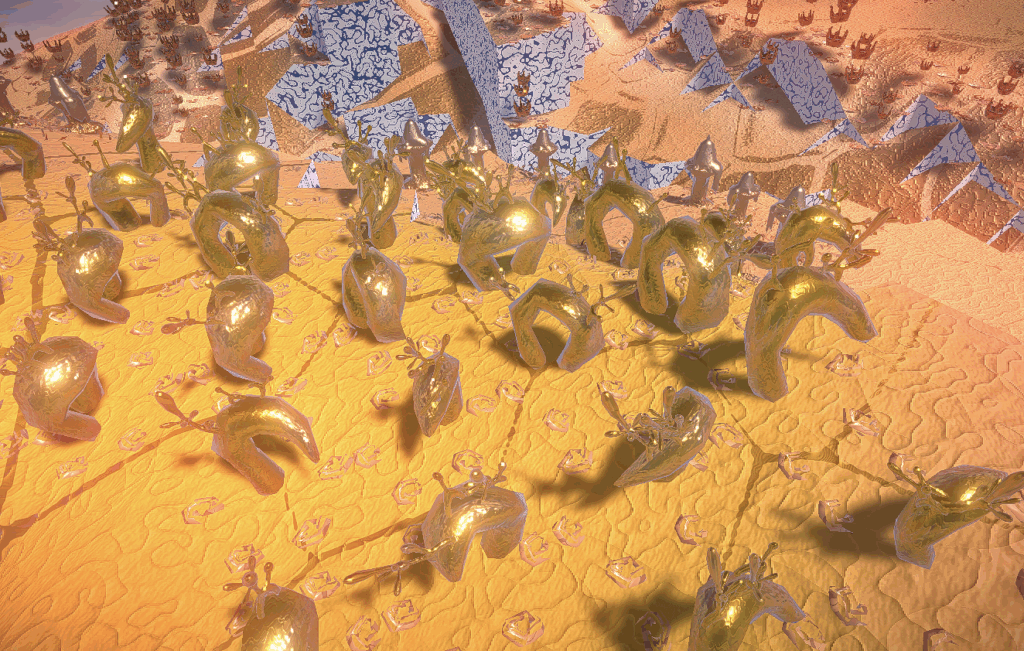
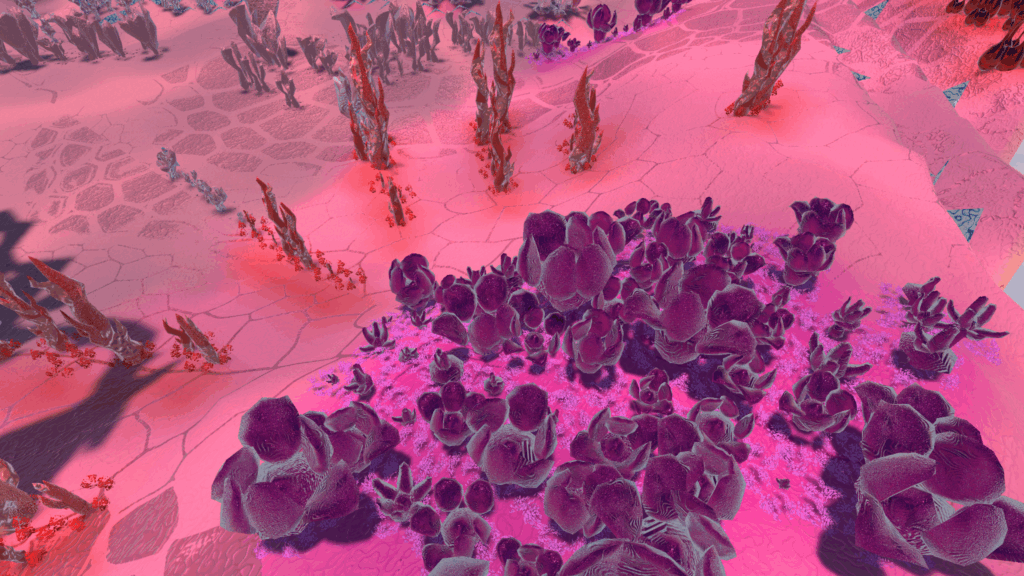
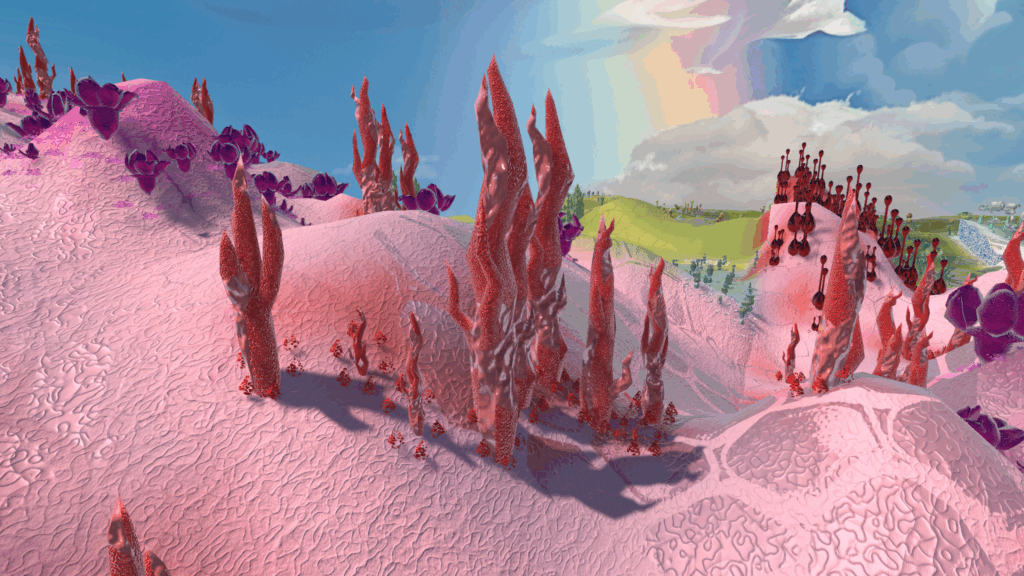
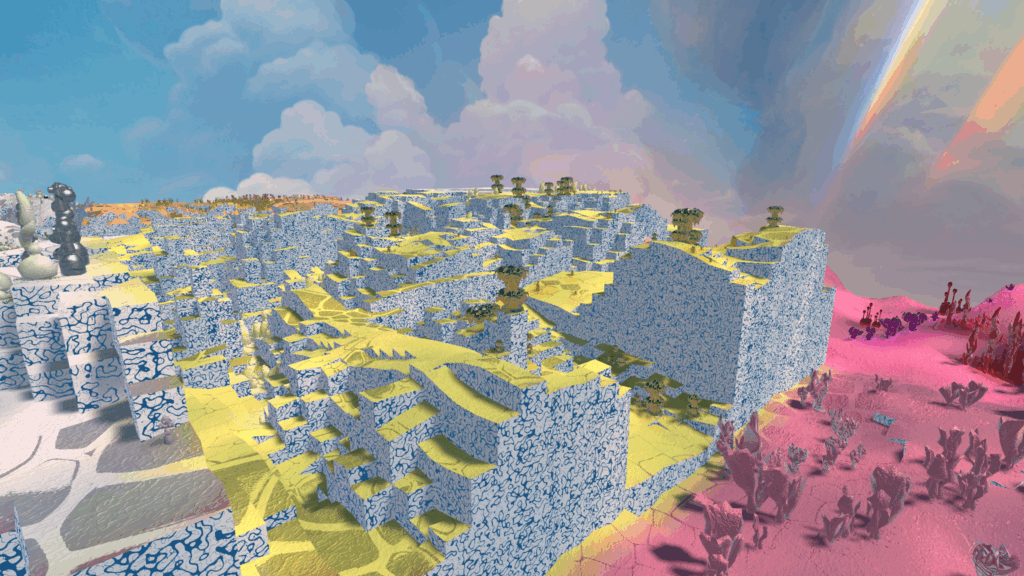
Imagery of the terrain in Le Zoo by MOTHER GAMES. Credit: Kelsey Falter.
Falter compares the current state of AI to the early days of social media, and how, rather than shaping “the algorithm” based on their values, priorities, and needs, users are allowing big tech companies to acquire, own, and leverage data to advertise to them. With the change from the time-oriented social feed to the algorithm, for example, tech giants “took away our ability to connect with each other,” Falter says. Facebook’s algorithms — which were recently revealed to be targeting beauty product ads to teenage girls who had deleted a selfie — are largely hidden to the public.
The same can be said for the weighting systems of AI models that determine what the AI considers most important, how it ranks different possible outputs, what approach it takes to response generation, and which training data influences the final result most heavily. AI companies often frame these systems as “black boxes” to suggest that it’s impossible to know how software like ChatGPT or Midjourney comes to decisions about possible outputs, though critics note that many aspects of that decision-making could be made transparent.
However, rather than adopting widespread security and transparency frameworks for AI companies, governments — particularly in the US — are not only banning regulation but actively working to dismantle what little regulation already exists. While grassroots movements have emerged around artist-led boycotts, data poisoning tactics, and mass-petition campaigns with thousands of signatories, more formal transparency frameworks tend to be controlled by the very corporations they’re meant to regulate — like Microsoft’s FATE (Fairness, Accountability, Transparency, and Ethics) research group.
Looking ahead
Although Falter has real concerns about AI, they also see opportunity. “This is the first time in over 20 years that the fastest growing companies do not have a consumer data moat,” they say, meaning market leaders haven’t yet accumulated such large troves of user data — on, for example, how individuals prompt and interact with genAI chatbots — that competitors can’t catch up or offer alternatives.
“There is an opening right now where we can say, ‘we don’t want to repeat that process of allowing ourselves to give everything over,’” they explain. Users still have time to demand transparency, consent, and control over their data before these systems become too entrenched to readily change, they add, even if many users believe that window is shrinking rapidly.
There are also existing philosophies and frameworks that could inform the development of rules to keep users and their data safe. AI skeptics like Dr. Timnit Gebru, fired from Google’s Ethical AI research team, are advocating for more inclusive development processes free from corporate control, through organizations like DAIR (Distributed AI Research Institute), founded to conduct community-rooted research that challenges big tech’s influence.
Through their work, King and Falter carry on the long tradition of artists calling for social change, using the tools under contest to light a path forward, and inviting others to join in advocating for transparency, consent, and control.
Observed
View all
Observed
Share on Social


By Baxstar Jonmarie Ferguson
 Baxstar Jonmarie Ferguson (he/they) is a gender/neuro+queer Canadian multi-creative based in southern Mexico, with more than a decade of experience in LGBTQ+ storytelling on art, health, science, and tech. They are the founder of Well Beings News, a queer trans health and wellness newsletter for practitioners, providers, and professionals. Their writing has appeared in TIME, Esquire, Yahoo! Canada, Playboy, Lonely Planet, Xtra Magazine and more. When not reporting on the intersections of bodies, identity, and justice, BJ can be found exploring the cultural and ecological richness of Oaxaca, organizing and attending local queer trans community events, reading tarot and oracle, watching horror movies with his husband, and cuddling with his two cats. See more of his work at bjthehetheygay.ca.
Related Posts
AI Observer
Dave Snyder|Analysis
The identity industrialists
AI Observer
David Z. Morris|Analysis
“Suddenly everyone’s life got a lot more similar”: AI isn’t just imitating creativity, it’s homogenizing thinking

AI Observer
Stephen Mackintosh|Analysis
Synthetic ‘Vtubers’ rock Twitch: three gaming creators on what it means to livestream in the age of genAI

AI Observer
Raphael Tsavkko Garcia|Analysis
AI actress Tilly Norwood ignites Hollywood debate on automation vs. authenticity
Subscribe to The Observatory
Related Posts
AI Observer
Dave Snyder|Analysis
The identity industrialists
AI Observer
David Z. Morris|Analysis
“Suddenly everyone’s life got a lot more similar”: AI isn’t just imitating creativity, it’s homogenizing thinking
AI Observer
Stephen Mackintosh|Analysis
Synthetic ‘Vtubers’ rock Twitch: three gaming creators on what it means to livestream in the age of genAI
AI Observer
Raphael Tsavkko Garcia|Analysis