


December 16, 2014
What’s Wrong With This Picture?
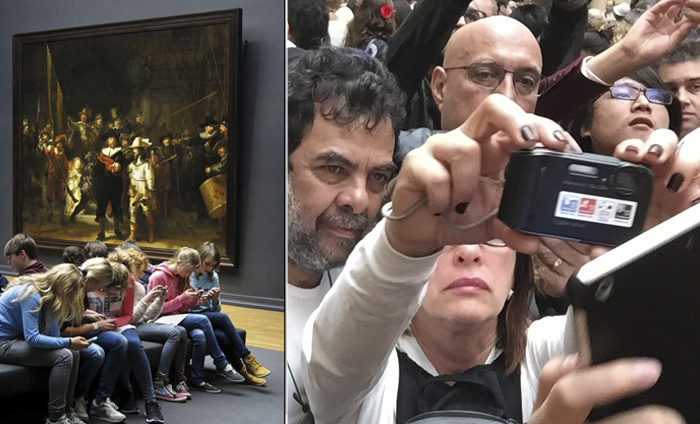
Left: Assembled school children in the Rijksmuseum, Amsterdam. Right: Assembled adults in the Louvre, Paris (Photography: Bonnie SIegler)
On the left, young visitors to Amsterdam’s Rijksmuseum sit with their backs to Rembrandt’s Night Watch, arguably his most famous painting, which was completed in 1642. Staring into their smartphones, they could be anywhere: at home, at school, on the subway, asleep.
This picture has been making the rounds online, evidence of an increasingly recognizable and yes, all-too-common behavior. (One person proposed the comical, if unlikely possibility that these kids were focusing on the painting’s QR code.) What does 1642 mean in 2014 and how are they supposed to relate to it?
The photo on the right shows a feeding frenzy of a different sort: tourists not looking but instead, feverishly snapping pictures of the Mona Lisa, Leonardo da Vinci’s 16th-century masterpiece, on a recent afternoon in Paris at the Louvre. These people are “relating” by taking their own pictures of the most famous picture in the world.
Screens are like crack: addictive, antisocial, relentless in their sly, psychological pull. Tecnological progress is clearly not the same as cultural progress. Which is tragic. And also, true.
Observed
View all
Observed
Share on Social


By Jessica Helfand
 Jessica Helfand is an artist and writer based in New England. A former critic at Yale School of Art and one of the founding editors of Design Observer, she is the author of several books on visual culture including Self Reliance, Design: The Invention of Desire, and Face: A Visual Odyssey. jessicahelfand.com



Subscribe to The Observatory