


June 10, 2026
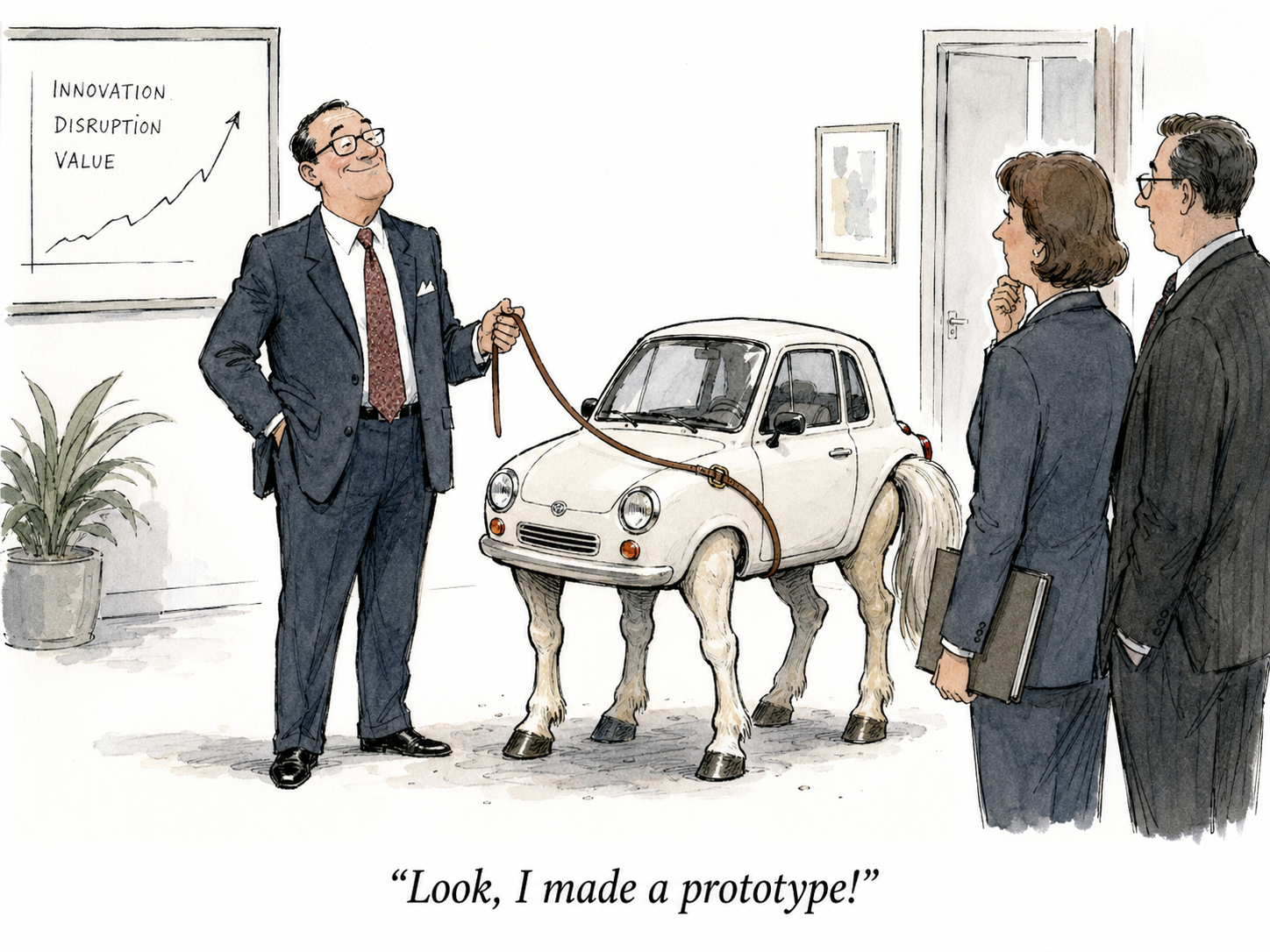
Your boss made a prototype
Good. The process was never the point.
A colleague of mine, a designer with over fifteen years of experience and someone I respect, recently came to me frustrated.
Another senior executive showed up to a meeting with prototypes. Folks whose domain, until five minutes ago, was limited to PowerPoint or Excel. They were bringing AI-created prototypes and ideas to the table and, in his view, undermining the design team’s judgment, process, and role.
I understood the feeling, but I also told him I thought it was a good thing.
Not because craft no longer matters. It does. But because the world changed, and a lot of what designers quietly enjoyed for the last two decades was a monopoly on the artifact.
We were the people who could make the thing look real. That used to buy us time. Status. Distance. Sometimes too much of all three.
Now the artifact is cheap.
I’ve been designing digital products and experiences for nearly thirty years. I lived through the death of Flash. Photoshop gave way to Sketch, now Figma. Bootcamps pumped out role-played expertise. Then came the “designfluencer” era. None of those moments felt especially great to an experienced designer. Most felt like some new group had wandered onto my turf with goofy sneakers and a mediocre point of view.
After enough cycles, you start to notice a pattern: the people who survive every tooling shift are rarely the ones most attached to the old process. They are the ones with the best judgment. The ones who know when an idea is real, when a prototype is lying, and when a team is sprinting toward a very polished dead end.
That’s the job now.
In a world where your boss can make a prototype on a plane ride home, the value of design can no longer rest on being the only people who can visualize an idea. That game is over. Good. It was never our moat anyway.
Our new moat is judgment. Knowing what not to build.
That was true before AI, and it’s even more true now. Because when making things gets dramatically easier, the penalty for bad judgment gets dramatically smaller upfront and much more expensive later.
That’s the danger of AI in the hands of teams with no filter. It doesn’t just make production faster, it makes premature certainty easier. It gives mediocre ideas better wardrobe.
That’s where experienced designers become incredibly valuable.
They are the people in the room who can say, “Yes, that looks real enough to fool everyone for twenty minutes, but it still solves the wrong problem.” Or, “Interesting route, but you’ve optimized the demo, not the product.” Or my personal favorite, “No, that sucks.”
I’m not especially interested in defending design by arguing that non-designers shouldn’t prototype. They will. They already are. The toothpaste is not going back in the tube.
What interests me more is whether designers can stop confusing the artifact with the value. Because the artifact was always the visible residue of the work, not the work itself.
The work is seeing the angle others missed.
The work is sensing when something is premature.
The work is having enough experience to know that just because something can be made quickly does not mean it deserves to exist.
That’s why I’m oddly optimistic.
AI will absolutely cheapen parts of the design process. It already has. But it also creates an opening for real designers to get back to what mattered in the first place: whether the thing should exist, what makes it better, and how to make it matter.
Your boss brought a prototype to the meeting?
Great.
Now the real design work can start.
Observed
View all
Observed
Share on Social


By Dave Snyder
 Dave Snyder is Partner + Chief Design Officer, Siberia. He is an award-winning design executive with over 23 years of experience in developing high-performance in-house and agency teams, focusing on building modern, multi-billion-dollar brands and digital products. His work for brands and companies is wide-ranging, from digital-first, integrated marketing campaigns and content, to immersive interactive experiences in VR and AR, to a long career in e-commerce and digital products, including Twitter, Flexport, and Slice.
He is driven most by discovering new ways for companies to express their purpose—whether it be a new product vision and narrative, a design system, a new feature, or the micro-interaction of a UI element. That passion and dedication to craft have enabled him and his teams to move businesses forward meaningfully, winning some notable awards along the way.
Dave has a small beach house about an hour outside of Brooklyn, where he raises his own oysters, skateboards, and enjoys rebuilding vintage Land Rovers.
Dave Snyder is Partner + Chief Design Officer, Siberia. He is an award-winning design executive with over 23 years of experience in developing high-performance in-house and agency teams, focusing on building modern, multi-billion-dollar brands and digital products. His work for brands and companies is wide-ranging, from digital-first, integrated marketing campaigns and content, to immersive interactive experiences in VR and AR, to a long career in e-commerce and digital products, including Twitter, Flexport, and Slice.
He is driven most by discovering new ways for companies to express their purpose—whether it be a new product vision and narrative, a design system, a new feature, or the micro-interaction of a UI element. That passion and dedication to craft have enabled him and his teams to move businesses forward meaningfully, winning some notable awards along the way.
Dave has a small beach house about an hour outside of Brooklyn, where he raises his own oysters, skateboards, and enjoys rebuilding vintage Land Rovers.
Related Posts

Business
Chris Mele|Commentary
Radical collaboration requires friction
Business
Helder Santo|Commentary
AI will offer you confidence and conviction. Don’t fall for it.

Business
Kate Watts|Commentary
The design-led business advantage: prioritizing the customer experience

Civic Life
Ashleigh Axios|Commentary
Performance review: United States of America
Subscribe to The Observatory
Related Posts
Business
Chris Mele|Commentary
Radical collaboration requires friction
Business
Helder Santo|Commentary
AI will offer you confidence and conviction. Don’t fall for it.
Business
Kate Watts|Commentary
The design-led business advantage: prioritizing the customer experience
Civic Life
Ashleigh Axios|Commentary