


October 12, 2026
You need an observation practice
In more than a dozen interviews, working designers keep pointing to the same idea
In all my Design Juice interviews, curiosity keeps coming up. Of course, it’s not completely surprising, considering curiosity is a designer’s natural inclination.
But these designers have pointed me to (and in some cases, told me outright) the same insight over and over: if you want to pursue truth, meet your client’s needs, have a portfolio that stands out, or meet a current cultural or political moment, you have to turn personal curiosity into an intentional observation practice.
I asked Jennifer Jerde, whose San Francisco-based studio, Elixir Design, has been around for 34 years, if she has an observation practice. “We do,” she said, after pondering for a moment. “I would never refer to it that way. We listen like crazy. We’re observing what lives inside clients’ minds and hearts.”
Her studio has sustained itself through its commitment to finding, as she calls it, “whatever’s really the truth” about a client. This means she’s serious about relationships and, as a result, keen observation.
For Ira Blossom, who founded the games-only analog newspaper, Sunday Club, observation is “the number one thing.” Blossom is a senior UX research manager at Google; after years of observing and documenting people using technology, he’s learned that customers want real time away from it. Sunday Club, which had a launch so overwhelmingly successful that even Blossom’s wife packaged over 50,000 copies herself, is a direct result of that insight.
His advice: “don’t start solution-forward. Always start with understanding the problem and the real underlying thing that people are trying to solve.”
The kind of observation that brings good design work can, and actually often does, happen outside of the context of design.
Graphic designer, art director, and mixed media artist Guillermo Flores Pacheco, whose distinctive style has landed him clients like Adobe, Apple, Nike, Sephora, and Marc Jacobs, says his style took years to refine. His artistic process is an observation practice in disguise. “I love to sit down in a coffee shop for hours and just watch everything. I’m doing some kind of research in my mind,” he says. “When someone asks me to create something, I directly go straight to those kinds of activities.”
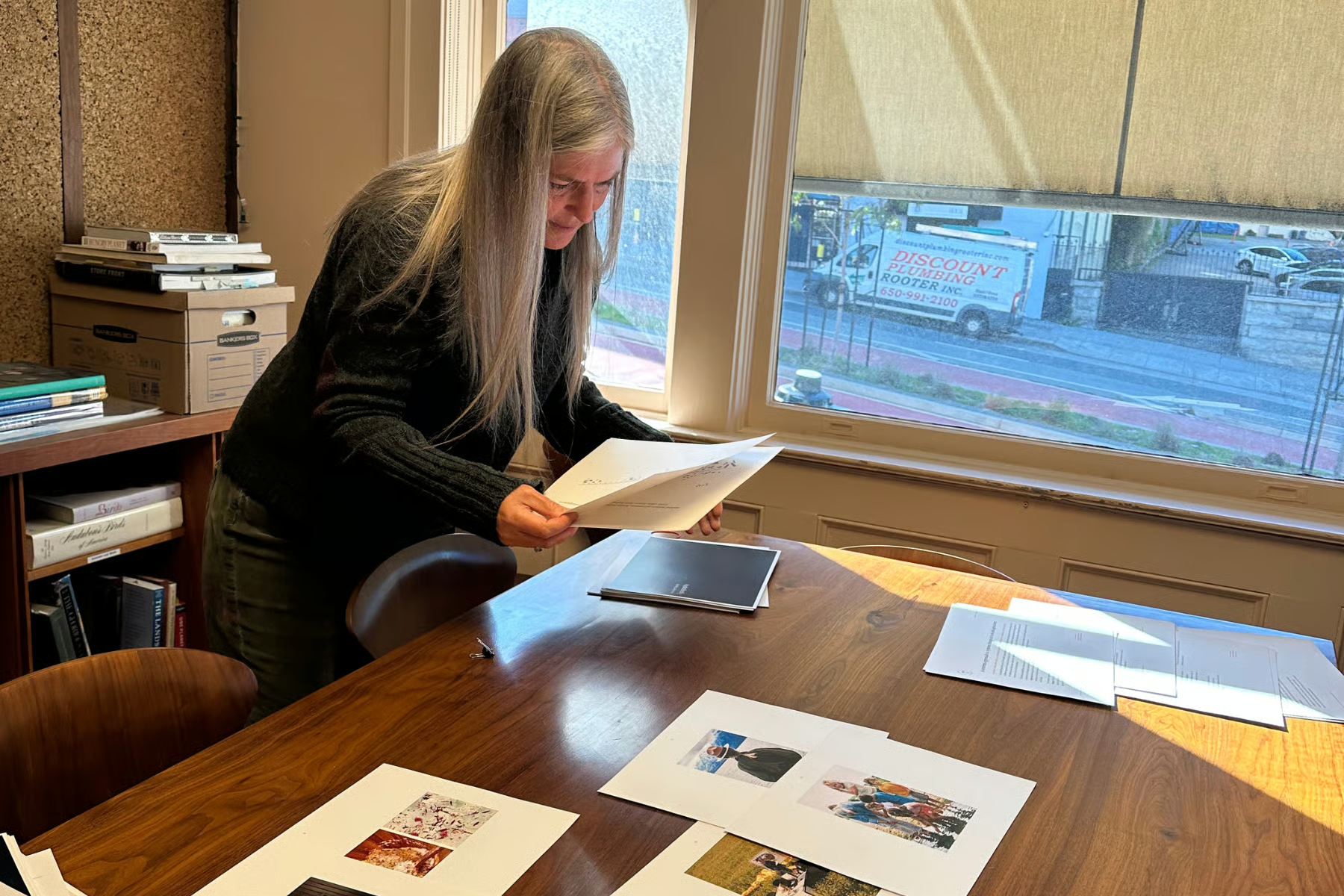
Early on in his 40-year-long career, John Ball realized he needed to get serious about deep observation.
He found himself in rooms, talking to clients about “big things,” and struck by the idea that he was woefully underprepared. “I had no idea how to be in that conversation,” he recounted. “I quickly realized, do I need to read the Wall Street Journal? Do I need to embrace what’s happening in the client’s world a little bit more, and step out of the design bubble?” Filling in the gaps with a deliberate information and experience diet outside the design field helped him become a more effective and empathetic thought partner.
For any intentional practice to take root, it must be repeated — and typically recorded — which takes discipline, patience, and more than a little faith. An observation practice, as varied as its practitioner, builds on what designers understand but can easily forget: the world outside your immediate experience often holds the keys to better work.
But it will only work if it’s intentional.
From John Ball: “As designers, we have many superpowers. Curiosity. A keen eye for the details. Taking in information and organizing it. Always questioning and looking for a better solution. These are the things we can lean into in pursuit of truth, whether for ourselves, our clients, or our society. Unfortunately, not everyone shares that same curiosity.”
Do you want more Design Juice? If so, send me your ideas: who would you like to hear from? What questions would you ask?
Rachel Paese
Deputy Editor
Rachel@designobserver.com
Substack
LinkedIn
P.S. Did someone who loves you send you this newsletter? Welcome! Subscribe here.
This edition of The Observatory was edited by Ellen McGirt.
This is the web version of The Observatory, our weekly dispatch from the editors and contributors at Design Observer. Want it in your inbox? Sign up here. While you’re at it, come say hi on YouTube, Instagram, LinkedIn, or TikTok — and don’t miss the latest gigs on our Job Board.
Join our community on Substack
We’re building a community on Substack, and we hope you join us.
Design Observer has always been free, and The Observatory always will be, but when we asked what you wanted from us, you told us you wanted more than a newsletter: more conversation, more access to the people doing the work, and a reason to show up together. Substack membership is where that happens. It’s also the most direct way to keep independent design journalism going.
Join us for:
- Live, informal conversations with DO editors and the designers we’re talking to
- A live discussion about design and democracy with the team being our audio documentary, Draw the Line around the midterms.
- A live deep dive into radical collaboration with editor-in-chief Ellen McGirt about our signature DO20 list (coming this fall).
- Chats with the editorial team. Full participation in Chat, where the editors are. Can’t make a session live? Send your questions ahead and we’ll ask them for you.
- First access to new benefits, recordings, and events as we roll them out.
We can’t wait to meet you.
Podcasts
Design of Business | Business of Design
DB|BD is back!
This season we are thinking about radical collaboration. For the second year in a row, Design Observer is publishing some exclusive conversations from the Aspen Institute’s Business and Society Summit.
In July, DBBD host Ellen McGirt interviewed eight thoughtful, important, and provocative leaders who are thinking deeply about AI, sustainability, and the role of business in a chaotic world.
Two new episodes are out! Catch AI is the Greatest Civil Rights Issue of Our Time With Chris Hyams and Dean Erika James Says a Prepared Leader is a Disciplined One.

Draw the Line
Episode one of Draw the Line out now.
The Supreme Court case Louisiana v. Callais gutted the Voting Rights Act and rewrote the rules of American democracy. Design Observer’s brand new audio documentary, Draw the Line, is telling the inside story of Louisiana’s fight over power, maps, and who gets left off them.
Every district line is a design decision — and every decision is about who gets power.
Observed
Plot twist: the Plague is back.
There will be some casualties, and that’s okay, OpenAI CEO Sam Altman tells Politico. Bad things may happen with AI in the hands of mere mortals, but that’s a small price to pay.
Can ChatGPT help you prepare for the midterm elections? As busy voters increasingly use LLMs to research their ballots, experts are making their concerned faces. “It might select some things that would reinforce and persuade you even more towards the way that you were leaning already,” says Rafael Batista, a research fellow who studies how AI shapes the way people experience the world. “So you leave more confident, without necessarily learning more about the world.”
Midcentury modern design has gone from cool to cringey, says the WSJ. (Spoiler alert: it’s the millennials’ fault.)
Save the date: Artist Jeff Koons is selling a treasure trove of art from his private collection — from the Dutch Golden Age to Picasso — at Christie’s this November. It is expected to fetch over $100 million. “It is a vision,” Alex Rotter, Christie’s global president, said of the collection. “It’s not pedestrian.” La de da.
Apple has a new chief designer, kinda. New CEO John Ternus is taking a “hands-on” role in design as part of his new remit. All design functions will report into him, in sharp contrast to Tim Cook, who evidently only checked in monthly, according to Bloomberg.
Come to find out, Renoir was kind of an asshole. With a new show, “Renoir and Love,” debuting at the National Gallery in London, art critic Waldemar Januszczak, notes the exhibit is an interesting choice. “It’s brave because Renoir can almost be considered a cancelled artist these days,” he says. “His sexual history causes disquiet. His politics are frowned on. His paintings of women…are habitually accused of misogyny.”
Or maybe Renoir Just Sucks At Painting?
Buildings and construction account for around 37% of global CO₂ emissions and nearly half of material extraction, according to the UN’s 2025-2026 Global Status Report. Ming Chen, an architectural designer at AUX Architecture in Los Angeles, uses research and professional practice to create architectural systems that understand “assembly, reuse, and material afterlives.”
Read more at designobserver.com or in your Substack feed.
YouTube
Hear the voices and see the faces behind the latest and greatest on our site.
Job board
Hiring a designer? Post your role on the Design Observer Job Board to reach a highly engaged audience of designers, creative leaders, and studios across the Design Employment Network.
AVP Brand and Creative Marketing at Providence, Renton, WA.
Social Media Associate at Earthjustice, Washington, DC.
Professor of Product Design (Open Rank) at University of Louisville, Louisville, KY.
End marks
It’s officially spooky season, which means it’s time to revisit Design Observer’s editorial takeover: The Design of Horror | The Horror of Design. Dive into the history of horror imagery in rap music, a conversation with the production designer for Hereditary, or an exploration of the rise of “beauty horror.”
This is the web version of The Observatory, our weekly dispatch from the editors and contributors at Design Observer. Want it in your inbox? Sign up here. While you’re at it, come say hi on YouTube, Instagram, LinkedIn, or TikTok — and don’t miss the latest gigs on our Job Board.
Observed
View all
Observed
Share on Social


By Rachel Paese
 Rachel Paese is Design Observer’s Deputy Editor, and she loves giving curious people access to stories that change the way they see the world. It began with a major in English, and then evolved with a project that sharpened her editorial instincts the old-fashioned way: founding and leading her own multimedia magazine at the University of Kansas. After college, she carried that passion to education, helping students in Spain and Thailand think beyond their culture. Today, she brings that same spirit to Design Observer, working to connect readers with the people and ideas shaping a better future. Connect with her on LinkedIn, and ask her about her quest to sew her own wardrobe.
Related Posts
Draw the Line
Audio
BONUS: Live from Essence Fest – The Work Gets Personal

Draw the Line
Audio
BONUS: Live from Essence Fest – The Accounting

Business
Audio
S13 E8 DB|BD at Aspen: Eric Ries Would Like to Apologize

Business
Audio
S13 E7 DB|BD at Aspen: Proactivity is the Key to Survival With Edelman’s Dave Fleet AI
Subscribe to The Observatory
Related Posts
Draw the Line
Audio
BONUS: Live from Essence Fest – The Work Gets Personal
Draw the Line
Audio
BONUS: Live from Essence Fest – The Accounting
Business
Audio
S13 E8 DB|BD at Aspen: Eric Ries Would Like to Apologize
Business
Audio