


Rachel Paese|Design Juice, Interviews
September 29, 2026
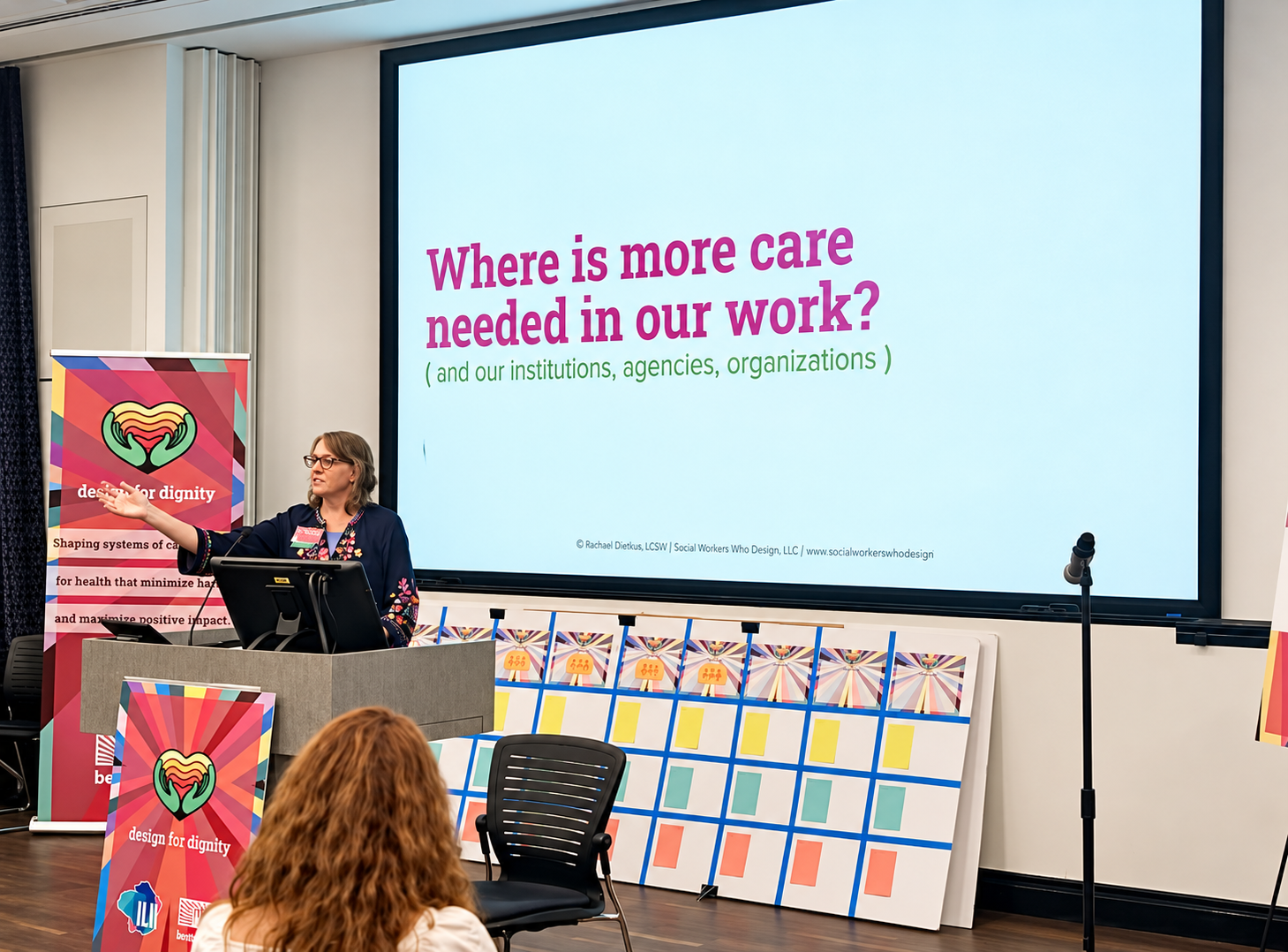
‘What if care were foundational to systems design?’ asks Rachael Dietkus
The founder of Social Workers Who Design asks what it means to care for the public, and argues that care-centered design is what makes systems last
Rachael Dietkus’s long and winding list of professional experiences have led her to a clear path: she knows how we can make the world better.
She began as an art and design student, and then pivoted to social work. She’s also taken on multiple advocacy and human rights positions, including joining an effort to abolish the death penalty in Illinois and serving as an NGO delegate to the United Nations Human Rights Council.
Her professional focus emerged while working at the U.S. Department of Veterans Affairs in 2013. Dietkus describes feeling “struck by lightning,” after experiencing the harm that complex systems often caused. She says she saw what was missing in the design: an intentional focus on care. More on that story below.
Dietkus first began “doubling and tripling down on care,” in her role as the first social worker for the United States Digital Service (USDS) during the Biden administration. While working with design teams within the government, she observed that the word “care” in the trauma-informed care systems assisting vulnerable populations had been misunderstood, often intentionally minimized, and frequently left out. Traumatized veterans are not a typical “human-centered design” scenario, she says. It made her think, “What would it look like if we explicitly started doubling down on care, if we just didn’t leave that word out?”
It’s worth thinking this way in other settings, she says. “We often just say ‘design thinking’ or just ‘design,’ implying or inferring that the human-centeredness is there.” But, she argues, that’s not necessarily the case. “I think any design practitioner could give many examples of when design has not been human-centered, or has been dehumanizing and traumatizing.”
This framework has shaped her entire career and has led her to ask the questions that have become central to her work: “What does it mean to care for the public? What does it mean to have care as critical infrastructure? What if care were foundational?”
Now, in her own practice, Social Workers Who Design, Dietkus helps organizations understand how to build their own systems, big and small, with sustainable care considerations. “At this point I can say that almost everything I’ve done feels relevant and interconnected in some care-forward way,” she says.
Below are stories from Dietkus’s non-linear career, tips for designing for and within big systems, and the crucial first steps to take to build a care-forward design practice.
This interview has been edited and condensed for length and clarity.
What does your work at Social Workers Who Design look like? Do you have an example of a client that, in your view, really approached their work the right way from the beginning?
Historically, all my projects have come through word of mouth through a trusted peer network. The work often involves partnering with an organization or company on a project with an explicit, known sensitive, serious, or traumatic element. An organization’s leader may come to me, knowing that the team is going to be exposed to either traumatic stories through the research, or the topic itself is traumatic, and the team needs help navigating this. Additionally, sometimes the interest in working together comes from knowing that their current practices are causing harm.
One of the best and most honest examples came from Civilla, a Detroit-based civic design studio. One of the leaders reached out and said explicitly: “We have a team that has a significant amount of research to do in a short window of time on a sensitive subject area, and we know the team is going to be exposed to trauma.” I was like, Wow, I can’t believe someone in a position of leadership is acknowledging the reality of what this team was going to be doing and being exposed to.
So we came together and figured out what could be most helpful in this acute situation. Some of it was around how they were going to approach the design, but most of it came down to just supporting the team — giving them space to truly debrief and process what they were being exposed to and how they were being expected to work.
Are there moments in your career where you understood the intersection between social work and design would become important to you?
There have been so many. I think the one that stands out as an earlier moment — really like getting struck by lightning — was probably in 2013 or 2014. I was a social worker working at Veterans Affairs as the Healthcare for Homeless Veterans program coordinator. I was working in the federal government, under the Obama administration, and we as a program were just flooded with money. We had every single resource we could possibly want or need for that program, on the healthcare side.
Under the Obama administration, there was this real commitment to systems redesign. There was a lot of focus on process improvement, the veteran experience,and quality management, and that language started blending with human-centered design, systems thinking, and systems redesign. I just happened to be there while all of that was occurring.
With the Healthcare for Homeless Veterans program, I remember being up in Chicago for a gathering of different regional programs. Someone from a nonprofit talked about human-centered design — about how they had received funding to do human-centered design research — and the way they described their approach to talking with veterans experiencing homelessness and housing insecurity was jarring to me. It wasn’t intentionally disrespectful, but I remember thinking, wait a minute — how are you doing that process with an ethical lens or with responsibility and accountability?
The lack of depth bothered me. I thought, how can people so easily go into a community and essentially extract that knowledge and be unaffected by it? We were out in the community day in and day out, and we had protocols, practice standards, a very specific scope of practice, ethical guidelines, tons of documentation. The expectation of responsibility and care was significantly higher compared to your average human-centered designer at that time.
I was really curious about practice, process, and peer-to-peer accountability — because those things were so core to how I’d been trained as a social worker. I just wondered, what does that look like in design? That initial curiosity, which admittedly probably stemmed from frustration, turned into: how can I be of service? If I’m coming at design from this lens as a social worker, and we’re doing very similar things from very different disciplinary angles, why don’t we learn from one another much more explicitly?
I think about that moment fairly often. I remember my heart starting to race a little, my stomach getting butterflies, because I knew I should probably say something. That was one of those impetus moments.
What happens when we don’t design with care?
I have a very recent example that I can share to answer this. This wasn’t a project I worked on, but a friend and colleague, Martha, who is part of the VA’s digital services team, sent me something recently. She said, “We give immediate notifications and emails, but they are so triggering to veterans. I’m not sure how to design a trauma-informed text.” And she sent me a link to something on Reddit. Somebody in the VA claim subreddit said “the scariest notification ever,” and they included a screenshot of a text from the VA that reads: “VA Benefits Update: Your VA benefit decision letter is available. Tap to view.” And then a series of people’s comments: Oh my God, I get so panicked. It makes me so nervous. I feel sick when I get a text from the VA.
So Martha and I were exchanging messages back and forth, and I said, here’s my take: it comes down to acknowledging that any kind of communication from the VA is going to be emotional. So one way to think about this is for the content to somehow acknowledge that the notification is not just an update or information, but that it’s going to be a highly charged emotional encounter. Anytime you get a communication or alert from a system you depend on for care, it’s going to be emotional — whether we want to say it is or not, whether our intentions are pure. So I said to Martha, instead of “your VA benefit decision letter is available, tap to view,” why not say something more along the lines of: We have an update about your VA benefits. When you’re ready, you can review your decision letter in the app. If you have any questions after reading it, we’re here to help. I was just riffing with her on language that could acknowledge, reassure, and create that moment of ease.
In design, we often talk about ambiguity as a good thing — we encourage people to be comfortable with it. But when you are dependent on a system for a service, ambiguity is a horrible thing. When has ambiguity ever been reassuring when you’re dependent on a system to deliver something? That’s where the tension of how we’ve been trained in design really needs to be questioned and reoriented.
You worked in government again under the Biden administration when you worked as the first social worker-designer at United States Digital Service (USDS). Do you have an example of a moment when someone’s understanding shifted based on your consultation?
Most people at USDS came in with serious expertise in their own field, but when you add misunderstandings around harm and trauma, people wanted to make sure they weren’t overstepping or misstepping. There were quite a few teams and individual technologists whose own life experience and professional background had not exposed them to the high volume of poverty, racism, and harm that exists in all of these government structures and systems. I witnessed quite a few people struggling with what they were seeing. It’s like — well, welcome. This is the United States.
A specific project that comes to mind was one related to one of the many claims processes for veterans applying for a claim or a benefit: the PTSD-MST (Post-Traumatic Stress Disorder – Military Sexual Trauma) claims process, also known as VA Form 21-0781. In the VA system, it’s a combined claim, and often if you experienced MST, you have PTSD as well. That process was cumbersome and retraumatizing; having to retell the same story over and over again felt unconscionable, but that was the process for many years.
This team put so much care and intention into doing the best possible thing at every step. When we started mapping out the entire system and structure — where we could integrate moments of ease or reassurance into the digital experience — I noticed a collection of things that felt small to me but were big to the team, because I don’t think they’d had someone explain them so clearly.
One example: if we’re asking a veteran to explain their story and we tell them, “you can say as much or as little as you want” — what I’d want to know is, if I overshare my deep personal story, is that going to make my claim stronger? If I share less, will that make it weaker? So there was some language being suggested around things like small hover buttons: “there’s no need to describe your experience in extreme detail.” We were reimagining what some of those moments of ease and reassurance might look like.
I also encouraged the team to be prepared for last-minute cancellations. We can have the best possible plan, the most carefully scripted interview plan, the most thoughtful communication leading up to it, and a veteran can still say, at the very last minute, “Nope, I don’t want to talk with anyone right now.” How you might feel at 8 a.m. might be different from how you feel at 11 a.m. or 2 p.m. — just think about your own emotional shifts in any given day.
Because we walked through those possibilities together, the team wasn’t caught off guard, and we built those considerations into our practices, processes, and timeline.
What advice do you have for designers who are working in systems and care about designing intentionally and thoughtfully?
One thing that’s been helpful for me and in the ways I work with teams, organizations, and individual practitioners is understanding your scope of practice. Scope of practice is a method that comes from regulated helping professions, including medicine, nursing, social work, and psychology. It comes down to clearly understanding where your work begins and where it ends. For me, this work can be very blurry, especially for design practitioners, so if you can, try to practice with caring discernment. Where are you equipped to do things, and where are you not? Where does your ethical line actually stand when it comes to working in some of these different systems and structures?
And you don’t necessarily have to be working in a government context to need an ethical compass for the work. We are seeing a growing need, especially in corporate tech and for-profit technology and design.
I think there’s so much emphasis — especially if you’re early career or a leader in design — on the portfolio, on the arc of your design practice, on how you can explicitly talk about the work you’ve done. But I would say just as equally important, if not more so: what is your care practice, and can you articulate that? How do you support people?
For someone who’s never had a care practice at work, how would you advise them to start?
I think one of the best places to start is to keep a log, diary, or journal of where you’re either witnessing or directly experiencing moments of care. They don’t have to be grand gestures. Even if it’s something as simple as someone genuinely responding when you need to reschedule — “absolutely, don’t worry about it, I got you” — those quick moments of exchange, if they’re coming from someone who genuinely has your back and isn’t going to hold something against you, are the work moments of care that accumulate. But really paying attention to when and where they’re happening, in all parts of your life, matters. Once you start noticing them, it’s hard not to see where the larger signals of care are occurring.
Observed
View all
Observed
Share on Social


By Rachel Paese
 Rachel Paese is Design Observer’s Deputy Editor, and she loves giving curious people access to stories that change the way they see the world. It began with a major in English, and then evolved with a project that sharpened her editorial instincts the old-fashioned way: founding and leading her own multimedia magazine at the University of Kansas. After college, she carried that passion to education, helping students in Spain and Thailand think beyond their culture. Today, she brings that same spirit to Design Observer, working to connect readers with the people and ideas shaping a better future. Connect with her on LinkedIn, and ask her about her quest to sew her own wardrobe.
Related Posts
Arts + Culture
Alexis Haut|Interviews
The Kardashians will make you cringe, but first they’ll sell you shapewear
Design Juice
Rachel Paese|Design Juice
Sara Soskolne is a typeface designer who thinks of herself as a craftsperson
Design Juice
Rachel Paese|Design Juice
Ira Blossom created a games-only, print-only newspaper — and it’s sold at a newsstand in New York City
Design Juice
Rachel Paese|Design Juice
Katie Conry on building public programming for San Francisco’s most historically rich — and most misunderstood — communities
Subscribe to The Observatory
Related Posts
Arts + Culture
Alexis Haut|Interviews
The Kardashians will make you cringe, but first they’ll sell you shapewear
Design Juice
Rachel Paese|Design Juice
Sara Soskolne is a typeface designer who thinks of herself as a craftsperson
Design Juice
Rachel Paese|Design Juice
Ira Blossom created a games-only, print-only newspaper — and it’s sold at a newsstand in New York City
Design Juice
Rachel Paese|Design Juice