


September 23, 2026
The Kardashians will make you cringe, but first they’ll sell you shapewear
Writer and media theorist MJ Corey, aka Kardashian Kolloquium, on making a career out of taking the Kardashian’s influence seriously
The Kardashians are some of the most influential designers of the 21st century.
Re-read that sentence. How does it make you feel? Did you crinkle your brow in confusion? Did you bristle in disgust? Did you shiver in fear?
It’s a provocative, controversial statement about a provocative, controversial family. Any reaction would be appropriate.
Some clarification: The word “designer” here is not referring to Kim’s shapewear brand Skims or Khloe’s Good American denim brand. It is in reference to the Kardashian’s lasting ability to design their inescapable influence on American life.
Over the past 20 years, the matriarchal clan, led by “mom-ager” Kris Jenner, has built an empire beyond their touchstone reality series Keeping Up With the Kardashians into a business portfolio of billion-dollar apparel and beauty companies — changing the way an increasingly online public dresses, speaks, and thinks.
Kim, Kylie, Kourtney, Khloe, Kendall. They know what you want to buy. And more importantly, they know what will piss you off.
To hear writer, psychotherapist, and media theorist MJ Corey tell it, the Kardashians know exactly what they’re doing: “The Kardashians understand that their role is to dispense images and stories for us to think about and distribute reactions to.”
And Corey has designed a career around taking their influence seriously.
Posting on Instagram as Kardashian Kolloquium since 2018, Corey analyzes the Kardashians’ many public moves through the lens of postmodern media theorists and philosophers like Jean Baudrillard and Michael Foucault. Corey has since expanded to posting on TikTok, Substack, and YouTube, as well as writing long-form essays about the Kardashians for publications like The New Yorker.
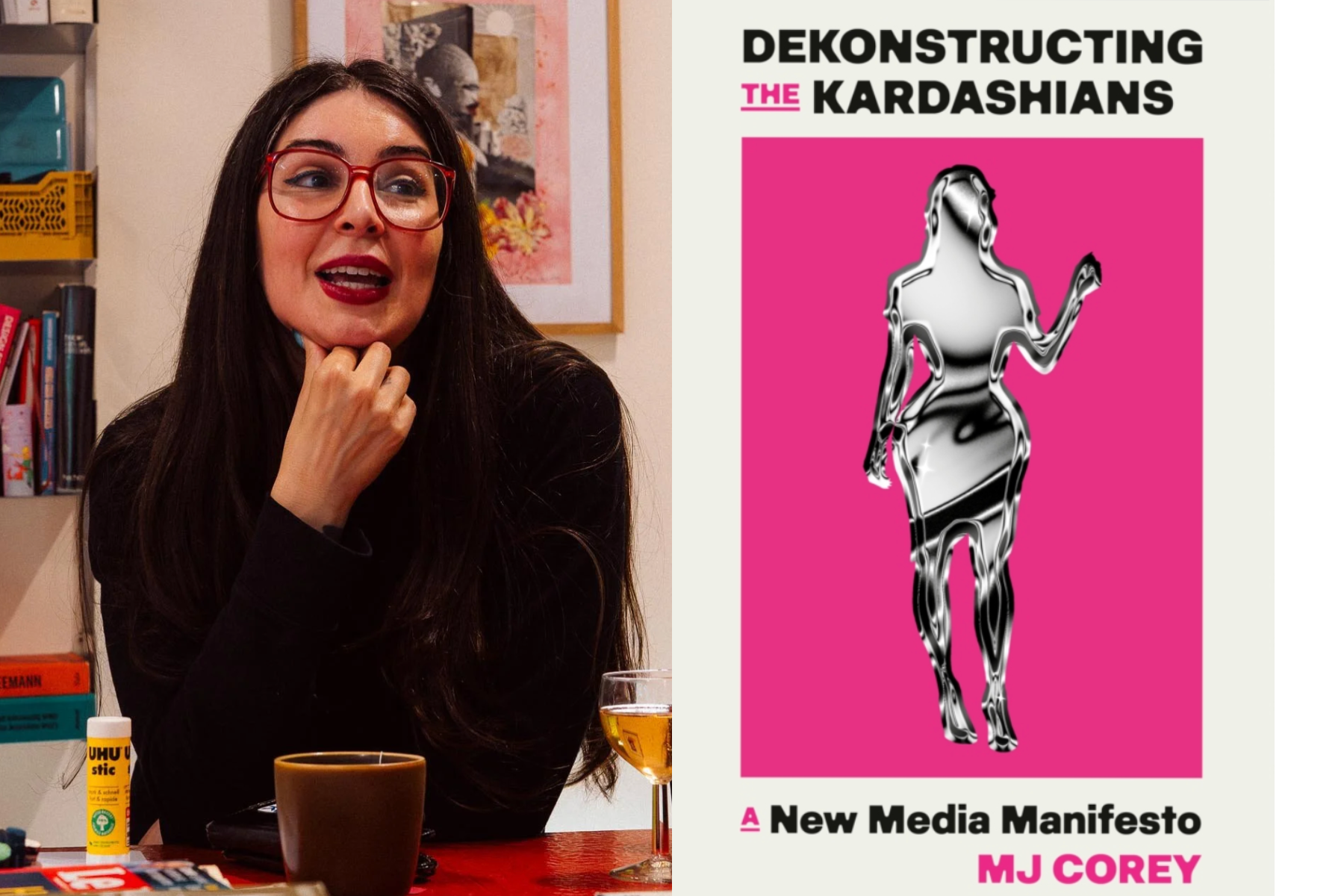
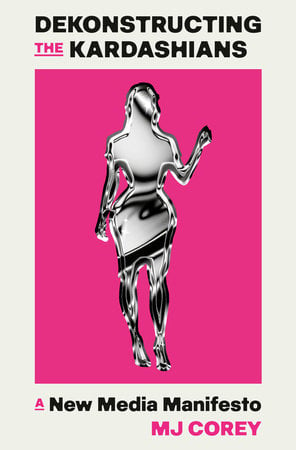
This year, Corey expanded her analysis into a book. Published in May, Dekonstructing the Kardashians, is a self-described “New Media Manifesto.” The connections Corey weaves between history, theory, and analysis are both revelatory and dense. It’s the type of book you read with a pen in hand.
For Corey, debating the virtue or value of the Kardashian’s influence isn’t the point. In both her writing and her online content, she analyzes the family with a distant, clinical lens informed by her career as a psychotherapist (MJ Corey is a pen name she goes by in her writing and online persona). “What I hope a close reading of my book will allow a reader to be skeptical about what the media does to us and develop a consciousness beyond it,” she says.
She also doesn’t buy products from Kardashian brands and refuses to take a moral stance on the family’s actions, much to some followers’ chagrin.
And boy, is there chagrin.
Building a public presence around analyzing the Kardashians isn’t necessarily a peaceful existence. And it’s one that Corey has ambivalent feelings about, especially as the years wear on and her content becomes more popular. She’s been both accused of being a Kardashian psyop and been spied on by actual Kardashian psyops.
Corey sat down with Design Observer’s Alexis Haut in between book tours to talk about it.
She reflects on why the Kardashian’s cultural value lies in their ability to make you mad. She also explains why Kylie Jenner’s Meta Glasses campaign made her break her own social media rule, how the family has acknowledged (and impeded) her work, and why she hopes she’s not stuck in the Kardashian bag forever.
This interview has been edited and condensed for length and clarity.
Turning media theory memes into a manifesto
Alexis Haut: How has your exploration of the Kardashians evolved since you started?
MJ Corey: I started the Kardashian Kolloqium project on Instagram really as a creative outlet while I was shifting my focus to therapy and counseling after my MFA. So I didn’t go into making the project with the plans of scaling it into the writing career that I’d always wanted to build, I just was really genuinely struck by the hyper-reality of Keeping Up With the Kardashians and very inspired by the media theory that I was reading to better understand the show. And I wanted a place to put that.
Initially the trend in 2017-2018 when I jumped on and started making the content to document my self-study, the popular meme format was taking a screenshot from a reality show and then transposing a fake subtitle of a quote from a philosopher or a theorist. And it was saying, Wink, we’re all intellectuals here. This is funny because it’s highbrow and lowbrow. But over time, I was starting to realize my audience was not just wanting an in-group signal about their knowledge of these philosophers. People were curious to understand these ideas better, especially because French and postmodern theory is famously Ivory Tower. So then I realized that there was an opportunity and a mission to make the theory more accessible.
AH: When did you realize that this work could be a book?
MJC: Even though I really critique TikTok and its algorithm, I still have to say that when I got on TikTok in 2020, that’s when my work really blew up. That really scary, dystopian, intrusive, customized algorithm was helping me directly reach people who would be interested in my work. So my audience doubled on Meta because of going so viral on TikTok.
There was a growing demand for culture takes, and I had amassed so much research over the course of the project because I genuinely found this feedback loop of learning about postmodern theory and media theory, applying it to what I was seeing in the Kardashian project and sharing it with the audiences. It was clear that there was a book in it.
And so a friend actually called me and said, “I think this is a book.” It was helpful to hear someone else say it.
AH: And how did you even decide what to include in the book in terms of theories and content? I know there was a lot you obviously had to leave out.
MJC: I always knew that I wanted it to be a kind of tidal wave that readers could surf — of theory, Kardashian lore, history. I wanted it to be a book that suits this internet age, even as it critiques it. I wanted it to be readable to people because I have such a wide audience. I have a lot of people who work in the media who follow me. I have a lot of pop culture fans and fashion and beauty fans that follow. I have some academics. So, I wanted to write something that could average these different readers and also just capture what I really feel strongly is true about the Kardashians and their relevance for posterity.
When the time came to actually write the book, I was like, Wait, how do I actually do that? I came across this encyclopedia of American icons. And it’s a three-edition encyclopedia, and it lists all the people, places, and things that its editors felt define American culture and are American icons, ranging from Marilyn Monroe to Mickey Mouse to Mount Rushmore. And I was like, Wait a minute, that’s my real point: Kim is a postmodern icon that reflects this moment. She’s made herself an amalgamation of people, places, and things.
I realized the book had to be two parts. Part one is the pantheon of figures that are able to represent the history of American media, starting with the old Hollywood system to the tabloid era that the Kardashians arrived in. And then part two is a chronological history of the family that goes faster and faster because suddenly we’re in this cascade of images and stories that the Kardashians were able to kind of perpetuate with new mediums.
The structure of my book has proven to be divisive for sure. And I knew the book would be divisive because the Kardashians are divisive.
“A horseshoe of feeling hazed”
AH: In part two of the book, you bring in your personal experience of being a content creator. What pushback do you get from people online? Does it differ by platform?
MJC: I had a real learning curve, and it felt important to integrate in the book. Part two is about how media is getting closer to us. So I personalized the narrative to speak to the media moment that was happening around the 2020s.
It blew me away when I got on TikTok. I would get hecklers on Instagram when I was making my memes, but there is a lot more emotion and mob mentality on TikTok. The videos might come to someone’s algorithm who’s looking at pop culture videos, but it might be a startle to see someone intellectualizing the Kardashians. This can be a really invasive, almost sometimes scary experience. It did intimidate me a little bit.
But it’s so interesting because the same distress or pushback I would have on TikTok would be what I also was getting from more elitist groups in the media scene in New York for applying academic theory to the Kardashians. And so there was a period with both sides of this, what I guess we’ll call a horseshoe of feeling hazed in the New York media and then also getting hate on social media.
AH: It’s so ironic because the social media “hate” part of the horseshoe proves to the other side of the horseshoe why you’re doing this in the first place.
MJC: For sure. It proves the point. It proves itself again and again. I did a KCRW interview with Sam Sanders in May, and people freaked out. Now I’m Kardashified enough from these years of studying their strategies that I knew it was ultimately good for the book. But people were so mad. And these are public radio listeners who we can assume are concerned about anti-intellectualism. And yet they’re in the comments saying kind of gross sexual things about Kim Kardashian, and some are absolutely defying any potential intellectual curiosity about the value of the subject. It was actually the most emotional comment section I had seen in a long time, along with those in the New York Times review of my book.
At this point it doesn’t hurt me because — exactly to your point, it validates the timeliness of my work. And yet I do think there’s a very broad, generalized culture shift slightly on the Kardashians because they’ve become normalized, and Kim has kind of proven her point that she can scale this high. People are mad that they have to just live with that. I always saw this coming. They’re not central to culture anymore because they’ve become so embedded, and I think that allows for a variance in how people relate to their content now. And at the same time, my book coming out really did show me like, people can still get really pissed.
AH: How do you respond when people get pissed? What does that feel like for you?
MJC: I think that the fact that I’m a psychotherapist really does also serve my perspective and it explains my refusal to engage too personally or emotionally in this stuff, because you can’t do that to your patients. People are not gonna get the spectacle of reactivity from me online. I’m delivering Kardashian news, which is the spectacle.
There is one thing that still shocks me. I was surprised, during the rollout of my book, how much interest there was in things my looks, my face, my relationship to beauty I got questions where people thought they were being slick and it was obvious that they were trying to nudge me towards sharing things about my personal views of beauty and the stuff that the Kardashians have done that have been formative to our world.
And I still am figuring out exactly how to address that because I’m not a wannabe influencer. I’m exactly what I’m saying I wanted to be, which is a writer. I’m not trying to commodify my personal life. I’m not selling beauty. I’m not even monetizing my videos. So the personal questions I have to figure out how to negotiate because I keep crowing that I want to be taken seriously as a writer. And some of that involves also being willing to shape a persona, that’s part of the job too.
The Kardashian “Meta Glasses” era and MJ’s desire to transcend
AH: There’s a lot of conversation in the ether about whether or not the Kardashians are still relevant. Are they still relevant? Does their relevancy even matter at this point?
MJC: I think we have to be really careful about feeling like we’ve defeated them because they’re not so central to culture. Because that’s not true. They’re no longer so visible because algorithms have changed and our relationship to media has become more fractured, just in time for them to become so embedded we’re not noticing them anymore. They’re part of the essence of American culture. I’m just never going to concede that they’re over.
The Kardashians now understand that their role is to dispense images and stories for us to think about and distribute reactions to. I think they’re quite comfortable continuing to do their method of throwing spaghetti at the wall and seeing what sticks. And what will work now is not so much like a break-the-Internet moment, it’s like a really good viral week on X. Like what we just saw with Kim’s energy drink that includes a surprising cameo of Gloria Allred — well, not surprising for me. It’s a new product that distills her, by this point, really well understood repetitive brand messaging. It might have the visibility required to make a stamp in our consciousness for a week for as long as we can sustain attention. Same with Kylie and the Meta Glasses. I actually think that’s a really big deal.
AH: Let’s talk Meta Glasses. As you wrote about in your book, it’s the acceleration of media from a big movie screen to a handheld phone to a camera we wear on our face. In a recent Instagram post, you said you were “sickened” by Kylie’s Meta Glasses campaign.
MJC: Look, I split my book into eras and left my book off on the family’s “Donda”era [spanning from 2020 to 2024]. If this book had been finished in 2026, there would be an additional Meta Glasses chapter, and it would have ended on an even more dystopian note.
I broke my own social media rule, my own ethic around the non-moralizing approach with the glasses.There’s a lot of self-evident moral issues in what the Kardashians do. I really strongly feel as a writer it’s been enough for me to put the information out there and then apply the theory and let people use their own critical thinking to work out where they want to land on the moral quandaries the family presents. So, normally, I just don’t like to weigh in, and it’s been better for my thesis not to. But with the Glasses, maybe I was feeling a little emotional.
The fact that they are easily concealed and that they’re going to weaken our will even more against the role of cameras and surveillance in our lives bums me out in a major way.
It’s not a surprise the Kardashians have aligned with it, because it also proves my thesis that they’re still very relevant. But because the one thing I also said in my book or I found in my book, like they will start conversations around morality that had been overdue — that is their cultural value. Surveillant culture was always going in the direction of the Meta glasses. And it was kind of not working until Kardashian picked up the glasses and collaborated, and now we’re finally having a conversation around surveillance. So I don’t know. We’ll see where it goes.
AH: In June, you posted that a representative from the Kardashian camp had reached out to you about promoting the Meta glasses, even though you have never promoted a Kardashian affiliated product before. How did you respond to that reach out? And is this the first time that they have acknowledged you?
MJC: Years ago, I made some kind of prediction on Instagram about the potential for Skims to start collaborating with high-end designers. A Skims representative asked me to take a video down, and I did. I was too small then, so I didn’t want to get into a thing with them. I think it was the right move strategically because there were some ladies that tried to do something similar to my concept, but an academic take on Oprah, and [Oprah] crushed it immediately. The Kardashians have opted not to do that to me. They could have and they didn’t.
The Kardashians have watched my stories. And so I was curious what would happen when my book came out. What seems to be happening is that they are going to be releasing an authorized biography, intellectualizing their own lives in the fall. You know, I’ll put it this way: I want to be careful, but I’ve taken note and documented the great number of influential people in their camp who have been keeping up with my work for many years. I’m, at this moment, feeling in a weird place about it.
But then to be contacted by some like a PR person trying to tease me into talking about this potential technology of the Meta Glasses that I would obviously not be for. And the fact that they thought they could get me there to do so for free after a book like the kind of book I’ve just written, it’s a little absurd. So I decided to just share that with the audience and those videos aren’t even doing that well. Not a lot of people are aware of the jump that I took.
AH: I’m surprised to hear that because I feel like people would like that sort of gossip.
MJC: No, I know. Like I never share things about myself and I’m sharing a little tea here. It’s really good tea. One other little thing beyond the people in restaurants and the family watching my stories, I was planning my book party in New York and initially I was hoping to do it at Madame Tussauds. I couldn’t afford Madame Tussauds, so they invited me to go to Planet Hollywood and we can roll over the Kardashian wax figures over there for no cost except for the cost of transport and insurance. But then they had to check with management. And then what do you know? it comes back to me that suddenly the figures are going to cost $150,000 each to use. So we can fill in the blanks there.
AH: My last question for you is about your future as a writer and creator. Is the Kardashian bag your bag forever? Are you getting Kardashianed out?
MJC: It’s hard because when I try to transcend, I don’t really get the space to. When I pitch outlets with other ideas, those pitches aren’t accepted. I pitched a major outlet that I’ve worked with before with an idea around the influence that venture capitalists might be having on taste networks. I’m really inspired by what I uncovered that Skims is funded by Thrive, and Thrive also funds A24. The publication rejected my pitch and it appears they gave it to a staff writer who published it.
I don’t actually enjoy pop culture. I really don’t even like the Kardashians, but I think there’s so much value to looking at what they’re doing. It’s my work. When I tune into their content, I have to put that hat on.
And so I would love to transcend, but we’ll see what opportunities come up. I would love the chance to explore.
AH: Yeah, and I hope you can too.
Observed
View all
Observed
Share on Social


By Alexis Haut
 Alexis Haut is an audio producer, writer and educator based in Brooklyn. She spent seven years teaching, leading teachers and coaching basketball in middle schools in Brooklyn and Newark before independently producing her first podcast series in 2018. Her audio work includes the 2019 B Free Award Winning podcast Appropriate: Stories from the Grey Area of Consuming Culture, Ball is Business an iHeartRadio Next Great Podcast finalist investigating the long con of high school basketball recruitment, the Signal Award Winning podcast Where’s My Village? about America’s broken childcare system, and Design Observer’s DB|BD. She is a Master’s Candidate in Film and Media Cultures at the CUNY Graduate Center. You can find links to all her work at www.hauttakes.com.
Related Posts
Design Juice
Rachel Paese|Design Juice
‘What if care were foundational to systems design?’ asks Rachael Dietkus
Design Juice
Rachel Paese|Design Juice
Sara Soskolne is a typeface designer who thinks of herself as a craftsperson

Design Juice
Rachel Paese|Design Juice
Ira Blossom created a games-only, print-only newspaper — and it’s sold at a newsstand in New York City

Design Juice
Rachel Paese|Design Juice
Katie Conry on building public programming for San Francisco’s most historically rich — and most misunderstood — communities
Subscribe to The Observatory
Related Posts
Design Juice
Rachel Paese|Design Juice
‘What if care were foundational to systems design?’ asks Rachael Dietkus
Design Juice
Rachel Paese|Design Juice
Sara Soskolne is a typeface designer who thinks of herself as a craftsperson
Design Juice
Rachel Paese|Design Juice
Ira Blossom created a games-only, print-only newspaper — and it’s sold at a newsstand in New York City
Design Juice
Rachel Paese|Design Juice